This 10-year-old electric boiler at a Florida dry-cleaning facility looked more like a case study for neglected maintenance instead of a regulated pressure vessel.
The condition of the unit raised an important question: How could a boiler subject to statutory inspections deteriorate so badly? The answer revealed several misconceptions about electric boilers, internal inspections, and maintenance practices that continue to challenge inspectors today.
This article explores some misconceptions and explains why setting expectations early – and enforcing them consistently – is critical to protecting both public safety and equipment.
Most boiler statutes require two statutory inspections to be conducted by inspectors holding a certificate of competency. For example, Florida Statute 554, “The Boiler Safety Act,” requires external and internal inspections on both high and low pressure boilers.
F.S. 554.108 Inspections
INSPECTIONS REQUIRED
(3) The construction, installation, and condition of each boiler used in a public assembly location shall be inspected as follows:
(a) Power boilers and high pressure, high temperature water boilers shall receive a certificate inspection annually. Such inspection shall include, but not be limited to, an external inspection while the boiler is under pressure and an internal inspection if the construction of the boiler so permits.
(b) Low pressure steam or vapor heating boilers shall receive a certificate inspection biennially. Such inspection shall include, but not be limited to, an internal inspection if the construction of the boiler so permits.
(c) Hot water heating boilers and hot water supply boilers shall receive a certificate inspection biennially. Such boilers shall receive an internal inspection every 4 years if the construction of the boiler so permits.
A frequently cited cause of boiler failures is attributed to lowwater conditions. While this is believed to be true, there is another significant loss contributor often attributed to low water conditions but is, in fact, unrelated.
Earlier in my career, I was a Field Services Supervisor for a large boiler insurance company in New York City. When I took the role, I reviewed boiler loss data, which included “root causes” assigned by the loss consultant or claims staff at the time of claim submission. For boiler incidents, a frequently cited root cause was the low-water cutoff not working. As a boiler inspector working in New York City for the previous 10 years, I intuitively knew this wasn’t quite right. The occasional need for a coat hanger to help free a muddy float-type low water cutoff indicated something different. The subsequent deluge of mud and black water, which, as an added bonus, destroyed my khaki pants when the offending obstruction was removed, told me different.
The mud, sediment, and scale that accumulate in boilers are insidious and preventable. These deposits accumulate in mud legs and at the bottoms of boilers, displacing boiler water and reducing its capacity.
These deposits accumulate:
- In connections and control piping, inhibiting their proper operation.
- In float chambers of low water cutoffs that prevent or retard the movement of the float and contribute to low water events.
- On heat transfer surfaces, including electrical elements, significantly decreasing the boilers’ steaming and heating capacity.
These deposits accumulate due to system leaks, including gasketed connections, poor chemical treatment, and lack of regular internal cleaning. Leaks at gasketed connections corrode boiler plate and make the removal of handholes or electrical elements problematic. Gaskets must be replaced regularly and should not be reused.
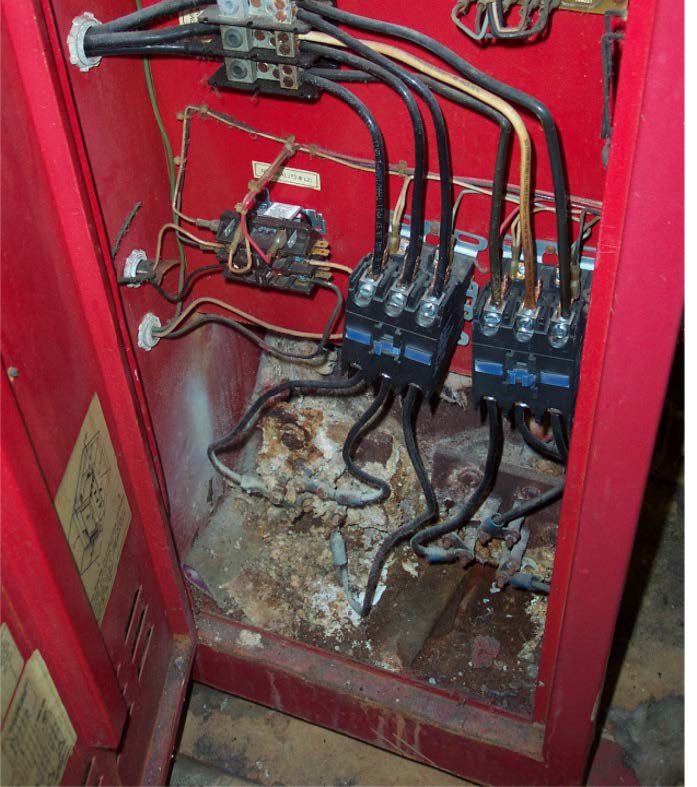
This 10-year-old electric boiler revealed
extensive corrosion and deterioration
caused by years of neglected maintenance,
underscoring the importance of routine
internal inspections and timely corrective
action.
These deposits can be easily removed when found early through scheduled internal inspections, cleanings, and adjusting boiler water treatment. The need for and the simple effectiveness of internal inspections is so great that it is usually found in statutes, rather than rules and regulations. These inspection activities are not only required but also help the boiler owner maintain boiler capacity, efficiency, and good working order of boiler controls.
Fast forward to 2010, when I had been Florida’s chief boiler inspector for almost two years. Inspection requests from a vacant territory in southern Florida brought me eight or so hours from the office in Tallahassee. Working from an overdue list between scheduled appointments, I visited a dry cleaner that had an electric boiler. (See photos)
I saw a half dozen violations before I was within six feet of the boiler. To put it mildly, I was stunned. The boiler was only 10 years old. How can any regulated boiler be operating on the “run-to-failure” maintenance program?
Returning to Tallahassee, I realized fundamental changes were needed in what we did and how we did them. So, let’s review some of the then-current practices and perceptions that contributed to this situation.
1. The perception is that electric boilers do not require internal inspection.
A few inservice inspectors and supervisors believe that the electric boiler, like the one pictured, without handholes, falls under “Internal inspection if the construction so permits” criteria.
 Figure 1
False. Handholes and manways are not the only methods manufacturers have to provide the required internal access for inspection in the ASME construction code. The absence of handholes or a manway is therefore not the litmus test for whether internal inspection access exists.
2. Removing the element is too extreme.
False. ASME issued the following interpretation back in 1977:
Interpretation Number: I-77-31 (in part)
Reference: Section I; Part PEB, Small Electric Boilers
Date Issued: 09/26/1977
Question (5): May openings in the end plate used to attach the electric resistance heater elements be used for the inspection openings (1/2 in. NPT openings in two places) as required by PEB-101?
Reply (5): For small diameter boilers, the intent of PEB-101 will be met using openings as stated in the question.
In Figure 1, this manufacturer chose to use the electrical element connections as the inspection openings, as allowed and described on the ASME data report. The data report’s section 10 specifically uses the two 3-inch element openings as a substitute for installing handholes as permitted by the interpretation.
3. Reporting of electric non-certificate boiler inspections is not required.
Florida statutes did not, at the time of this inspection, require the filing of a non-certificate but statutorily required inspection reports, but they did require both inspections be performed for these boilers.
The language at the time stated:
2016 F.S, 554-108 (4) in part, deputy inspectors and special inspectors shall file a written report on each certificate inspection with the chief inspector within 15 days following such inspection. The filing of reports of inspections other than certificate inspections are not required unless such inspections disclose that a boiler is in an unsafe condition.
This meant that, as chief, I had to trust that the inspectors were performing both inspections when they submitted the certificate inspection report which could be performed using either the internal or external statutory inspection.
The statutory language was modified to close this loophole in 2017 (and still exists), requiring the submittal of inspection reports of all statutorily required inspections:
2017F.S, 554.108 (4) in part states: A certificate inspection report must list all violations of the State Boiler Code and any conditions that may adversely affect the operation of the boiler. The filing of reports of inspections, other than statutorily required inspections, is not required unless such inspections disclose that a boiler is in an unsafe condition or unless the boiler has failed and requires major repair or replacement.
4. If the jurisdiction wanted it done, they would say something.
False. If the jurisdiction didn’t want these inspections done, they would adjust the statutory requirements. This is a case of missing a few inspections when new boilers are pristine, and skipping the inspection then becomes the norm rather than the exception.
5. Chiefs who encourage or require the internals of electric boilers are oblivious to current realities.
The chiefs who require these inspections are probably very familiar with the construction code requirements and interpretations. And if you are still not convinced, have you looked at the pictures?
6. Electric boilers do not have to be inspected in Florida at all.
False. Electric boilers are included in Florida’s definition of a boiler.
F.S. 554.1021 Definitions (3) “Boiler” means a closed vessel in which water or other liquid is heated, steam or vapor is generated, steam is superheated, or any combination of these functions is accomplished, under pressure or vacuum, for use external to itself, by the direct application of energy from the combustion of fuels or from electricity or solar energy.
A key to avoiding issues is to start when the boiler is installed. Expectations with the boiler owner and maintenance staff should be set during the first inspection. A description of the cadence of internal and external inspections, regular maintenance in accordance with the manufacturer’s owner and operation manual, and the importance of effective chemical treatment of the boiler water should be emphasized, beginning with the first inspection.
Ensuring the owner and operation manual is in the hands of the owner or user, which provides details on the frequency of internal cleaning and inspections. Statutorily required internal inspections should be scheduled to coincide with prescribed maintenance, which minimizes costs and downtime. The need to have spare gaskets on site and to address leaks as soon as they are found should be discussed.
High pressure boilers usually have inspections due every six months. Schedule the next inspection before you leave the current one. If the maintenance described in the accompanying breakout box had been performed, the owner would not need to buy a replacement boiler.
Before your next inspection, review the statutes, rules, and inspection procedures that apply to electric boilers in your jurisdiction. During routine inspections, confirm that internal inspections are being performed as required and that boiler owners, management, and users understand their maintenance responsibilities. During the first inspections, communicate good maintenance practices and educate owners on the requirements. The lessons from this Florida boiler are not limited to one jurisdiction. The real question is whether a similar boiler exists under your purview today, and if so, what steps you’ll take to educate stakeholders and avoid more severe consequences.
MAINTENANCE SCHEDULES
Inspectors should encourage owners to coordinate required internal inspections with scheduled maintenance activities. Typical maintenance recommendations for electric boilers include the following quarterly and annual tasks, which help identify scale, sediment, and control issues before they become significant problems.
Quarterly
- Every four months, the boiler float control must be checked to ensure proper operation.
- The lower equalization column should be visually and manually inspected to confirm it is clean and unobstructed.
- If scale or mineral deposits are present, the float control must be disassembled and thoroughly cleaned.
- At least one lower heating element should be removed for inspection.
- If any scale or mineral buildup is detected, all heating elements should be removed, cleaned, and reinstalled using new element gaskets.
- The operating and high-limit pressure controls should be tested for proper function.
- If necessary, remove and clean the pressure controls.
- Water feed supply check valves should be inspected and replaced if needed.
- If the boiler is equipped with an electronic auxiliary low water cutout, the probe must be removed every four months, inspected for deposits, cleaned, and reinstalled.
Annual
- Inspect the bottom of the boiler for scale and lime buildup by removing a heating element.
- Clean or replace components as necessary. This procedure must only be performed when the boiler is cool and vented to the atmosphere.
- Verify proper operation of the low water relay by observing that it shuts off the contactor when the water level drops.
- Check for loose terminals and wiring connections.
- Remove, inspect, and clean the water electrode probe.
- Inspect the boiler shell for mineral buildup and clean if required.
- Examine the heating elements for leaks and check flange bolts and nuts for tightness.
- Confirm that the heating elements have the correct amp rating.
- Ensure the boiler receives an annual inspection by a qualified ASME boiler inspector.
- Refer to the Handhole Gasket Installation section for proper gasket installation procedures.
- Periodically verify that the temperature/pressure gage is compatible with the operating aquastat or controller.