
Upon the arrival of Big Boy No. 4014 in Eaton, Colorado, the crowd gathers trackside to look at the towering locomotive, which is 132 feet, 9¾ inches in length and weighs 762,000 pounds.
On a clear early October day in Eaton, Colorado, the stillness borke first with a distant murmur – then a tremor in the rails, followed by the unmistakable thunder of a steam locomotive working hard across the plains.
Long before Union Pacific's Locomotive No. 4014, famously known as Big Boy, came into view, the crowd knew it was near. Cameras rose. Children climbed onto their parents' shoulders. Some were local residents; others had crossed state borders just to stand trackside to catch a glimpse of one of the wonders of the steam world. For Bob Lee of Longmont, Colorado, the moment bordered on reverence.
"Well, to me,that is the finest machine ever made by man," he said, pointing to Big Boy. “That, to me, is cooler than landing on the moon. I am dead serious. That is the epitome of all mankind right there.”
It was Lee's second viewing of the locomotive on that trip. He also caught the stop in nearby Greeley, Colorado, offering proof of the magnetic pull this machine still has for generations after the end of the steam era.
Nearby, Tim Seastead watched with the quiet excitement of someone reconnecting with a childhood memory first sparked decades earlier on a train ride in Jamestown, New York.
“I just love this train,” he said. “It’s the largest in the world, and it’s running. I’ve always loved trains, so this is a huge day for me. It’s so unique.”
Now living in Fort Collins, Seastead had joined hundreds of others drawn by the same combination of nostalgia, engineering awe, and living history to see Big Boy on this two-day round trip between Greeley and Cheyenne, Wyoming. Scenes like this play out across North America wherever steam appears: Strangers united by the sound of exhaust beats echoing across open country.
Big Boy’s size is rivaled only by Chesapeake & Ohio’s Allegheny locomotives. Of the 60 C&O Allegheny engines built during the same era, only 17 remain, and none are operational, with no current plans to do so.
You can read that Big Boy stands 16 feet, 2 inches tall, weighs 762,000 pounds (1.2 million with its tender), and stretches just shy of 133 feet in length, with a wheel diameter of 5 feet, 8 inches.
But the numbers lose meaning when the locomotive fills your field of vision and Ed Dickens, UP’s senior manager of heritage operations, leans from the cab to acknowledge the crowd. Up close, scale gives way to something closer to disbelief.
As Big Boy prepared to depart Eaton, the crowd loosened with many hurrying back to their vehicles. Watching the giant come to a stop and sit still is one experience. Chasing it is another entirely.
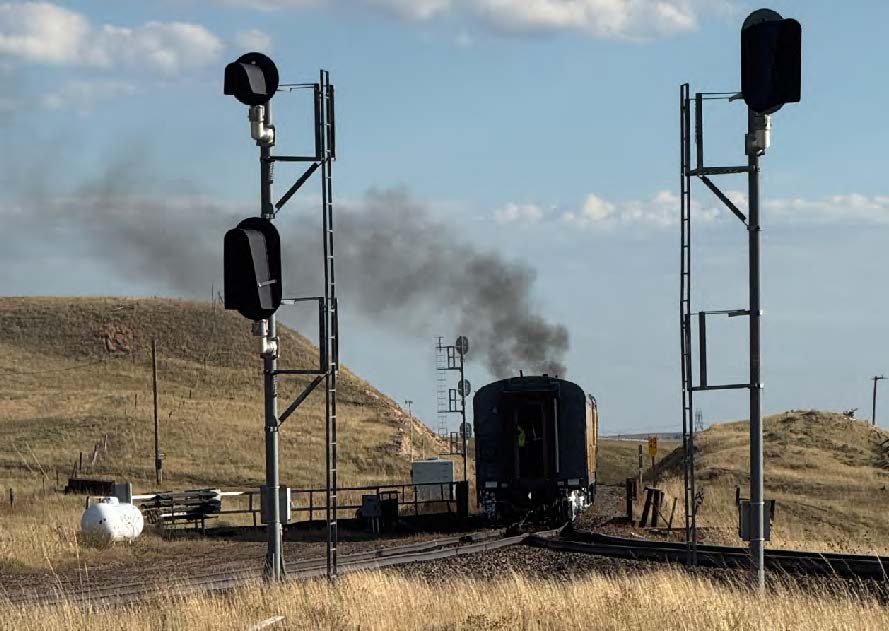
Big Boy No. 4014 moves through the wye near Union
Pacific’s steam shop, using the triangular track
arrangement to turn the locomotive for the return
trip. The locomotive is too large for most turntables.
The run from Eaton to Cheyenne spans roughly 45 miles by road, with UP’s track tracing a similar north-south corridor often visible from U.S. Highway 85. Big Boy was never meant to be fast, even though its design allowed speed approaching 80 mph, with excursion runs occasionally reaching 70 mph. More often, it moves deliberately, governed by track conditions, operating rules, and the quiet discipline of safety.
That measured pace turns the journey into a moving procession – cars traveling at the same speed alongside Big Boy and people gathering on overpasses with cameras poised for the moment the locomotive surges past.
Upon arrival in Cheyenne, the engine rolled beyond the steam shop and continued about a mile farther to a wye track, a triangular arrangement of rails that allows Big Boy – too long for most turntables – to reverse direction. The maneuver takes 10 to 20 minutes, long enough for a small crowd to gather, again with cameras and phones ready.
A UP police officer, keeping watch, gently reminded visitors that stepping to the grounds inside the rails constituted trespassing, although he allowed them to remain where they stood.
As he watched seemingly more as a spectator than an officer, he nudged one visitor and said, “It’s an amazing sight, isn’t it?”
This fascination is all the more striking given how close this all came to disappearing. The steam locomotive era in North America began to fade in the late 1940s and largely ended by the early 1960s as diesel-electric locomotives proved more economical, reliable, and easier to maintain.
Even Big Boy was nonoperational for more than 50 years, being retired in 1959 and placed on permanent outdoor display at the RailGiants Train Museum in Pomona, California, from 1961 to 2013, before UP reacquired it.
Power, Presence, and Preservation
Designed during World War II to haul heavy freight over the Wasatch Mountains, the 4-8-8-4 (four leading wheels, two sets of eight driving wheels, and four trailing wheels) locomotive represented the pinnacle of American steam power so large that, according to railroad lore, a shop worker scrawled “Big Boy” in chalk on the smokebox door of the first locomotive, giving the class its enduring name, which continues to be written on the engine before departure.
Of the 25 Big Boys built, eight exist, with seven on display in museums, leaving only No. 4014 operational.
In 2013, UP began restoring No. 4014, which required not just historical knowledge but also modern engineering discipline. The effort took place in UP’s steam shop, a facility whose roots stretch back to 1919, and which became the railroad’s dedicated steam home in 1960.
Inside that shop, history is not preserved behind glass; it is measured, machined, welded, inspected, and proven.
The rebuilding of No. 4014 required a small core team of nine to 11 people to work for two and a half years, alongside a much broader network of contractors and specialists. In another major reassembly effort tied to the project, 35 contractors worked for five and a half years, and costs ultimately reached three and a half times the original projections, Dickens said.
“We had to unravel a lot of stuff,” Dickens said during a tour of the steam shop and Big Boy. "It seemed crazy to have that few people, but it was good to have a tight group like that.”
In his role, Dickens guides restorations, plans national excursions, and ensures that century-old technology meets modern safety and engineering expectations.
Through the restoration process, the target never moved: May 4, 2019, was the departure date tied to the 150th anniversary of the completion of the transcontinental railroad.
Dickens, who has spent his career in railroading and has guided UP’s steam team since 2010, said there were times when doubt seeped into the crew.
“I remember probably about two months toward the end, the guys almost mutinied on me because we were working so long,” he said. “They didn’t think we had time to get it finished.”
Dickens smiled when recalling the final push.
“What I won’t tell you is that the last five months I lived here in this shop, and literally in the last three weeks, I never set foot out the door,” he said. “It was 18-hour days, and some days longer. But we got it done.”
After its return to the rails, Big Boy became a moving ambassador for steam heritage. The 2019 tour lasted two months and featured stops in Utah and a few Midwest states, while also traveling through the Southwest and the West. With the 2020 season canceled due to the COVID-19 pandemic, service resumed in 2021 with an extended summer tour. In 2023, it operated in a limited capacity, but the 2024 season featured two major runs. Last year, Big Boy made limited runs through northern Colorado.
For a locomotive chugging toward its 90th birthday, Big Boy is scheduled this year to undertake its first transcontinental steam tour. Union Pacific CEO Jim Vena said the tour would be part of the celebration of America’s 250th anniversary and added his excitement about sharing the iconic locomotive with communities coast to coast.
“We are proud to honor our nation’s great history and legacy of innovation with our heritage locomotives. For the first time, we will share the Big Boy with communities on the East Coast, operating it from ocean to ocean,” Vena said in a news release. “America has never been afraid to dream about what’s possible – and neither is Union Pacific as we carry the grain that feeds families, the steel that builds cities, and the household goods that stock store shelves.”
Departing Cheyenne on March 29, the locomotive will travel west to California, then return to Cheyenne on April 24, with planned public display stops in Roseville, California (April 10-11) and Ogden, Utah (April 18-19). The rest of the tour hasn’t been announced, but there is much anticipation. (Go to up.com for an updated schedule.)
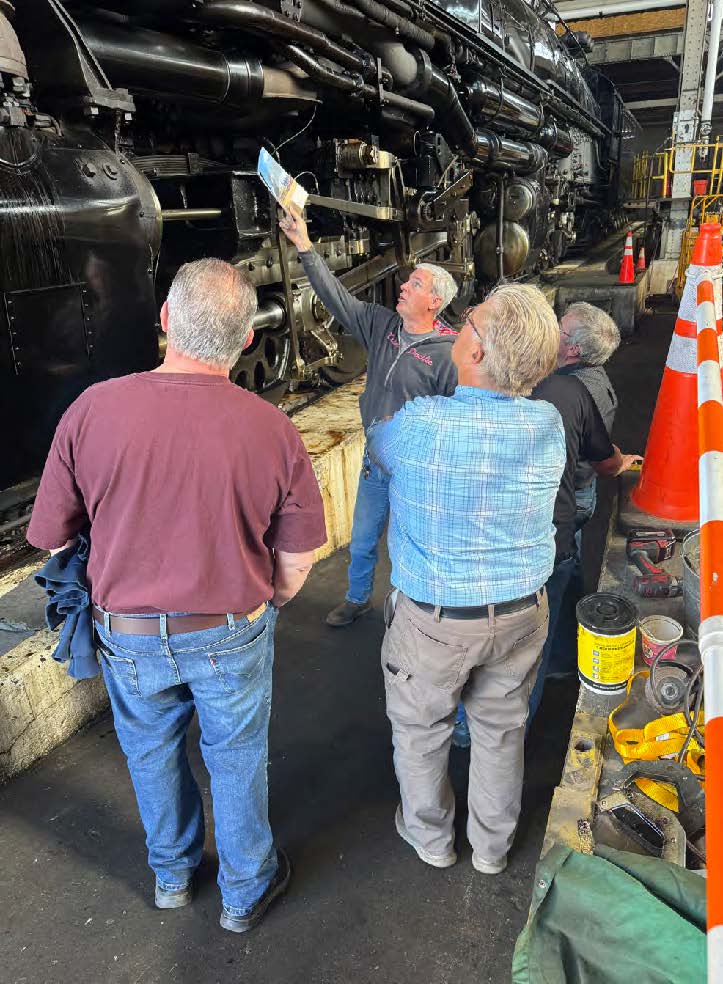
Ed Dickens, Union Pacific’s senior manager of heritage
operations, talks with visitors during a tour of the
steam shop in Cheyenne, Wyoming.
The planned East Coast segment will mark the Big Boy’s first appearance beyond the Upper Midwest. If the proposed merger with Norfolk Southern, announced in July 2025, is approved, it would create a coast-to-coast freight network and could broaden the geographic stage for such heritage movements, but the nation’s anniversary celebration remains the purpose of the journey.
No public passenger excursions are currently planned; the tour is intended as a heritage mainline movement honoring America’s railroading legacy and the role of steam in the nation’s history.
Never Alone
The visit to the Cheyenne facility reveals more than tools and machinery. It reveals continuity.
Generations of railroad workers staff the shop, witnessing the steady evolution of machining technology, materials, and locomotive design.
“They had seen lots of evolution: change, modernized machining tools, equipment, steam locomotives continuing to get better and better,” Dickens said.
When the locomotive leaves Cheyenne, that sense of continuity travels with it. During tours, both short and long, Dickens often remains aboard overnight in a support car converted into a living space – part office, part bunkroom, part rolling museum archive – while much of the crew rests in nearby hotels.
The arrangement reflects both practicality and devotion. Even at rest, the world’s largest operating steam locomotive is never entirely unattended.
And when Big Boy moves – whether across its home state or, for the first time, toward the Atlantic Ocean – crowds will gather long before it arrives, listening for the same distant murmur that rolled across Eaton.
In an age defined by speed, silence, and sealed machines, the mystique of steam still carries. Not just across rails and open country, but across generations – proof that some technologies endure not because they are efficient, but because they are unforgettable.