Years ago, I decided to get a private pilot’s license in one month before returning to college. My friends described it as a crash course in aviation.
After ground school, instructor flights, and solo trips, earning the license required passing a check-ride flight with an FAA-certified examiner, about an hour’s flight from my home airport. Our flight over fields and farm roads went well until, without notice, the examiner reached over to bring the throttle to idle: this was the standard test to see how fledgling pilots handle emergencies. “Your engine just quit,” he said.
Had I been paying attention to wind direction? The wind, I decided, must be from the west. I paused, then turned upwind toward the nearest field. But I’d lost too much altitude, and this flight plan was going to end in a gully, a fence, or maybe both. He pushed the throttle in when we were 100 feet from the ground and looked at me dourly as I climbed to a cruising altitude.
“You boogered it, didn’t you?”
It wasn’t really a question, but it needed an answer. I nodded.
“I did. I could have reacted faster and found a better spot. No obstructions.”
“Let’s continue,” he said.
When he pulled the emergency trick again later in the flight, I was paying attention then, and he signed off on my check-ride a half hour later.
It may seem obvious that any student pilot would admit error, store it in the “lessons learned” file, and move on. But it’s not always so. Some people simply cannot fess up to mistakes or misdeeds, even when others might suffer … even when this puts their own skin at risk.
What’s driving this? Fear.
Fear was one of three key personality dimensions I listed in my winter 2019 column, “Goals, Fears and Peers.” Psychologists who study shame and guilt say some people are terrified by the prospect of losing status within their peer group – friends, coworkers, immediate superiors, and family. What’s more, they fear seeing themselves as failures. According to former Marine aviator Mario Jimenez, there’s a saying in the elite-pilot field:
“I’d rather die than look bad!”
So, what if ignoring a failure or lying to cover up a misdeed will boost the risk of injury or disaster sometime in the future? The key word here is future. Surely that’ll be somebody else getting hurt, somewhere else. Adding to the incentive, many employers penalize anyone found to have been making costly mistakes. So, here and now, falsehoods and devious silence may seem like the safest course.
Psychologists have a label for this: “identity threat.” It’s a term explaining why some people will go very far to avoid shame and embarrassment. It’s not as familiar a term as “identity theft,” but maybe it should be.
On occasion, a post-disaster investigation turns up a person who surely knew that he posed a real danger but could not admit any shortcomings and took pains to cover them up. This brings us to Atlas Air Flight 3591. Atlas operated this Boeing 767 under contract to Amazon Air.
The date was February 23, 2019. The jet was in the final moments of delivering a load of Amazon packages and USPS mail from Miami to George Bush International. First officer Conrad Aska was in command. On approach, at an altitude of 6,000 feet, the “go-around mode” was inadvertently activated.
Go-around is an automated sequence that sets up the airplane to climb in case of a scrubbed approach. It boosts engine power and pitches the nose up to gain altitude. Hitting this tiny button by mistake was somewhat understandable. Aska was following company instructions to use his left hand to hold the speed brake lever on descent, and mild turbulence could explain how that hand lifted upward just enough to activate the go-around switch on the underside of the thrust levers. Focused on landing, Aska missed two indications of this: a loud click over a cockpit speaker, and a coded message appearing on the annunciator panel, “GA/GA/GA/CMD.”
Accidentally triggering the go-around mode wouldn’t have caused a problem to a flight crew who recognized it – the mode would have been quick to deactivate – but Aska missed the signals, and the situation deteriorated quickly.
Here’s why, according to the National Transportation Safety Board: With a thick cloud layer obscuring the horizon, the combination of pitchup and acceleration from the engines created a “somatogravic Illusion” that led Aska to believe that the aircraft, for some reason, had entered a stall. A stall occurs when an airplane, held nose up and losing speed due to spoiled lift, is in danger of falling from the sky. The solution for a stall is for the pilot to quickly push the nose down with the yoke and add more power. That’s what Aska did … without first checking with the captain or with instruments that would have indicated that the go-around autopilot had been attempting to take the plane into a fully controlled climb.
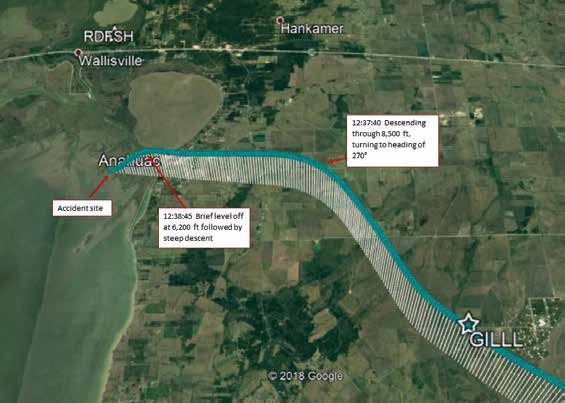
The path of rapid descent of Atlas Air Flight 3591, which crashed on February 23, 2019.
Captain Ricky Blakely knew from his instruments that the aircraft was not in a stall. In seconds, the altitude was plummeting and the airspeed was rising. Blakely tried to counter Aska by pulling back on the controls, as Aska shoved forward. The struggle continued until the plane emerged from the cloud deck, revealing how close the ground was. Aska probably realized his mistake at that point and released the yoke, but it was too late to arrest the dive. The plane crashed into the shallow waters of Trinity Bay at nearly 500 mph.
At the outset, nothing about this crash made sense. The aircraft had started the flight in good mechanical condition, with no smoke or fire alarms, and the Houston-area weather, while overcast and mildly turbulent, was fully manageable for a crew with so many hours in jet aircraft (over 5,000 hours in Aska’s case). Aska’s medical and airman certificates were in order, and no drugs or alcohol played a part.
In every such incident, the NTSB sets up a human factors team. Shocking revelations weren’t long in coming. When applying to Atlas, Aska had skipped two years when filling out his flying resume. When the Atlas interviewer asked about it, Aska lied that he had only been doing non-flying work at the time, like real estate sales. The cover-up worked because the FAA had failed to finalize rules to ensure employers could access an applicant’s prior training records.
Those two years of records would have shown that Aska’s training failures had cost him pilot positions at CommutAir and Air Wisconsin Airlines. When was Aska most likely to fail a test? When the training pilots set up the simulator to present emergency conditions. Here was a pilot who did well when everything was going smoothly; but when the situation demanded composure and expert judgment, he became startled and angry.
One trainer told the NTSB that Aska was “making very frantic mistakes, lots and lots of mistakes, and did a lot of things wrong but did not recognize this was a problem. He thought he was a good pilot, never had any problems, and thought that he should be a captain.”
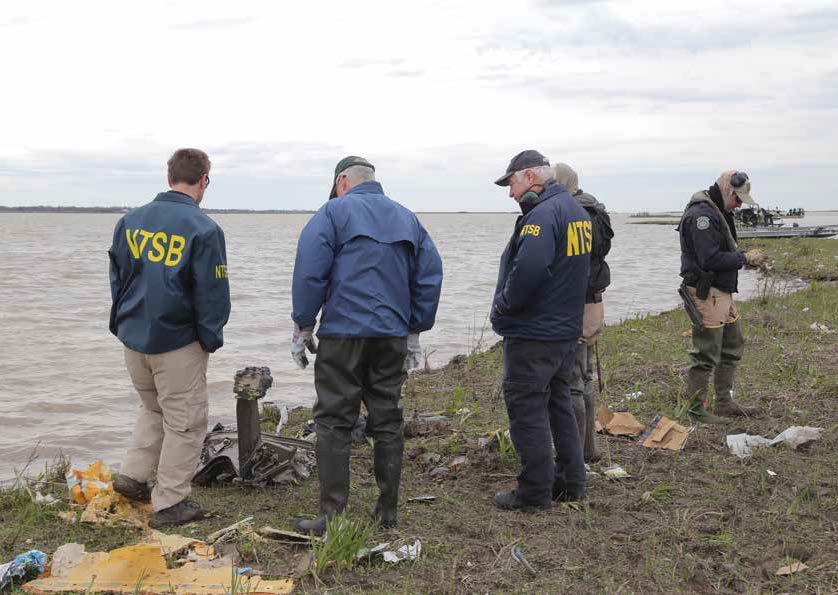
NTSB investigators examine debris of Atlas Air Flight 3591 at the edge of Trinity Bay near Houston. Both pilots and a passenger were killed.
In the debriefings, Aska had a rationale for every failure: he blamed copilots, unfair instructors, and even a hotel for being too noisy the night before one test.
This is precisely the kind of defiantly dangerous attitude that Adm. Hyman Rickover monitored during his rigorous interviews with officers applying to serve on nuclear submarines. Any sign of blame-shifting would abruptly end a session.
“The first officer in this accident deliberately concealed his history of performance deficiencies,” wrote NTSB Chairman Robert Sumwalt, “which limited Atlas Air’s ability to fully evaluate his aptitude and competency as a pilot.”
Aska, Blakely, and Mesa Airlines captain Sean Archuleta, who was riding in the jump seat, died in the crash. The toll could have been much higher as another moment in the air would have ended in a Houston suburb. Even more sobering is that Atlas’ other business was military and civilian charters. Aska’s fatal flaw – panicking under pressure – could have killed hundreds of passengers.
After 10 years of delays and two related airline crashes, the FAA finalized regulations requiring that “notices of disapproval” training records be disclosed to later employers without requiring permission from applicants.
Deceitful and selfish behavior, driven by a perceived threat to identity, shows up in the medical field, the military, business, and manufacturing.
The impulse to run from shame isn’t confined to the reckless and selfish. Nobody likes to be seen as falling for a Bitcoin, fake law enforcement, or fringe banking scam, but this impulse, however understandable, helps keep online cheaters in business.
According to Amy Nofziger, AARP’s director of fraud victim support, “Many times victims want to isolate themselves and not share because they are so hurt and just want to hide.” A detective in Whidbey, Washington, estimated that only half of scam victims in his county ever contact police. People pushed by scammers into financial ruin may contemplate, and sometimes proceed with, suicide.
The main question is: What can be done?
Maybe we can overcome some of that cover- up instinct, even reaching as far as misbehavior. A U.S. military academy studied by a team of psychologists over four years turned up a surprising tool, with results published in 2022. Twenty-three cadets, judged to have committed a major honor infraction (cheating, lying, or stealing), were required by the academy not only to attend the usual disciplinary sessions, but also to wear a pin on the uniform for months afterward.
About an inch wide, the pin became a signal to other cadets that this person had gotten in serious trouble. Upon hearing about the punishment, the team presumed that wearing this modern-day scarlet letter would yield nothing but simmering anger. Instead, they found that the pin prompted serious discussions among the cadets and their peers, rather than forcing them to withdraw in shame. The team finished their work cautiously optimistic that this dynamic might work outside the military setting: “By doing so, transgressors may coactively create narratives that form the basis for personal narrative control and, ultimately, the sustained self-control that characterizes rehabilitation.”
Another way to overcome this human self-protective instinct is for an organization to stop penalizing employees who promptly report mistakes. I visited a Cessna plant in Kansas once, where an employee told me he was actually honored for reporting that he had accidentally cut into, and ruined, a key component of a business aircraft. Without such a quality-centered culture, people are strongly tempted to pass mistakes down the line.
Shame leading to destruction doesn’t have to happen! Start by talking it through.