When it comes to ensuring the safety and reliability of pressure equipment worldwide, The National Board of Boiler and Pressure Vessel Inspectors (NBBI) stands at the center of it all.
As the only ASME Designated Organization (ADO), NBBI plays a pivotal role in upholding the highest standards of safety through audits, certifications, and training programs that impact industries across the globe. Serving as ADO since 1937 is a testament to NBBI’s unwavering commitment and expertise, and this status is a source of pride and motivation, said Gary Scribner, NBBI assistant executive director-technical.
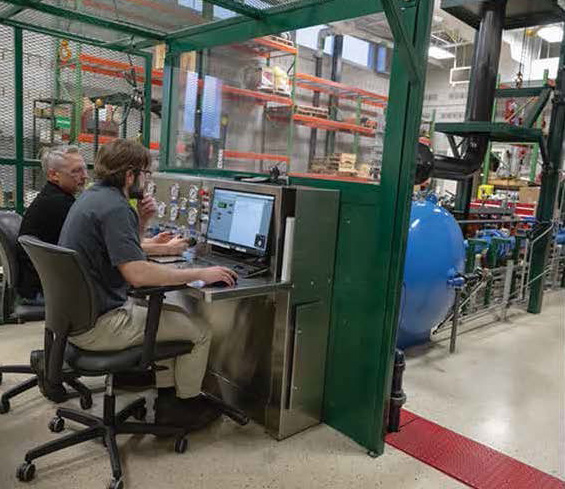
Senior staff engineer Bob Viers (front)
and lab technician JP White perform
a test on an air/gas service valve at
the National Board’s Pressure Relief
Laboratory. Last year, the lab
performed almost 3,000 tests
on air, water, and steam.
“This ensures that we’re meeting the highest standards and staying at the forefront of safety,” he said.
The ADO agreement defines the scope of work with ASME for NBBI’s Pressure Relief Laboratory (PRL) and Technical Services, which both fall under the scope of the Technical Department. PRL oversees pressure relief devices, and Technical Services handles boilers and pressure vessels. The ASME ADO audit ensures that NBBI correctly administers ASME’s certification programs. Audits occur approximately every three years. The last audit was in October 2022, and the next one hasn’t been scheduled.
The agreement gives NBBI the responsibility of:
- Conducting audits on ASME-certified flow labs.
- Performing comparison testing to validate the accuracy and consistency of other labs’ results.
- Providing ASME with all required documentation so they may approve the certification of manufacturers of pressure relief devices, testing labs, and authorized observers.
- Training and administering examinations for NBBI Team Leaders to perform audits.
- Training and qualifying of ASME Designees to conduct audits and investigations.
ADO Responsibilities
Pressure relief devices are critical to ensuring the safety and reliability of numerous industries worldwide. From power generation to oil refining to residential applications, these devices play a vital role in ensuring the safe operation of boilers and pressure vessels by releasing excess pressure to prevent catastrophic failures.
PRL’s auditing of ASME-certified flow labs is central to efforts to ensure safety, consistency, and reliability across these labs. Unlike the other ASME-certified flow labs, which are manufacturer-affiliated, PRL operates independently.
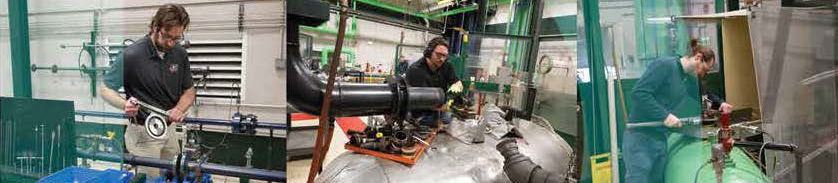
Pictured left to right, senior staff engineer Bob Viers installs a sharpedged orifice plate for flow metering into the lab’s medium-pressure nitrogen test line. Staff engineer Matt Birch sets up a valve for testing on the steam test system. This past November, PRL completed an eight-month upgrade to the steam system. Lab technician Andrew Carter sets up a valve for testing on the water test system. Since PRL opened in May 1991, 26.4% of the tests conducted have been on water.
“The most important task we do for ASME is product capacity certification,” Scribner said. “It pushes us to do everything we can to be the best lab possible. We not only calibrate daily, but we have to compare our results against other labs to validate that we’re meeting the requirement because we’re the ones who go out and make the recommendation for other labs to be certified.”
Flow labs are equipped to measure and analyze the flow characteristics of various fluids, ensuring that equipment and systems meet specific performance, safety standards, and compliance with “ASME PTC 25 Pressure Relief Devices,” which provides guidelines for fluid flow measurement systems and calibration.
PRL's responsibility is critical. Certification helps maintain uniformity and consistency in testing and calibration procedures, ensuring that flow measurements are precise and reliable. This reduces variability across labs, ensuring accurate and repeatable results regardless of location.
Additionally, certification by PRL assures that the lab has the necessary equipment, training, and protocols to properly evaluate and verify flow measurement devices. This also promotes accountability and trust within industries that rely on these measurements for regulatory compliance and operational efficiency.
“For the certification, it's important for the National Board to be involved because it's sort of like the beginning of the certification of all the other companies and all the other valves,” said Tom Beirne, PRL technical manager.
PRL is audited every five years to obtain its pressure relief device certification. This audit ensures that the lab is performing ASME Code-adherent flow tests. The next lab audit will be in 2026.
PRL, located in Worthington, Ohio, about three miles from NBBI’s Columbus headquarters, is one of 10 ASME-certified flow labs worldwide. The others are:
- Anderson Greenwood Crosby in El Campo, Texas: Tests for nitrogen and water
- BS&B Safety Systems, LLC, Tulsa, Oklahoma: Tests for air
- Continental Disc Corp., Liberty, Missouri: Tests for air and water
- Dresser, LLC, Jacksonville, Florida: Tests for nitrogen and water
- Elfab Limited, North Shields, UK: Tests for nitrogen
- Farris Engineering, Brecksville, Ohio: Tests for air and water
- Fike Corporation, Blue Springs, Missouri: Tests for nitrogen
- Leser GmbH & Co., KG, Hamburg, Germany: Tests for steam, air, and water
- Oseco, Inc, Broken Arrow, Oklahoma: Tests for air
Becoming an ASME Designee
An ASME Designee is required to perform flow lab audits. The PRL has three – Beirne, PRL lab manager Austin Peck, and senior staff engineer Bob Viers. Audits are performed every five years and handled on a rotating basis. When other labs apply for certification, NBBI conducts the same audit it receives from ASME.
“I definitely take pride in having this responsibility,” Viers said. “It's a unique kind of review.”
To become an ASME Designee to perform lab audits, a person first must become an Authorized Observer and then an ASME Team Leader. Currently, there are 82 Team Leaders, with 67 holding both ASME and NBBI certifications and 15 certified only to NBBI.
A Designee refers to an individual or organization formally authorized by ASME to perform specific functions on its behalf, such as audits, certifications, or oversight activities. Designees may work across various programs and industries (e.g., flow labs, pressure vessel fabrication, and repair organizations).
A Team Leader is qualified to lead audits and reviews of manufacturers, repair organizations, or testing facilities to ensure compliance with ASME codes and quality standards. A Team Leader focuses specifically on auditing and compliance activities within defined areas, such as valve manufacturing or testing.
Both roles require significant training and an application process to gain acceptance.
An Authorized Observer oversees and certifies testing conducted in ASME-certified flow labs.
Requirements include formal thermodynamics and fluid mechanics education and extensive testing experience.
“New hires typically undergo six months to a year of training before qualifying as authorized observers,” Peck said.
Staff engineers Devon Ault, Matt Birch, and Tyler Burton are Authorized Observers. Ault is in training to become a Team Leader. All three are expected to eventually become Designees.
Certification Process
PRL audits can last two to two-anda- half days, but about half extend to three to four days because of the complexity of the lab’s scope. During these audits, labs must demonstrate compliance with required standards, focusing on several key areas:
- Instrumentation: Ensuring the laboratory’s instruments meet the required precision and are correctly calibrated.
- Calibration facilities: Assessing the methods and equipment used for calibrating flow measurement devices.
- Procedures: Reviewing testing and quality control procedures for consistency and accuracy.
- Personnel qualifications: Ensuring staff members have the expertise to perform and validate flow measurements.
In addition to documentation and procedural reviews, each lab must demonstrate its capabilities through proficiency tests. These tests measure flow under controlled conditions, with results compared against known standards to evaluate accuracy.
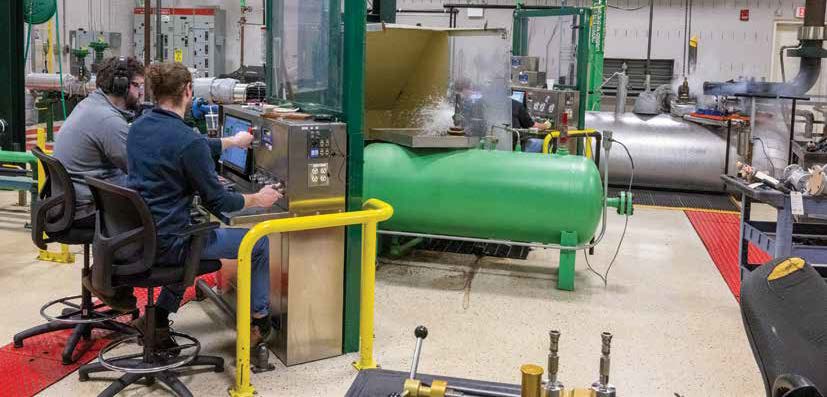
Lab technician Andrew Carter (front) and staff engineer Tyler Burton conduct a liquid service pressure relief test.
“When we qualify labs, we audit their quality program, review documentation and records, and then we witness their authorized observers conduct the testing on the test media they are requesting certification for and types of products they want to conduct flow testing on,” Beirne said.
“We also witness testing of fixed flow objects or flow nozzles. They'll perform a test at a certain pressure on a flow object at their lab. Then they'll send it to us to perform the same exact test at our facility.
Beirne said the data measured by the two labs must agree. The code requirement is plus or minus 2%.
“One of the things that we get questioned on sometimes is what if the results are outside the plus or minus 2% tolerance. If that occurs, we will first conduct our own investigation and make sure everything is OK with our equipment. We try to exhaust all possibilities to ensure the discrepancy is not on our end. Once that has been determined, we’ll usually question the other lab and look at what the problem is.” Because PRL serves as the hub for all certified flow labs, successful comparison testing ensures consistency across the industry.
“Essentially, that means that all the other labs are in agreement with us and, by extension, with each other,” Beirne said.
To date, a flow lab has never failed recertification.
“When we do comparison testing of flow nozzles, sometimes the data is slightly off. When that happens, we ask the lab to repeat the test,” Beirne said. “Generally, it works out when the test is repeated, or they find some small issue that gets corrected.”
Staff at the labs are highly receptive to the certification process.
“Everyone understands the importance of our mission,” Beirne said. “We don’t view these labs as competitors. We share the same goals; they’re our colleagues in protecting public safety through the certification testing we do.”
Scribner echoed this sentiment: “We’re not just auditing labs; we’re building partnerships.”
Authorized Observers are also certified or recertified as part of the audit.
Pressure Relief Device Certification
NBBI certifies pressure relief devices for capacity or flow resistance on ASME’s behalf. The process involves a design review, initial baseline testing, testing of production samples, and the shop audit of the quality system.
After initial certification, each device type must be recertified every six years.
“It’s a sample piece,” Viers said. “For example, think about the valves on a water heater at homes.
The company makes millions of them every year. We get two every six years to test to verify that the design is still good.”
The process ensures the design still meets requirements and that the company still knows how to build it.
Reviews
NBBI conducts audits, training, and certification for manufacturers and repair organizations as part of the ADO and repair organizations to ensure compliance with the National Board Inspection Code (NBIC).
PRL conducts reviews for manufacturers and assemblers of pressure relief devices bearing the ASME V, HV, UV, UD, and UD3 designators. Technical Services performs joint reviews and surveys for boilers and pressure vessels. Joint reviews refer to non-nuclear audits, and surveys refer to assessments at nuclear repair organizations. For this section, a review refers to a review, joint review, or joint survey.
Beirne oversees PRL’s certification program, and Luis Ponce, manager of Technical Services, handles the process for his division. NBBI consultants play a dual role as ASME Designees and NBBI Team Leaders, conducting reviews to uphold industry standards. Technical Services has 14 consultants, and PRL operates with 10. Reviews are scheduled every three years.
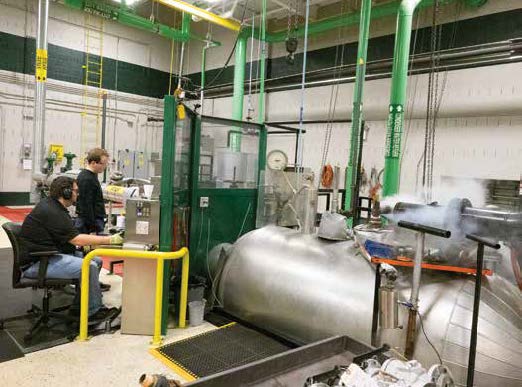
Staff engineers Matt Birch (front)
and Devon Ault follow a steam
service valve being tested for
relieving capacity.
PRL reviews include a quality system assessment and an implementation demonstration, during which production sample valves are selected and tested at PRL. The on-site portion typically takes about two days, though this varies depending on the number of samples tested.
Technical Services reviews are performed over two or three days and involve the company’s Authorized Inspection Agency (AIA) and a Team Leader. The jurisdiction can also participate.
The first day is spent reviewing the company’s quality manual, which the Team Leader and the AIA conduct. The subsequent days consist of a meeting with company representatives to discuss the results from the quality manual review, followed by document and process inspections.
Once a review is completed, consultants submit reports – pressure relief reports to Beirne and boiler and pressure vessel reports to Ponce. Following final review, the reports are submitted to ASME for approval, after which ASME issues certification.
Each year, PRL performs about 100 shop reviews worldwide, and Technical Services conducts about 900 reviews. Unlike PRL, which operates globally, Technical Services handles those only in the US, and ASME oversees international ones.
If a major issue arises during a PRL review, a follow-up is recommended to address and resolve any deficiencies. If the issue remains unresolved, a re-review may be necessary.
For a Technical Services review, a 30-day follow-up with an AIA is recommended to close any outstanding issues. If the problem persists, a re-review can be scheduled.
In both instances, if ASME or NBBI upholds the recommendation, the company is scheduled for another review.
A History of Testing Excellence
In November 2024, PRL completed an eight-month upgrade to the steam system, resulting in about a 500-valve backlog, which Peck said: “We’ve been working through the last couple of months.”
This marks the latest in a series of lab upgrades since PRL moved to its current site in May 1991.
NBBI’s involvement in valve capacity testing dates back to 1935, when founder and secretary C.O. Myers partnered with The Ohio State University for safety valve testing – a collaboration that lasted until NBBI opened its first dedicated lab in 1974 at the Picway Generating Station in Pickaway County, Ohio, before moving to its current location in 1991.
Since then, PRL has continued to grow:
- 2011: The lab expanded by nearly 3,000 square feet, bringing the total test area to 6,400 square feet.
- 2013: The original boiler system was replaced.
- 2020: PRL transitioned to a digital data collection and storage system.
Since conducting its first test at the Worthington site on May 10, 1991, to qualify the water test system, PRL has performed over 63,000 tests and now averages over 2,500 tests per year, although that number reached almost 3,000 in 2024. Of these:
- 48.4% have been conducted on air
- 26.4% on water
- 25.2% on steam
With continual upgrades and a commitment to industry-leading testing standards, PRL remains at the forefront of pressure relief valve certification and safety.
PRL’s Core Activities
In addition to the ADO, the lab has three other primary activities: VR repair program, T/O testing program, and investigative testing.
VR Repair Program
This certification authorizes organizations to repair and recondition pressure relief valves, ensuring they meet the same standards as newly manufactured devices. Certification ensures that repairs are conducted in compliance with the NBIC, specifically Part 4, Pressure Relief Devices.
“The VR program is really international,” Scribner said. “Our goal is to get a lot more expansion of the VR program in Canada in the next 10 years.”
NBBI also is focusing the VR program on Argentina. NBBI’s previous work with the Argentinian National Institute of Industrial Technology includes the Spanish translation of the NBIC, Part 1, Installation, Part 2, Inspection, and Part 3, Repairs and Alterations. This was the focus of a cover story for the 2024 summer edition.
T/O Testing Program
This program accredits organizations to perform testing on pressure relief devices, ensuring they meet stringent requirements for the functionality, capacity, and compliance of pressure relief valves under controlled and standardized conditions.
Both the VR and T/O programs require regular inspections and audits to ensure ongoing compliance. Investigative Testing Often conducted at the request of ASME, regulatory authorities, or member jurisdictions, this testing evaluates pressure relief devices involved in boiler and pressure vessel incidents.
PRL Team
As lab manager, Peck oversees the staff engineers and technicians and is responsible for the daily operation of the facility. He said variety is one of the best aspects of his job.
“We have 10 full-time employees, so it feels like we’re running a small business,” he said. “We get to wear a lot of different hats. Some days, we're back here doing maintenance or trying to troubleshoot issues. On other days, we're just doing our standardized testing processes. But it’s diversified work, and it’s hands-on work.”
As technical manager, Beirne oversees audits of applicants’ quality control programs, reviews design documents for new product certification, and oversees two administrative assistants.
Viers is currently the lab’s only senior staff engineer. His primary responsibility is to perform tests as an Authorized Observer. He also manages the lab’s test schedule and oversees the calibration program.
Ault, Birch, and Burton are staff engineers whose main responsibility is to perform tests as Authorized Observer. Ault is also the lab’s primary programmer and maintains/modifies test software. Birch also oversees the lab’s boiler feedwater treatment program, and Burton handles outgoing shipping and is training to become a backup programmer.
Lab technicians Andrew Carter and JP White assist with testing, perform routine maintenance, and collaborate with Peck on complex maintenance issues.
Heidi Metzmaier and Amy Zehendner are administrative assistants who process applications, schedule audits, and issue certifications.
Additionally, Ault, Beirne, Peck, and Viers contribute to the NBBI Training Department by teaching the Pressure Relief Valve Repair Seminar (VR).
By the Numbers
- More than 63,000: Number of tests performed at PRL since opening May 10, 1991
- 2,930: Number of tests performed in 2024
- 346: Number of VR Certificate Holders
- 70: Number of VR/TO Certificate Holders
- 6: Number of T/O Certificate Holders