In 1944, MGM Studios released a musical called “Meet Me in St. Louis.”
The title referenced a popular song written to promote the extravagant Louisiana Purchase Exposition, also known as the St. Louis World’s Fair, in 1904. The two-square-mile fair, offering 1,500 purpose-built structures and a million electric lights, came at the peak of technological optimism. Refined oil fuels were replacing coal, which meant power to move faster and faster. Ordinary citizens were eager to learn anything related to speed, whether travel by airship, train, steam liner, or the newfangled automobile and motorcycle.
“Speed is our most powerful ally,” inventor George de Bothezat wrote early in the century. “Let us use it, develop it, and venerate it. It is in infatuation with it that is found the most powerful source of happiness.”
While Americans were enthralled by what de Bothezat called “speed intoxication,” mechanical engineers longed for leaps in reliability and efficiency.
This brings us back to the title of the 1904 song and the movie on which it was based.
While the title had no connection to the characters in the movie – they already lived in St. Louis – an important meeting was planned for the expo. It would help set the course of steam engineering for years to come.
In one of the buildings erected for the fair, the 15-acre Palace of Transportation, three bitterly competitive steam-efficiency upgrades were scheduled for a showdown in front of experts and the public. Called superheaters, each model had fervent backers who promised steep drops in fuel burn and water use.
This was no small matter among locomotive operators, given the expense of coal and the need for frequent stops at water tanks. The Pennsylvania Railroad financed and supervised the tests in its 33,000-square-foot exhibit. Its engineers tried each device in the three locomotives, making 100-mile simulated runs on a dynamometer test stand. Which superheater performed the best would determine the designs for thousands of locomotives to be ordered worldwide over the coming years. These were patent superheaters from Schmidt, Cole, and Pielock.
A superheater dries steam by heating it, and dry steam carries more energy when heated than steam directly from a boiler. The latter is “saturated steam,” meaning it contains tiny droplets of water.
All early boiler-driven reciprocating engines relied on saturated steam, which gobbled fuel and water, so boiler innovators never stopped looking for better performance. At first, they did this by raising pressures inside the boiler (boosting the power delivered to cylinders) and later by compounding the reciprocating machinery. Compounding cut fuel consumption by adding low-pressure cylinders downstream of high-pressure cylinders.
These changes to saturated-steam boilers satisfied customers for a time, but much room remained for improvement. If steam could be dried and superheated, it would solve two serious problems. Saturated steam erodes metal surfaces from corrosion because the water droplets affect cylinder walls and turbine blades. It also wastes energy as the steam loses pressure in the exhaust and condenses to cause more water droplets.
Superheated steam doesn’t have water droplets, and if hot enough, even the pressure drop at the exhaust won’t force it to condense there. All those hoping for a workable superheater understood that the highest possible temperature was the key. When superheated steam arrived at the cylinders at a temperature of 100 degrees hotter than saturated steam off the boiler, this was called 100 degrees of superheat. The higher the superheat, engines would consume less water and fuel while delivering the same power. But it wouldn’t be easy.
Wilhelm Schmidt, a German engineer, was a leader in the development of the superheater for locomotives in the early 20th century. Today, superheaters are nearly universal in steam-power practice.
Locomotive legend Richard Trevithick filed a patent for a superheater in 1832, and many others followed. All plans relied on adding tubes to capture waste heat, usually running “dry steam” tubes to tap into waste heat inside the firebox or exhaust-gas flues.
By 1880, there was good news and bad news.
The good news was that superheaters had proven practical for stationary boilers, which offered plenty of space for the extra tubing runs and flues. These early models used dry steam heated to 450 degrees and achieved moderate efficiency gains of 10% to 15% in fuel savings.
The bad news was that despite many attempts at adding superheaters to locomotives, none worked, given the tight spaces and heavy demands of a road engine. Packing and joints leaked, and the experimental engines spent more time in the shop than on the rails. The animal-fat lubricants scorched in heat far exceeding that of normal boilers. The metals available to fabricate the complex tubing required were prone to overheating when engine drivers cut back on the throttle or when coated by cinders. Common wisdom had it that superheating for railroads wasn’t worth pursuing because some efficiency gains had already been achieved by going from a simple to a compound design for steam engines.
Surveying this seeming dead end, a German engineer named Wilhelm Schmidt saw an opportunity. Not only did he intend to raise dry-steam heat to almost 700 degrees, but he would design a superheater for locomotives.
Born to a Prussian farming family in 1858, Schmidt had struggled in early schooling. He was dyslexic, unable to memorize sections of text, and even stumbled over the alphabet. But he flourished upon entering a technical high school in Dresden, where he could devote himself to machinery details and schematics.
Schmidt was hired as a civil engineer in 1883 and spent the next 14 years tackling each superheater problem. During that time, he looked into new materials and techniques, such as mineral-oil lubricants that tolerated high temperatures. Faced with the problem that superheater tubes tended to overheat when engine drivers reduced the throttle and had no way to provide cooling, Schmidt provided dampers to divert heat from the superheater. Non-superheater equipment needed changes, too, from pistons to stuffing boxes.
By 1898, Schmidt had established himself with an improved superheater for stationary boilers. He settled on a design for locomotives called a smokebox superheater because it routed steam-drying pipes into a circular chamber in the smokebox. Gases from a big flue off the grates heated these pipes.
Rigorous testing was next, so Schmidt needed an ally in the railroad business and found one in Robert Garbe, chief mechanical engineer of the Berlin division of the Prussian State Railways. Garbe disregarded in-house skeptics and authorized Schmidt’s smokebox superheaters in two Prussian S 4 series road engines.
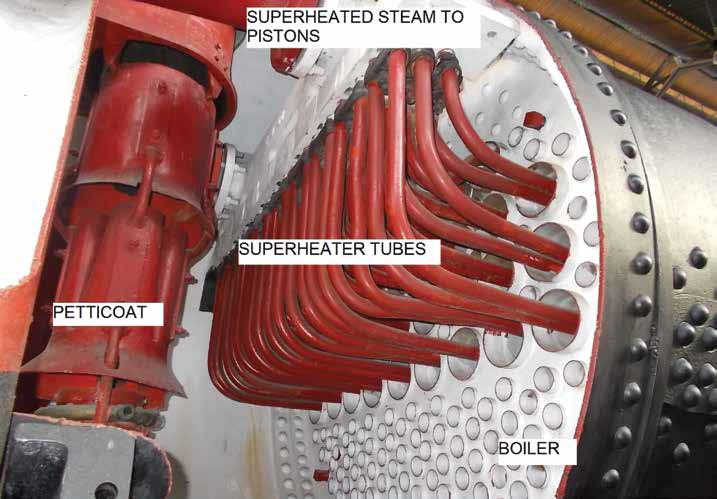
These worked but didn’t satisfy the inventor now known as “Hot Steam Schmidt.” Three years before the Louisiana Purchase Exposition, he shifted to a more compact arrangement, called a smoke-tube (sometimes called the firetube) superheater. This relied on a compact serpentine design with U-shaped end tubes to route the drying steam four times through the exhaust. Coal and water savings hit at least 25%, and remarkably, Schmidt accomplished it without adding a maintenance headache. A British railway reported one engine ran 76,000 miles without requiring any additional repairs or upkeep due to Schmidt’s improved superheater.
Quality in fabrication was critical to the Schmidt design. Faulty U-tubes were prone not just to leak but to burst, unleashing a fatal blast of steam into the cab. Along with the expansion of metal when heated and intense vibration from the locomotive, Schmidt’s plumbing had to cope with very high velocities. As the target temperature approached 700 degrees, the steam reached the cylinders at nearly half the speed of sound.
Although demanding, Schmidt’s layout avoided problems with the Pielock superheater, which relied on a boiler-located chamber capturing heat from boiler tubes. This arrangement limited the degree of superheat and was difficult to maintain.
Here’s an excerpt from “Railway Magazine” in 1910: “The fact is that the early stages of superheater development were so thoroughly threshed out by Dr. Schmidt and those associated with him that almost every possible weakness was discovered and provided for years ago, and the result is that the apparatus as now fitted is well-nigh as perfect as engineering science can guarantee.”
While the Cole and Pielock superheaters continued to sell after the Pennsylvania Railway tests at St. Louis, those two never matched the performance of Schmidt’s version. His smoketube superheater soon dominated European and British railways. American railroads were slower to adopt a Schmidt superheater, but by 1920, more than a third of the 65,000 American locomotives used one.
Superheaters are nearly universal in steam-power practice today. Heat-recovery steam generators, when tapping the exhaust of gas turbines, depend on superheaters downstream of the economizer and evaporator sections.
What else does Schmidt’s work mean? It illustrates how to navigate what I call the machine frontier. In the introduction to “Inviting Disaster,” I compared the pros and pitfalls of technological advancement to a machine frontier. An English dictionary of 1721 defined frontier as “the limits or borders of a country or province.” Later, in the US at least, the word came to mean an unsettled wilderness that was ripe for exploitation by restless – and sometimes reckless – risk-takers.
America’s geographical western frontier has long vanished, but I see similar dynamics along the machine frontier – a mix of danger and opportunity that offers innovators new economic gains. However, developing such niches increases the risk of error since safe and reliable methods have not been established. While popular history tends to focus on seemingly overnight successes, over the long haul, the greatest rewards on the machine frontier go to innovators who proceed on solid facts and exhaustive testing. When experiments are unsatisfactory, the inventors correct and move forward. If that means scrapping a design and starting from scratch, that’s what they do.
These are people like Schmidt. Along the 14-year path toward a high-performance locomotive superheater, he faced many problems. He found that a solution to one problem often generated second-order issues. He knew inventing a bolt-on “superheater gadget” wouldn’t be enough; it would have to fit into the entire system of railway practice, from throttle handling to mechanics’ training. Some people would be infuriated by such a slow stop-and-go pace, but Schmidt never gave up.
Thomas Edison once said genius was 99% perspiration; Schmidt might have suggested two more Ps – patience and persistence.