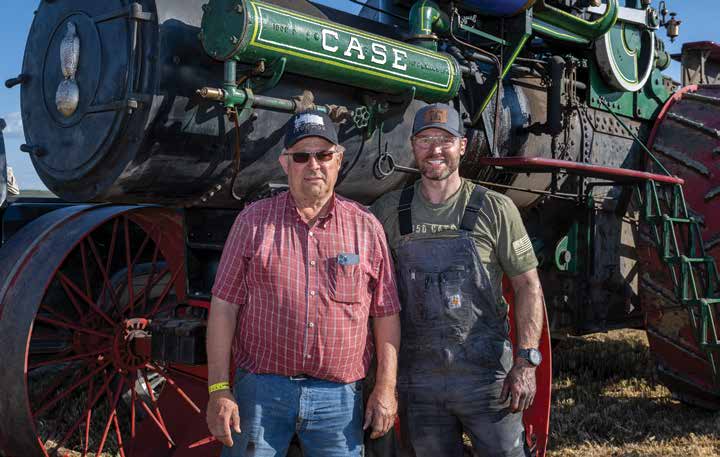
Kevin Anderson (left) and Kory Anderson take a break from working on the 150 HP Case during the James Valley Threshing Show.
6 Questions with
Kevin and Kory
Anderson
Kevin and Kory Anderson, father and son, are two of the most familiar names in the field of steam traction engines.
A lifelong resident of Andover, South Dakota, Kevin also is known for his several farm-related inventions, adding that “farm always profits from new ideas” and he enjoys “doing what people said can’t be done.” Among his inventions is an opener for air seeders. Brought to market in 1984, the Anderson Opener allowed fertilizer to be placed below the seed in the same pass.
He eventually partnered with Michael Horsch, whose German company manufactures agricultural machinery and technology. Horsch Anderson, LLC, grew from Anderson’s shop to a facility in Mapleton, North Dakota, and produces a wide range of farming equipment.
Kevin, who owns about 20 steam engines, has been a member of the National Board Inspection Code (NBIC) Task Group Historical Boilers since 2021. In his collection is a 1910 Stanley steam car, but he said his 1911 110-horsepower Case engine is his most prized possession. He also is one of the founders of the James Valley Threshing Show, which recently celebrated its 50th anniversary.
Kory, also an Andover resident, attended his first steam show at five days old and is widely known for his extraordinary achievement of constructing a 150 HP Case steam engine. Only nine were manufactured from 1905-07, and none survived. Kory’s passion drives him to share this historic engineering feat with others. He participates in six to eight steam shows annually, taking the Case engine to two or three events, including James Valley.
Kory also founded Anderson Industries at age 22. In 2011, he acquired All Service Manufacturing in Mapleton and built the new factory for the Horsch Anderson operation. Three years later, he bought Dakota Foundry in Webster. He serves as CEO of both companies. He also founded the Iron Warrior Academy, a nonprofit designed to provide young people with opportunities to develop manufacturing skills through apprenticeships. Its core mission is “to build the future warriors of work and American manufacturing.”
In addition, Kory wrote “The 150 Difference,” a book which details the significance of the Case engine and his journey in bringing it back to life. He also travels for public speaking engagements.
Q What sparked your interest in steam traction engines, and who were your mentors?
Kevin: Harold Somers got me involved. He owned a Chevrolet and International Harvest dealership, and my school was nearby his business. He owned a steam engine and would start it in the morning and drive it home for lunch. When I heard it, I often would sneak out of school to sit on the engine. I was 10 or 12 years old, and occasionally I wouldn’t return to school. My mother wasn’t too happy. One time, I reached over and put my hand on a hot steam pipe and blistered my hand. I was really in trouble. Harold sold that engine, bought a half-sized one, and said, “You might as well learn how to run this thing because I’m too big, and you’re the right size.” I ran a steam engine for the first time in 1969 in Foreman, North Dakota, with his half-sized 60 HP Case.
I bought my first, a 1910 Case, in 1978 and started collecting them because I had a passion for how they operated – boiling the water, making steam, the intricacy of it all. You had to be cautious to successfully operate it. The people I’ve met through the years have remained friends for life. That led me to want to start our show. Reunions are a great way to see how inventors solved problems and advanced agriculture. Meeting amazing people who can take a problem and solve it using common thinking is rare. Networking at a show is a great way to bring out the best ideas.
Kory: My interest in steam tractors was sparked at an early age because my parents regularly took me to steam shows. I was drawn to the stories shared by older generations, and I was fortunate to grow up in a time when I could still hear firsthand accounts from people who had made a living operating steam engines – whether on locomotives, sawmills, or plowing.
My greatest influence in this hobby is my dad, who raised me around steam engines. He taught me how to operate them at a young age and gave me the incredible opportunity to restore my own steam tractor, a 1915 65 Case, while I was still in high school. Another important mentor is Jim Briden. I grew up learning from him, riding along on his 1911 110 Case and eventually running it myself. Jim’s shop, Larson Welding and Machine, has been deeply rooted in the preservation of steam tractors since the 1950s, and after high school, I apprenticed under him, honing my skills in welding, machining, and metal fabrication – crucial tools for pursuing my dream of building the 150 Case.
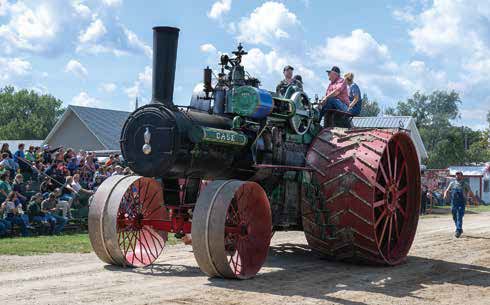
The Anderson family leads the parade at the James Valley Threshing Show on September 6.
Dennis Powers, a renowned tractor collector and successful businessman, played an instrumental role in my entrepreneurial journey. His vast business experience and encouragement gave me the confidence to take on the seemingly impossible challenge of building the 150 Case.
One of my closest friends, Gary Bradley, is the son of the late Don Bradley, another steam tractor collector. Gary’s experience with large machinery, stemming from his career in coal mining and oil drilling, became invaluable when he offered to help build the 150 Case. We worked full-time at his shop in Sheridan, Wyoming, using his equipment and resources to assemble the parts for the project.
Q Kevin, why is being on the NBIC Task Group Historical Boilers important?
The task group has changed the whole steam hobby. We all have a voice. The future will grow by committee members and inspectors going to states that don’t have safe operations and showing them what the NBIC has to offer. This is huge. We must attract insurance companies to travel with us to these situations. Selling this to the insurance side will take some work, but it's the carrot we need. My goal for the task group is to get everybody involved who wants to be involved because there’s always a lot of questions. And if we have the team to answer these questions, we can continue to make progress.
Q Kory, what inspired you to build the 150 HP Case, and what did you learn from the process?
I first learned about the 150 Case at the Case Expo in 1992 in Rollag, Minnesota, when I was 9 years old and I met George Hedtke from Davis Junction, Illinois, for the first time. George owned the only surviving piece of a 150 Case road locomotive – the boiler from engine No. 14666. George was well known for his storytelling, and his passion for the legacy and history of this tractor ignited my curiosity. As a 9-year-old, I dreamed of seeing this tractor in real life.
The journey to build the 150 Case spanned about 12 years, overlapping with the early stages of growing my businesses. I needed the resources to support a project of this scale, and after acquiring Dakota Foundry in 2014, the pieces finally came together. I set to work fulltime on the project in April 2017. Over the next 16 months, with an investment exceeding seven figures and about 12,000 combined man-hours, we completed the project. In August 2018, we fired the engine for the first time, a moment that fulfilled my childhood dream.
One of the biggest lessons I learned during the project was the importance of planning, organization, leadership, and maintaining strong relationships with the team members involved. Building the engine required a detailed plan and meticulous management of hundreds of parts being produced simultaneously across different facilities. Aside from my dedicated team at Dakota Foundry, I also relied on about 30 volunteers who supported various stages of the project. Coordinating their efforts required effective planning and setting milestone achievements as a way to motivate and reward those who were sacrificing their time and, in some cases, their own resources for the project.
What inspires me the most are the personal impacts this project has had, especially among younger generations who are now taking an interest in history and machines like the 150 Case. Seeing young people engage with something meaningful and rooted in innovation and hard work gives me a great sense of purpose. The 150 Case has become more than just a restoration project. It’s become a symbol of what can be achieved when we honor our past and pursue big dreams.
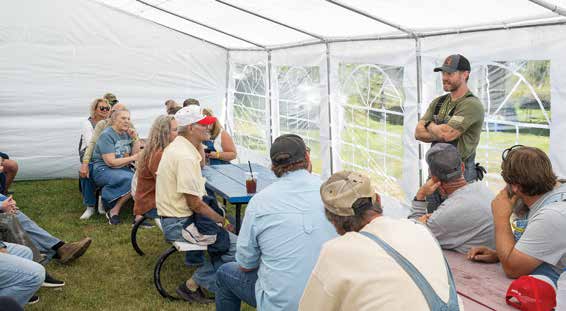
Kory gives a presentation on the 150 HP Case during the James Valley Threshing Show.
Kevin: I was so excited when Kory started the process. I knew it was possible because of the engineering software. Kory had the components that could answer the massive amount of what I call riddles involved in why the Case 150 died.
Q Kevin, what do you feel are the highlights of your career?
Wow, what a question! I would say that it would be having our family involved and committed to this hobby and continually trying to make it better for everybody. That’s such a big deal for me. My wife, Donna, is involved in the women’s side of the era. At the (James Valley) show, the heritage craft building, where all the quilts are displayed, that’s all her – lock, stock, and barrel. My other son, Scott, is more involved on the agricultural side of it. With the machinery we’ve invented, we try to take farming to the next level. And Kory and the Case 150 have given us the exposure we never expected.
Q Kory, many people emphasize the importance of passing this history down to the next generation. How do you prepare them to keep it alive?
We inspire the next generation toward preserving history by creating opportunities for them to get involved and experience the marvels of innovation these machines represent. But more importantly, we inspire them through stories – the stories of people who used these machines, restored and built them, and lived lives that are hard for us to imagine in today’s culture of easy and immediate gratification.
Those who truly appreciate the hard work and passion it took to operate these machines, as well as the importance of safety and maintenance in preserving them, are the ones who develop a deeper respect for the skills required. They become passionate about keeping this history alive.
My wife, Ali, runs a miniature steam train, and our daughter, Selah, has already attended Q Q several steam shows at just 14 months old. Together, we carry on the legacy of historical preservation and innovation.
Q What’s next for you both?
Kory: That’s the most frequent question I get. First and foremost, my focus is on continuing the mission of preserving history and promoting hard work by displaying the 150 Case at events and shows. I aim to inspire others to preserve not only these great machines but also the values of discipline, resilience, and dedication – skills that are becoming as rare as the steam engines themselves.
For specific projects, I’m restoring an 1898 center crank Case steam tractor and building nine half-scale 150 Case road locomotives. I’m assisting Gary Bradley with restoring a 40 Case steam tractor, and I’m helping Jim Briden build a half-scale 60-90 Twin City gas tractor.
Kevin: Well, for now, I’m going to help Kory with the 1898 center crank Case. We’re going to build a new boiler and make everything else new or as good as we can. It’s just incredible because we both think a lot before we say much. We try to analyze it before discussing it. Neither one of us really shoots from the hip. When I’m working with Kory, life doesn’t get any better when you’re on the same page.