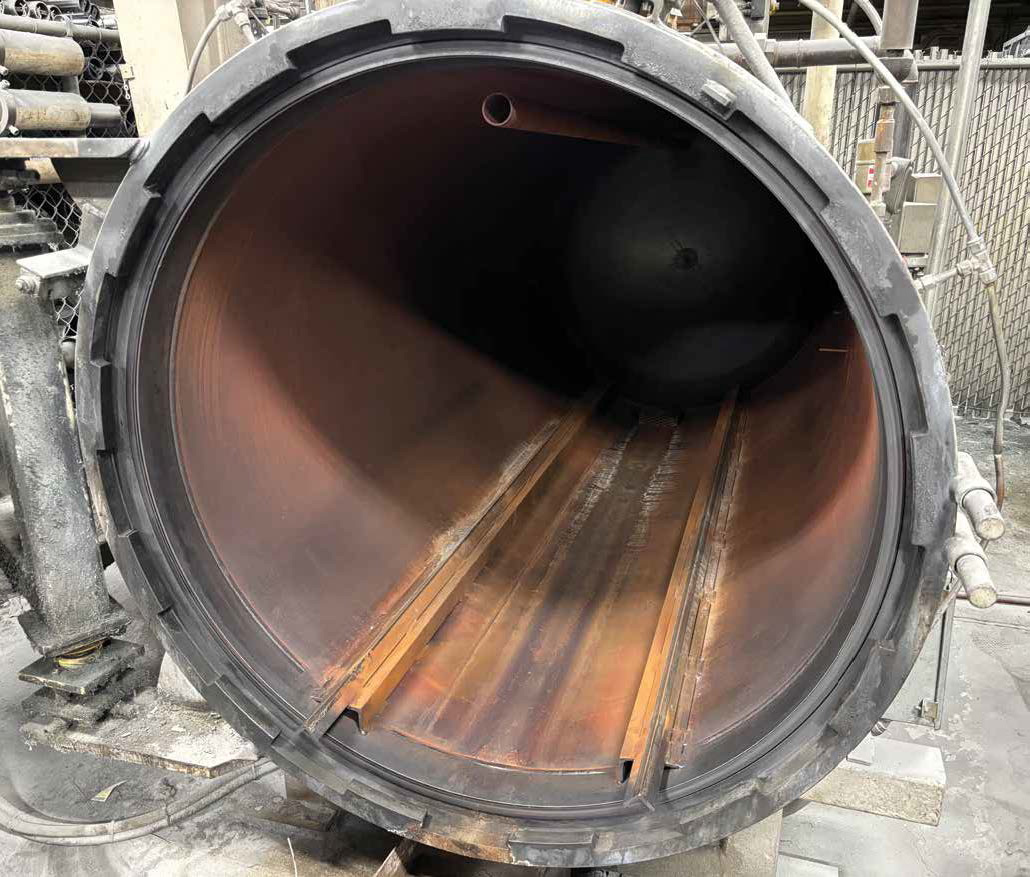
This is an example of a lock-ring enclosure on an autoclave from a gasket seal manufacturer. Quick-actuating closures are commonly used on autoclaves to allow secure, rapid access to pressure vessels during repeated loading and unloading cycles. Photo courtesy of ARISE.
Quick-actuating closures (QACs) are a vital tool in industries where efficiency and access matter, but they also carry risks that demand constant vigilance.
When these closures fail, the consequences can be severe, underscoring why inspectors and engineers continue to focus on their safe operation.
To address these challenges, The National Board of Boiler and Pressure Vessel Inspectors (NBBI) has prioritized QACs in the National Board Inspection Code (NBIC). Volunteer special task groups have reworked a section in Part 2, Inspection, and are developing new guidance for Part 3, Repairs and Alterations, ensuring that inspectors and repair companies receive clear, practical direction.
Their efforts highlight the NBIC’s unique strength: it is a living, consensus-driven document that adapts as new knowledge emerges. By capturing the expertise of those who work daily with pressure equipment, NBBI is reaffirming its commitment to safety and to preventing incidents before they occur.
A QAC is a specially designed pressure-retaining device that allows rapid access to the interior of a pressure vessel without removing multiple bolts or fasteners individually. Unlike conventional flanged connections, a QAC uses a mechanism, such as a hinged ring, bayonet lock, segmented clamp, or other design, that engages or disengages all holding elements with a single action.
While lives have been lost in QAC incidents, there’s no current, reliable number isolating QAC-related fatalities. Fatal pressure-vessel incidents are usually logged under “boiler/ pressure vessel” or “autoclave” rather than by closure type.
QACs gained popularity in the mid-1900s and are found on a variety of pressure vessels and process equipment that require frequent access. Because QACs are susceptible to cyclic loads, they are built with robust materials and redundant safety features. ASME Boiler and Pressure Vessel Code (ASME BPVC) requires that they be designed so that the failure of a single holding element will not cause the closure to release under pressure.
Autoclaves are one of the most common applications, particularly in the rubber, composite, and medical and laboratory industries, as well as in food processing. An autoclave is a pressure vessel designed to carry out processes that require elevated temperature and pressure. Instead of generating steam for heating or power, it uses steam or another pressurizing medium to create a controlled, high-pressure, high-temperature environment for a process.
Medical facilities rely on autoclaves to sterilize surgical instruments, laboratory glassware, and biohazardous waste. Their ability to destroy bacteria, viruses, and spores through pressurized steam makes them indispensable to infection control programs. Modern hospital autoclaves range from tabletop units in clinics to large, walk-in models in surgical centers, all designed for frequent use and rapid turnaround.
Autoclaves can range from a table-top size of one to five gallons to industrial ones that can hold in excess of 50,000 gallons and can exceed 100 feet in length.
And, of course, the larger the autoclave, the greater the increase in force exerted on the QAC.
For example, a 10-inch household pressure cooker operating at 15 psi exerts nearly 1,200 pounds of force on its lid, which is more than a half ton. By comparison, the pressure inside a tire vulcanizing autoclave 10 feet in diameter operating at 100 psi generates more than 1.1 million pounds of force against its QAC. That’s the equivalent of supporting the weight of more than 280 midsize cars.
These tremendous loads explain why even minor defects, improper repairs, misaligned closures, or inadequate operation procedures can have catastrophic consequences. A failed closure doesn’t simply vent pressure; it releases energy stored in compressed gas or steam with explosive force, often turning the vessel door into a projectile.
QACs are also used on:
- Filter vessels – in oil and gas, water treatment, and chemical processing
- Separators and strainers – where rapid opening is needed for cleaning or maintenance
- Pig launchers and receivers – in pipelines, to quickly load or retrieve pipeline inspection tools
- Reactors and process vessels – in chemical and pharmaceutical plants
- Digesters – in pulp & paper and wastewater treatment industries
QACs also come in a variety of styles (see section at the end of this article).
“I've seen at least 10 different types, but I'm sure there's an endless amount,” said Chuck Becker, who has been the director of technical services at Bureau Veritas since June 2024 after working several years as vice president of engineering for a QAC manufacturer. “I saw one recently where even I had to write to the company and say how elegant the design was because it never dawned on me to do it that way.

Chuck Becker
“That's the funny thing about quick-actuating closures. Once you see it done, you think, of course you would do it that way. If you see a new pickle jar, it wedges shut. But other companies use a clamping style. Others have it pinned. There are many different ways to get a quick-actuating closure to close.”
Becker said QACs generally have a lifespan of about 30 years, depending on several factors.
“One of the largest (factors) is how often the vessel is used. What is its cycle? Is it opened and closed 10 times a day, or once a week because of incredibly long cycles? Was it built with stainless steel or carbon steel? Is it an autoclave that has steam inside, or is it just a vessel that has dry air inside?
“When a lot of these vessels hit the 30-year mark, even if they’re still working, QAC OEM companies won’t provide service for them anymore.”
Becker added that most QACs cost at least $100,000, making the goal to extend the life as long as possible. And that brings us back to the need for proper maintenance, inspection, and repair. The NBIC doesn’t address maintenance; that’s the role of the company, but inspection and repair are the focus of the NBIC.
Why QACs Are Back in the Spotlight
Issues have persisted almost as long as QACs have been in use. In 1985, QACs were featured in a BULLETIN article and addressed at the 54th General Meeting in Salt Lake City, Utah.
The reasons vary – but all center on safety.
“It takes only one accident to get people’s attention,” said Gary Scribner, NBBI assistant executive director-technical.
After an incident in her home state of North Carolina in 2017, Kathy Moore of Joe Moore & Company, who is also chair of the NBIC Subcommittee Repairs and Alterations and a member of the NBIC Main Committee, submitted the proposal for an addition to NBIC Part 3.
In that incident, 12 of the 24 locking wedges failed, and the QAC traveled about 80 feet across the facility floor and the autoclave was sent about 30 feet in the opposite direction. Repairs had been made about four months earlier. It had been inspected less than two months before the incident.
“The inspector made that mistake,” Scribner said. “There was no oversight of the repair, and it failed.”
“Repairing these closures is quite complicated,” said Moore, whose company holds an R Stamp. “The repair firm needs to have a technical understanding of the design. A limited number of industrial repair companies may have the capabilities and design knowledge to make the repairs safely.”
Vincent Scarcella, Eastern territory director with CNA and a member of the NBBI Advisory Committee representing Authorized Inspection Agencies (AIAs), also made a presentation on QACs at the 90th General Meeting in New Orleans in 2022. He said the COVID pandemic in 2020 pushed the issue of QACs into the forefront.

Vincent Scarcella
“When COVID first occurred, it was classified as a Biosafety Level 3 pathogen, which means all the pressure vessels involved with containment now fell under guidelines of the Center for Disease Control and Prevention and the National Institutes of Health, which, in turn, made them inspectable items from a jurisdictional point of view.”
Concerns over QACs have not only focused on design and operation but also on the legal and safety implications in the event of accidents. Because these devices can fail catastrophically if improperly installed, maintained, repaired, or secured, incidents often lead to extensive investigations and litigation.
“There tends to be a number of lawsuits over quick-actuating closures,” said Mark Lower, program manager at Oak Ridge National Laboratory, chair of ASME Section VIII, and a former NBBI Advisory Committee member representing boiler and pressure vessel users. “The question always comes up about safety.”
Each closure design is typically proprietary, meaning engineering details, stress calculations, and performance tolerances are not shared outside the manufacturer. As a result, companies attempting to repair or modify a closure without complete design data may unintentionally make the situation far more dangerous.
“From a quick-actuating closure manufacturer perspective, it's incredibly scary,” Becker said. “We would only work on vessels and closures we had personally fabricated. We wouldn’t touch someone else’s item because we didn’t really understand the design.”
Beyond design and inspection, maintenance is another critical issue.
“Ninety to 100% of failures we see are related to wear,” Becker said. “It’s rarely a design flaw. It’s usually that the equipment’s been used too long, not maintained properly, or the operator simply doesn’t know the limits.”
The underlying issue, many agree, comes down to awareness and humility.
“This is strictly my opinion,” said Tim McBee, manager of codes and standards for Arise. “I think the lack of knowledge is one thing, but I think sometimes folks have a hard time asking for help. If it’s outside their realm, they should contact the manufacturer or an engineering firm for guidance.”

Tim McBee
McBee recalled field examples of technicians using sledgehammers to force QAC rings to be opened or closed – an illustration of how a lack of training and understanding can turn a powerful piece of equipment into a severe safety hazard.
The National Board Inspection Code Process
The NBIC provides rules and guidelines for the installation, inspection, repair, and alteration of pressure-retaining items, including boilers, pressure vessels, and other components, and is intended to ensure the continued safety and reliability of pressure equipment after it has been placed into service, serving as a post-construction companion to the ASME BPVC.
Behind every update to the NBIC lies significant discussion, review, and collaboration among professionals committed to one central goal – protecting lives through clarity and consistency. The code is shaped by individuals who have spent decades in the field, inspecting, maintaining, and learning from real-world equipment and incidents.
“Vinny and I have been in the field for at least 30 years doing inspections,” said Tim Bolden, risk control director at CNA. “You know the code, and you see how other people are doing inspections, and you want to make it crystal clear in the code. You want the code to be doable, but you also want it to be specific enough that everybody’s doing it the same way. That’s how we create safety across the board.”

Tim Bolden
That shared understanding – the importance of uniformity and precision – is at the heart of every NBIC revision. For committee members, writing code can be a challenge because each word is weighed for meaning, interpretation, and legal clarity.
“We’re building on the work of hundreds and hundreds of people,” Scarcella said. “Tens of thousands of volunteer hours over several decades. We want to make sure that 50 years from now, when somebody says, ‘What does this mean?’ it still works. The language has to be plain and easily understood, whether it’s read by an inspector in the field or by someone in a courtroom.”
While NBIC Part 1, Installation, doesn’t provide QAC-specific rules, it lays the groundwork for safe operation by mandating proper installation, conformance to manufacturer guidelines, mechanical joint integrity, and installation testing.
However, Scribner said QAC requirements and guidance must appear in NBIC Part 2, Inspection, and NBIC Part 3, Repairs and Alterations.
“For Part 2, we need to educate inspectors to recognize QAC varieties and failure modes, especially for inservice inspections,” he said. “For Part 3, we need to clarify that certain closure parts are part of the pressure boundary and thus subject to strict repair requirements.”
Every change to the NBIC begins with a request.
“Sometimes it’s industry people, sometimes it’s an inspector, or just a person out there looking for more information,” Scribner said.
Requests are submitted through NBBI’s website (nbbi.org) via the Business Center. The form allows submitters to describe the issue and upload any supporting materials. Once received, staff reviews the request to confirm that it’s relevant and not already covered elsewhere in the code.
“After a request is submitted,” said Jonathan Ellis, an NBBI staff engineer and NBIC secretary. “Luis (Ponce, manager of Technical Services) and I review it to make sure it’s applicable and does not overlap with any existing items. After our review is completed, I assign a tracking number to the item, and it is forwarded to the appropriate subgroup.”
From there, the work begins. Each item is assigned to a subgroup or task group. These volunteers may include inspectors, engineers, and industry representatives. If the request is deemed worthy, a task group of subject experts is formed.
“The chairs of the subgroup, subcommittee, and Main Committee determine when to establish a task group to work on an action item,” Ponce said.
Once a task group is formed, members develop a proposal for the new supplement or revision. This process can take months or even years, depending on the complexity of the topic.
“Work dealing with hyperbaric chambers dragged out in Part 1,” Scribner said. “I think that took 10 years. It really depends on how much work people want to do on it.”
After the proposal is completed, it undergoes multiple layers of review.
“You have 30 people in the subgroup, 30 in the subcommittee, and another 15 at the Main Committee,” Scarcella said. “Then it goes into review by the National Board, staff, and legal. Because the NBIC is an ANSI standard, industry, owner- users, inspection agencies, and jurisdictions all look at it, so there are several sets of eyes before it gets published.”
Following a 45-day ANSI public review and final committee vote, approved supplements are incorporated into the next edition of the NBIC, which is published in July of odd-numbered years.
For Scarcella, project manager of Part 2’s task group, and McBee, Part 3 task group project manager, the process involved online meetings, in-person discussions, and revisions to achieve consensus across multiple committees.
“That was the hardest thing, getting everybody on the same page,” McBee said. “But through several Teams meetings, committee sessions, and countless emails, we got it to where it is today.”
Part 2, Inspection, Rewritten
Scarcella, Becker, and Bolden are all members of the Subcommittee and Subgroup Inspection. Joining them on the Part 2 task group were Joseph Petersen, a nuclear facility electrical engineer at Idaho National Laboratory, and Matt Sansone, then-chief of the state of New York who has since retired. Formed in January 2021, the task group had the mission of clarifying QAC inspection expectations and reducing ambiguity.
“Inspectors don’t see them that much, and they don’t understand all the different types of locking mechanisms,” Scribner said. “They need to know what to look for on all different types of QACs so they will notice any type of damage to the mechanism.”
The revision of Section 2.3.6.5 (Inspection of Pressure Vessels with Quick-Actuating Closures) was essentially rewritten “from head to toe,” according to Scarcella.
“You generally don’t get to rewrite a whole section,” he said. “You might change a few words throughout to reflect changes.”
The updated version is more specific, with language keyed to known failure modes. Previously vague or generic clauses were replaced with clearer direction about what constitutes an acceptable condition, what types of damage must be examined (such as wear in lugs, locking mechanisms, or actuation linkages), and under what circumstances non-destructive examination (NDE) should be considered.
One contentious proposal was to exempt small closures under five cubic feet, effectively table-top units, from full QAC inspection rules. Some task group members supported it, but the Main Committee declined to include the exemption, emphasizing uniform safety expectations even for smaller units. Another debated item was making certain NDE methods were mandatory for high-risk components, though not all these proposals made it into the final draft.
The committee also chose to include brief explanations of why rules exist, a somewhat unusual step for a code. Scarcella and others advocated including short statements warning of potential injury or loss of life tied to particular failure mechanisms. The intention was to help inspectors understand not only what to do, but why it matters.
“The whole reason you have this section is because of the loss of life,” Scarcella said.
The revision was approved by the Main Committee in April 2024 and incorporated into the 2025 NBIC, which was released in July.
Bringing QACs to Part 3, Repairs and Alterations
While Part 2 focuses on helping inspectors recognize the potential dangers and failure modes of QACs, Part 3 addresses what happens when damage is found and how these components can be safely repaired or altered.
NBIC editions from the early 1990s briefly addressed QACs in a “Guidelines” section found in the 1992 edition and its ’92, ’93, and ’94 addenda. These guidelines primarily covered inspection practices, with only a brief note advising that the original manufacturer – or another qualified organization if the manufacturer was unavailable – be consulted before making repairs. Notably, the title page of this section stated that the guidelines were “not part of the NBIC and are provided for information purposes only.” The Guidelines section was removed entirely beginning with the 1995 edition.
The task group responsible for drafting Part 3 language was formed in April 2023 and brought together a diverse team of experts from different NBIC committees.
McBee was joined by Aziz Khssassi, chief inspector for Quebec who has been involved in QAC failure investigations; Matt Schaser, a fitness-for-service (FFS) engineer who provided analytical insight; Robert Smith, a Navy veteran and consultant who contributed deep knowledge of closure systems used in marine environments; and Becker, who was on both task groups because of his years of experience designing and maintaining QACs.

Matt Schaser
McBee, who was voted on the NBIC Main Committee at the July meeting in Cincinnati, is a member of the Subcommittee and Subgroup Repairs and Alterations; Khssassi and Schaser are members of the Subgroup Repairs and Alterations; and Smith is on the Subcommittee and Subgroup Installation.
McBee and Becker gave a presentation during the January 2025 NBIC meeting in Charleston, South Carolina, about an autoclave incident in December 2019 that injured 15 people at the Textron Aviation facility in Wichita, Kansas. The presentation sparked lively discussion from all four NBIC subcommittees, underscoring the need for increased industry awareness.
“The individuals on the task group are very knowledgeable, and all members brought unique insights into the development of the supplement,” Schaser said. “This included viewpoints from QAC manufacturers and designers, to AIA perspectives, to jurisdictional guidance. My perspective was related to code requirements and fitness-for-service/engineering- related issues.”
Repairing QACs requires specialized knowledge, Moore said.
“These closures are quite complicated. A limited number of industrial repair companies may have the technical understanding to make the repairs safely,” she said.
“We’re very lucky to have experts in this field on our committees.”
Khssassi added that inspectors most often encounter issues with locking mechanisms, door faces, and corrosion damage – repairs that must be handled precisely to restore safe operation.
“Repair organizations are generally aware of the particularities of such equipment, and they need the help of the AIAs and jurisdictions to make sure all possible repair work is done according to applicable codes and standards to have the equipment put back into a safe operating condition.
“Checks and balances need to be fully satisfied,” Khssassi said.
One of the group’s challenges was the variety of QAC designs.
“There’s no one-size-fits-all answer,” Becker said. “Different manufacturers approach closure design in completely different ways.”
For this reason, the new Part 3 material emphasizes principles over rigid formulas, highlighting that critical components such as lugs, wear blocks, and locking mechanisms form part of the pressure boundary and must meet strict repair standards.

Luis Ponce, manager of Technical Services, presented changes to the 2025 edition of the NBIC via two Teams meetings on October 15.
Scribner said the Part 3 addition could be a brief section rather than a supplement, depending on committee work and accident analysis.
“Part 3 is understanding what an inspector should be looking for,” Scribner said. “It’s important for inspectors to understand that this lug is really important. It holds pressure back, and if it lets go, the whole door is coming off.”
For repair organizations, understanding the risks and limitations of working on QACs is critical. Becker emphasized the real-world implications of attempting repairs without proper knowledge or guidance.
“It really lets people know this is something to be very well considered when you’re doing anything in a repair or alteration sense,” Becker said. “Because if you don't know the risk that you're getting into, and if you don't know the limitations of what you should or shouldn't do, you could put yourself, your company, your end-user, and the general public in a very dangerous position.”
Ellis said the Part 3 supplement will be balloted to the Main Committee before the January 2026 NBIC meeting in New Orleans, Louisiana. If approved, the supplement will go through the public review process along with all the other approved changes for the 2027 NBIC. The public review window runs from late August through early October 2026.
“If no concerns come up during public review, then we move forward with the rest of the publication process, and the supplement will appear in the 2027 edition of the NBIC,” he said.
The Living Nature of the NBIC
One of the defining characteristics of the NBIC is that it is not a static document; it is designed to evolve continuously.
Every revision, supplement, and interpretation reflects new technologies, industry experience, and lessons learned from the field. As committee members often say, the NBIC “never stops moving,” and that’s what keeps it relevant and effective for the inspection and repair community.
“As with all content, once published and as the users of the code work with it, I imagine there will be feedback and perhaps requests for interpretations,” Schaser said of the proposed Part 3 supplement. “We tried to write it to minimize the potential for interpretation requests, but you can never anticipate how all readers will interpret what is written. We’ll make adjustments where necessary.”
That flexibility is essential to the NBIC’s role as a living document. The code must be adapted as inspectors, engineers, and repair organizations apply it in real-world situations.
“Sometimes you still make mistakes,” Scarcella said. “Because it’s a living document, we can come back and make changes, and we may get questions from the public, which happens all the time, and then we explain through the inquiry process. It never ends. It’s a constant, constant movement.”
Change is not only inevitable; it’s necessary. As Scribner pointed out, new materials, technologies, and repair methods continuously reshape how pressure-retaining items are designed and maintained.
“Things change, things improve, technology changes,” he said. “The Yankee Dryer is a good example. It sat dormant for the longest time, but the information was still good. Then new technologies came up, and other industries using similar vessels benefited from those lessons.”
For McBee, this process of ongoing refinement ensures that the NBIC remains relevant and effective.
“This will be the first of many talks,” he said. “We want to get it right and get it out there. People will start implementing it, have questions, and we’ll modify it again. But at least we’ve got a place marker in our book.”
Communicating the Changes
As the NBIC is updated, ensuring that updates are effectively communicated to the inspection community is essential. These changes directly impact jurisdictional chiefs, AIAs, repair organizations, and individual inspectors responsible for enforcing and applying the code in the field.
During the Members’ Meeting in Columbus, Ohio, on October 7, Melissa Wadkinson, vice chair of the NBIC Main Committee, delivered a presentation outlining the 2025 NBIC revisions. Likewise, Ponce led two Teams presentations on October 15 designed to reach a wider audience of inspectors, chief engineers, and industry professionals who rely on timely and accurate NBIC updates. These sessions represent a coordinated effort to ensure consistent understanding and implementation across all levels of inspection and repair activity.
“The National Board publicizes changes on its website, and we all get copies,” Scarcella said. “By being entered into these code books, these changes now become part of the inspector’s body of knowledge. So now we have to train people to it.”
Scarcella added that his staff received the 2025 NBIC this past summer, and training on the updates began soon after and will continue through the end of the year.
Jurisdictions also handle training independently.
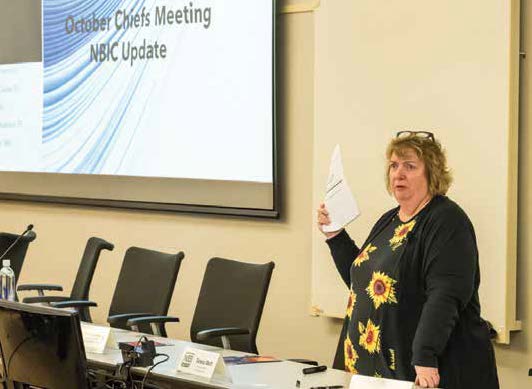
Melissa Wadkinson, vice chair of the Main Committee,
updated jurisdictional chiefs on changes to the 2025
NBIC during the Members' Meeting on October 7 at
NBBI headquarters in Columbus, Ohio.
North Dakota Chief Trevor Seime, who is a member of the NBIC Main Committee and chair of the Task Group Historical Boilers and Task Group Interpretations, said he will review with his staff the presentation PowerPoint and the information packet received at the October Members’ Meeting.
“I find that easier and then answer any questions they may have after reviewing it,” said Seime, who also is first vice chair of the NBBI Board of Trustees.
Oregon Chief Tom Clark, a BOT member at large, said after the NBIC is approved, he puts together a day of training for his inspectors, reviewing each Part and discussing changes and additions to ensure consistency in their approach to implementation.
“Because Oregon is on a three-year code adoption cycle, there are editions of the NBIC that we end up skipping entirely,” he said. “For example, in 2024, we adopted the 2023 NBIC. Our next code adoption cycle is in 2027, so we’ll miss the 2025 edition altogether. However, I still provide training to my staff on the major changes, just not to the same level as with an adopted edition.”
As a member of the NBIC Main Committee and Subcommittee Installation as well as vice chair of Subgroup Installation, Clark said he’s also able to share additional context with his team that “helps us better understand the code and be more effective as inspectors.”
In addition, Ponce’s recent presentation is available to jurisdictional chiefs at the NBBI website nbbi.org. Scribner said education and visual examples could be essential.
“Maybe we need a short online course explaining the different types of closures, showing the mechanisms, so if an inspector’s going out to look at autoclaves, they know what they’re looking at,” he said.
McBee added that although AIAs have internal training programs, an NBBI course would be welcome.
“Our repair inspectors will know about it for certain,” he said. “But I think a National Board training course on quick closures for inservice inspectors would be paramount. That way you’ve got more eyes out there – and more word of mouth to spread that knowledge.”
Kimberly Miller, director of training, said QACs are not on the list of potential future courses, but will be considered if deemed necessary.
McBee said keeping this technical knowledge alive is as important as the revisions themselves.
“My biggest thing is I believe we’re losing knowledge because of inspectors retiring. The younger generation is trying to run this equipment, and I want to help educate them. And right now, the only way I see to do that is through my involvement with the NBIC.”
As the NBIC’s living framework demonstrates, safety is not static. It is built through continuous improvement, shared knowledge, and an unwavering commitment to protecting lives and equipment.
The work of the QAC task groups stands as a model of that process in action: volunteers identifying a critical issue, restoring and refining guidance, and strengthening the foundation for those who follow.
With each revision, presentation, and training effort, the National Board reaffirms its goal to “leave it better” for the next generation of inspectors and industry professionals, one clause, one closure, and one code cycle at a time.
“The reality is if we miss stuff, people could get hurt,” Scarcella said. “It can weigh on a person. We really care about what we're doing, and we're passionate about it. It's because we're protecting life.”
Common Types of QACs and How They Work
Quick-actuating closures (QACs) are designed for rapid access to the interior of pressure vessels or pipelines and come in a variety of designs, each with its own advantages for specific applications.
Here are some of the most common types:
- Bayonet Type: A quick-release mechanism featuring a quarter-turn rotation that locks or unlocks components by engaging bayonet-style pins into corresponding slots. This design allows rapid connection and disconnection with minimal rotational movement.
- Clamp Type (Double Yoke Type): A closure system utilizing two parallel yokes that apply symmetrical pressure to secure components together, providing uniform clamping force and ensuring a tight, leak-resistant seal. The double yoke design distributes mechanical stress evenly across the connection point.
- Lock Ring Type: A closure mechanism that uses a circular retaining ring which slides or rotates into a groove to lock components securely in place. The lock ring provides a robust and repeatable connection method with high resistance to vibration and separation.
- Rotary Lock Closures: A closure mechanism activated by rotating a handle or lever, which mechanically engages locking elements to secure two components together. This design alls for quick and ergonomic connection with minimal physical effort.
- Bandlock Closures: A closure system using a flexible band or strap that wraps around and tightens components, creating a secure and adjustable connection. This method is particularly useful for irregular or nonstandard geometries.
- Threaded Closures: A connection method where components are joined by rotating matching internal and external threads, creating a mechanical lock through screw-like engagement. Threaded closures offer precise positioning and can provide a hermetic seal.
- Tool-Less Closures: A quick-release mechanism designed to be operated without specialized tools, enabling rapid connection and disconnection using only hand pressure or simple manual manipulation. This closure type prioritizes speed and user convenience.
- Yoke Style Closures: A closure mechanism using a U-shaped or C-shaped mechanical element that pivots or clamps to secure components together. The yoke provides mechanical advantage and can accommodate varying component sizes.