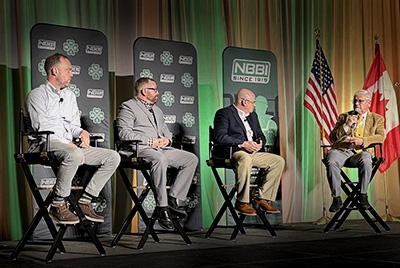
Pictured from left to right are John Siefert, Sean Franklin, David Downs, and Gary Scribner.
94th General Meeting Presentation
"NDE Examiner Proficiency Challenges with Inservice Volumetric Exams"
John Siefert, Sean Franklin, and David Downs
The following remarks were delivered at the General Session of the 94th General Meeting on May 11, 2026. It has been edited for content and phrasing.
INTRODUCTION: Dr. John Siefert, an area lead at EPRI, returned to the General Session stage for the second consecutive year. With more than 14 years of experience in materials and welding research, he has contributed to more than 150 technical publications.
Sean Franklin, a senior program manager at EPRI, supports digital transformation initiatives in nondestructive examination (NDE), as well as industry engagement and workforce development. Prior to joining EPRI, he held leadership roles in the nuclear power industry, bringing extensive experience in inspection, engineering, and operations.
David Downs is a principal engineer and supervisor of metallurgy and material applications with Southern Company.
A panel discussion and Q&A followed their presentation, which was moderated by Gary Scribner, NBBI assistant executive director-technical.
Their slide presentation can be found here.
MR. SIEFERT: Last year wasn’t controversial enough, because they brought us back, right? This year, we’re going to talk about something even less controversial: NDE proficiency. I hope that what you’ll find at the end of this discussion, at least the initial presentation and the following discussion, is that this industry desperately needs this codified. We’ll walk through a few examples of why we think that’s absolutely the case.
Why are we talking about new builds if what we’re worried about is inservice or post-construction inspection?
The reality is multifaceted. If we’re going to build more stuff, which is definitely the case, no matter what article you want to cite, at least in terms of the U.S. capacity that is planned, approved, announced, or in preconstruction, we’re talking about increasing the gas installed base by about 80%.
This is likely to change, but what is accounting for this isn’t just data centers; it’s things like electrification, new industry that’s being on-shored. It’s also other things like chip manufacturing, regional concerns, and residential migration. Even if the data center boom goes away, we’re still going to build a ton of infrastructure.
What it means, though, is that because we need so much more capacity, we’re going to put increased strain on the current nonnuclear and nuclear thermal fleet to maintain reliability and safety of that equipment. How easy is it going to be to do that if this is happening simultaneously? Probably not so easy. Therefore, we have to do it right the first time: Do it once and do it well. That’s part of the thesis for today’s discussion.
This is an interesting way to start. We talked about the really cold stuff to start, and now we’re talking about the much hotter stuff. So, what are we worried about? In the combined cycle plant, this is actually two two-on-ones, but if you look at the footprint for a two-on-one combined cycle plant, that’s two HRSGs making steam that’s transported to one steam turbine. We’re talking about a 500-by-500 footprint or so. Those piping systems usually measure 1,000 to 2,000 feet in length and require hundreds of welds to fabricate.
Those welds are part of the concern, but just beyond the girth welds that are required to piece these systems together, there are hundreds or perhaps thousands of features operating at high temperature inertially in the creep range, which require, in some cases, semi-frequent inspections to help monitor the health and disposition to safety of this equipment for future operation.
What happens then when something fails in a high-energy or HEP system? What is the magnitude of the energy stored by these features? When we talk about small-bore connections, “small-bore” doesn’t mean they’re unimportant. In fact, these are often the connections you need to pay the closest attention to.
We’re talking about a significant release of energy that, in this simple calculation, is 600 or 1,600 foot-pounds of force; this is the equivalent of the typical U.S. Army and NATO 5.56 ammunition, so this is no small potato. In some cases, depending on the size of the small-bore connection, the energy released can be much more than that. But some of these components ejected catastrophically from the plant are never found again, and others are sent tens of feet across the plant, wiping out significant amounts of equipment.
This was mentioned last year: It’s amazing, quite frankly, with the number of failures we’ve seen in some of these sampling connections that no one has been killed, because they often face a walkway. If we had an unfortunate incident where a girth weld or perhaps a long seam weld in one of the high-energy piping systems let go and we lost containment of that steam stored in the system, depending on the pressure of the system, that event could be the equivalent of something like a 500-, a 1,000-, or a 2,000-pound bomb.
The kill radius for a 1,000-pound bomb is 150 feet, so we’re talking about a serious release of energy. That is everything we’re doing to try to prevent that, in part by conducting routine, hopefully informed inspections that rely very heavily on things like volumetrics and state-of-the-art phased-array techniques.
MR. FRANKLIN: The difference between phased array and conventional UT is that a single probe in phased array can sweep multiple angles without requiring all the equipment changeout.
In the days of old, with conventional UT exams, especially on complex geometries, there was a lot of equipment changeout, and time was involved in conducting those field examinations. It’s a bit debated, but around 15 to 20 years ago, the nuclear power industry adopted phased array technology from the medical industry.
Again, the ability to perform these examinations in the field more rapidly was obviously enticing, especially when you’re dealing with nuclear power plants where there’s occupational radiation exposure, but even in extreme environments in a coal plant, we don’t want our inspectors in harm’s way. The difference is nuanced: More data can be good but also challenging.
When you do a sweep using a phased-array UT probe, you’re going to get a lot of material noise, so that’s something the examiner has to deal with. Training is challenging. If we’re talking about people, the availability of highly skilled folks to do these examinations is limited.
John set the stage on the need for these types of folks, which is growing. If we’re building more, then more inspections are required. Folks are retiring. We have a lot of challenges bringing new folks into the industry. Equipment can be more complicated than your traditional A-scan conventional UT.
If I think about 40 to 100 different digital settings you have to set up, more essential parameters – just sheer setup of a phased array UT scope is more challenging. I talked a little bit about how to discern the analysis piece or the indication interpretation. With the presence of all that extra data, there’s a lot of material noise that an examiner has to go through and evaluate. With more noise and more scan information, it becomes challenging when determining the difference between inservice flaws and construction flaws, and that’s where we can get into trouble.
In terms of proficiency, being proficient in an activity means being skilled and competent at executing a task. When I think about nondestructive evaluation, what does that look like? We can operate a procedure. We understand and maintain compliance with the practices in procedures. We’ve demonstrated we know how to pick the right equipment and set it up appropriately. We know how to do our calibration. All the preparation activities involved in developing scan plans. A basic understanding of what I’m going to examine; I know how to find it, whether it’s creep damage, whether it’s a lack of fusion. Then, certainly last, but not least, when I do detect something, can I interpret it appropriately and document it? Those are key features of what it means to be proficient when conducting nondestructive examinations.
Based on our research, there’s an absolute lack of industry proficiency, leading to increased risk. We have components being cut out that have no issue. We’re missing flaws in the field. Now, I’m going to turn it over to David to give you a little bit of a member perspective or somebody at a utility that has to deal with this, but those things can be costly and create more safety issues.
MR. DOWNS: I’m going to share two examples with you. Southern Company really started to make us aware that we need to focus on our phased array program and improve it. One of these examples was about seven years ago, and another was just this spring.
This first example was on a 900-watt supercritical unit. This is main steam piping, and the wall thickness was about six inches. The connection you see on the right was the main steam piping connection to a large Y-block forge.
Two years previously, we inspected this weld and found it to be fine. There were no indications noted. Two years later, in 2019, we went to look at it and found a 3-inch-deep crack in the mid-walls, so it was not connected to either the ID or the OD. As you can see by the representation here, it actually went around the circumference.
Knowing it had been two years since we inspected it, and it’s really not possible to develop that damage in a two-year period. We cut a bolt sample from this and determined it was creep. So, this brought up another question. If we missed this crack, what else did we miss on this unit?
We ended up broadening the inspection, inspecting six different welds and found six similar cracks. The unit was offline for approximately a month trying to fix these cracks. As you see in the takeaway box, we talked to the technician in question from two years previously, conducted an in-depth review of his equipment and techniques, and found that the techniques used with that equipment would not have found that damage. This was a technician we trusted to conduct inspections around that time.
This next example is in HRSG. It’s an emerging area for us at Southern Company and elsewhere in the industry. These are HRSG end caps, and they’re different designs. One of the designs is a flat end cap. If you look internally, there’s no radius. It’s a sharp corner, so it’s just conducive to developing damage, but the damage tends to initiate on the ID, so you cannot see it. You have to use phased array to inspect for that damage from the OD surface. While we initially didn’t think this would be difficult to inspect for, our service history has shown that it is very difficult to inspect for. You need the right technician using the right equipment to find it.
The picture on the right side is a leak that we had in 2017. You can see the length of the crack around the circumference. Obviously, that raises the possibility of the component potentially coming off with pressure. In this case, it did not. You can see the condensate leaking out from the crack.
The crack in question, the HRSG end cap, was inspected about two years ago, but since then we’ve learned some lessons about the techniques vendors use to inspect end caps. We learned those lessons on other units in the system. Because of that, we went back to that unit that had been inspected in spring 2005.
We sent off the right-hand corner acceptable for the end cap that’s in question. We inspected that end cap and asked the vendor to use the new techniques we had learned since then. You probably don’t have to be an NDE technician to see the large red streak going from the ID to the OD. This crack was 10 inches in length. It was a few thousandths of an inch of the OD surface. I believe this probably would have leaked this summer.
This outage was extended by days, so it cost a lot of money. You have to bring in welding labor and cranes because these modules are so close together. You have to cut one module loose and lower it to access the OD surface. Obviously, you have the lost power considerations. So those are two examples I have.
MR. SIEFERT: That’s some horror stories from one end user-owner, but David’s experience, unfortunately, which is why we’re here, is not unique. There are many stories like this, and they happen every time we get together.
Again, this whole proficiency initiative is really to try to change where we’re at, in part because the stuff we’re running is indeed complicated. I would say it’s quite miraculous. You can have a tractor powered by steam that’s pretty reliable. The fact that these units are 85% reliable or more is also a modern feat of engineering, but if we look at the two items in piping systems that we’re generally most concerned about, the main steam and the hot reheat system, again, for a two-on-one configuration, it’s just two HRSGs carrying steam to the steam turbine. In this configuration, we’re talking about systems more than 600 feet in length that can weigh upwards of 150,000 pounds of steel.
As I mentioned before, the number of girth welds we’re talking about, at least in this case, is about 235; about a third of those would be done in the field, and two-thirds or so would be done in the shop. That changes in some cases. It’s a bit worse than that, but we’ve seen issues with both field and shop welds.
Before I hand it to Sean, I’m going to talk about the girth weld inspections, which in my view are horrendous. We’ll talk about why the tee inspections in some of those tee intersections that we’re inspecting are equally horrendous, because this is the pretty basic stuff that we just need to get better at, and, quite honestly, probably needs to be included in proficiency.
This story is pretty simple. It’s two parts. I was here last year talking about emerging issues, with tees being one of them. EPRI has had the luxury of collecting data from about 400 tees across the world to put into a screening database. As part of that, we ask for inspection data to see what’s been done. And included typically in that is a very rigorous thickness inspection.
If we start on the right, and for the database we have, we can tell you that 40% of the readings of the tees that have been provided to EPRI – 40% of that population have had discrepant readings for UT thickness measurements. That’s not phased-array girth welds; that’s relatively simple, straightforward UT thickness measurements. So that’s a problem, but it’s worse than that.
A colleague of mine went on site because this tee on the left had a leak, and it was one of the first ones, so we were interested to inspect it in the field and provide our own perspective. The minute we got to the tee, because this was on the coast in Florida, this was already improperly labeled. North should be east, but as soon as we walked up on this, it was a problem because what we find is that if we label plant north or true north or upstream and downstream, if we get those things wrong and then we tell David, “Hey, the crew found something in the downstream girth weld that was the field weld on the main side, go repair it.” And it’s flipped, what happens?
You’re going to repair two welds, right? And hopefully you don’t have a leak in the process that brings the plant down. But this is basic stuff. And we’re not getting this stuff right to the tune of at least 40% of the tees in our database.
MR. FRANKLIN: We’re not hitting it out of the park. One of the parts of the EPRI program that we’ve done a lot of studies on and that are important to operators is assessing girth weld exam proficiency. This is just a 12-year review; half the time we’re getting it right. That means folks are coming into our shop, they’re getting some preparation activities done up front, they go do their proficiency exam on a blind sample, and we’re about half the time with a passing result.
There are a couple of nuances in the day; the COVID year in 2021 when we didn’t have a lot of attempts. We made some changes to the program in 2015, as well, that sort of skewed the data, but by and large over a 13-year period, we’re getting it right half the time. That’s not good.
When we’re talking about high-energy components with extreme safety concerns and, quite honestly, between the keynote speech (from Charlie Morecraft) and the team from CNA (Benjamin McKay and Stephen Kapnis), I thought they established and teed this up for us – the results matter. If you’re paying an outfit to come into your plant and when we do a blind assessment they only get it right half the time, that’s a problem, because all that data feeds into all the other evaluations and things we need to keep the plants safe.
We recognize that there’s a digital aspect of a phased-array UT scope that can be set up ahead of time, but it creates challenges. We have folks going out who don’t understand how to get through all those setups. The demand for people is at an all-time high, and John certainly articulated that it’s only going to grow.
Our proficiency program at EPRI is just testing a fraction of the folks who are out doing exams. API has their own in the petrochem industry, and some utilities maintain their own. I’m not here selling you on the EPRI way. I’m just telling you the folks that we’re testing, at least for girth welds, are only getting it right half the time. That’s not acceptable. We should not be OK with that.
If I think about all the critical high-energy component exams we’re doing, we have to make a change. We have to train our staff. We have to make sure they understand that before they go out to do an exam, they know what they’re looking for and how to find it; they’re able to adapt to a change in field conditions; and they can move across the industry and get it right the first time. Enhancing training and establishing proficiency requirements will be essential if we want to improve safety and reliability of our units.
We’re taking some actions. We’re partnering with the National Board. John made mention of a BULLETIN article we released and helped publish last fall. We put another one together talking about more specifically NDE proficiency. It just came out a couple weeks ago. We’ve established a task group for NBIC Part 2 to establish minimum requirements for phased-array examiner proficiency.
The task group met twice, and in July we’re bringing a proposal to the NBIC Committee Meeting in Salt Lake City on what that’s going to look like. At least within EPRI, we’ve made some changes to our program. We’ve heard the feedback. We told you there’s a training issue. We’re putting training into the fold. We actually did a pilot on the tee inspection training course late last year, and we’re building out more training modules for the different components that you can come in and do an assessment of, but there’s more that needs to be done.
We all have to come together and figure out what’s the best way to tackle this. And I think with that, Mr. Scribner is going to come up. Something I’m excited about is hearing your feedback, hearing your questions, what challenges you have, because if we’re all not working together, we’re not going to get those code changes through and we’re not going to make a dent in the problem.
MR. SCRIBNER: This is very important to me. I had a conversation with the owner of a small NDE firm in January of 2019. He voiced some concerns about the inservice phased array and its results, but he had nothing to back them up.
In early December last year, I went down to EPRI to talk about some NBIC additions we’re working on, and they added NDE to the list. I really went in blind to what I was going to see. When they got to the third slide showing the results of some of the testing, I had to stop.
I came back to the office and started calling people at big mechanical firms and everything, asking if they were aware of this. It seemed like everybody was aware of it. So, my first question to the panel, before I open it up to everybody, is: If everybody knows about this, why aren't they talking about it?
MR. SIEFERT: It’s an inconvenient truth. The first reaction to some of this is that no one wants to admit they’ve done a bad inspection and no one wants to have to repeat that and spend more money. But the other half is that Sean showed the statistics, and there’s more to show you if you want to see more; half don’t know they’re doing bad inspections. That’s equally alarming.
MR. FRANKLIN: There’s a cost associated with it, and it’s going to take work. There are certainly nuances regarding initial certification and the training a newbie in the field receives in assessing construction-related fabrication flaws, as well as the differences between examining and analyzing inservice flaws. I think that’s a big piece of it. And there’s a lack of code rules that are pushing folks to elevate their game.
MR. DOWNS: As John said, I don’t think the technicians believe they’re doing anything wrong. They may come to a plant site and never go back, or it may be years before they do. The people could work there 10 or 20 years, or it could be two or three years, meaning the feedback loop of information may not make it back to that technician to let him know that he missed something five years ago.
MR. SCRIBNER: Sean, what’s it going to take to get meaningful inspection results from phased array for inservice?
MR. FRANKLIN: It starts with training and creating a platform where folks can go and learn the base-level knowledge and what it takes to examine these components. There are unique geometries and essential variables that need to be dialed up to get accurate results. I didn’t get into some of the nuance relative to material noise and things, but there’s a lot of post-processing that has to happen with phased array.
When you’re trying to discern between material noise and what a true flaw is, there are things you do on the back end. If you do it inappropriately, you’re going to make the wrong call. You’re going to overcall things. We have operators who are cutting out perfectly good components. They’ve sent it to us for destructive analysis, and there’s nothing wrong with those welds.
David certainly articulated the case where we missed something, and that’s the real problem. Those are real safety concerns. Those components are in places where our teammates walk every day. We can’t be coming back here saying we need to make the code change after an incident happens. We need to be proactive in that.
MR. SCRIBNER: David, could you give me a perspective of the cost of having this testing done with improper results?
MR. DOWNS: The first thing is safety. As we heard this morning, that’s the worst possibility. Aside from that, in terms of costs, the NDE testing itself may only be a fraction of the cost of doing the inspection. We’ve tried to add that up. NDE testing itself may be, say, 15-20% of the total cost. You’ve got scaffolding, insulation, pipefitters, cleaning, putting all that back together, so just the cost to reinspect is high.
Also, if you do have a leak, the cost of replacement power depends on the unit, the time of year, and the situation. If the unit is off for several days, that could end up costing hundreds of thousands or millions of dollars in power.
MR. SCRIBNER: We’d like to open it up to the audience now for questions.
MEMBER: David, for the two examples you showed us, do you feel the imperfections were due to fabrication?
MR. DOWNS: No. We were able to get bolt samples in both cases, cut those open in the lab, and verify that it was creep damage, which was inservice damage or fatigue damage with creep that cracked up. That happened inservice.
MEMBER: The other question I had was I’m with an insurance company and, of course, we ask questions. We don’t actually do the exam. We look at the reports, and we make sure they’re doing it. What kind of advice or training or education could you provide us so we can provide our staff to make sure we’re asking the right questions and holding people accountable for doing the right kind of exams for the application? That would be beneficial because we’re in a lot of facilities with high energy.
MR. DOWNS: In terms of training, one thing that means a lot was the NDE technician. Was he trained for code exams for fab walls and not for inservice damage, because his mind works totally different? I’ve heard technicians say, “Well, the crack is not connected to the ID or OD, or the indication is not connected. Well, it’s not really a crack.” That’s just not the case, and he doesn’t think he’s doing something wrong. It’s just that’s the way he was trained, or he thought he was trained for code exams.
MEMBER: When you have all this high-energy piping in all these plants, they’ve been inspecting it, they’ve been doing everything they’re supposed to do, so what do they do now? They can’t trust anything they’ve done in the past. Code changes and training will take years. What are we going to do in the meantime? Are there any options to do anything different now to kind of stave this off?
MR. FRANKLIN: That’s a great question. First, I hope it doesn’t take years, but “hope” is not a strategy, right? And I wouldn’t say everything that’s happening in the field is bad. I would tell you the early mitigation actions are all about your preparation activities. We talked a little bit about the expense of doing field exams. Where I see and believe we need to ratchet up our game is all the preparation activities leading up to an exam.
I put together just a few bullets of what we’re forming into our code action. It is quite simple. There aren’t a ton of technical details in a checklist for the preparation activities of a few key bullets. And it was on the previous slide. We’re an option for you if you want to send inspectors through, but there aren’t many options that have good, robust programs. API recognizes a few of their members' and code users' programs as very worthwhile. There are options out there, but our goal is to push this code action, establish the minimum requirements up front, and potentially follow up with a supplement providing more detail.
Again, we need to make a change now. There are a few key bullets up front that you could be doing in your exam preparation activities and allowing those folks that are coming in to do those exams, allowing them that time to get it right up front.
MR. SIEFERT: The other aspect of this that is really important is that because we relied almost solely on inspection in a lot of cases, a lot of stuff we’re inspecting doesn’t need to be inspected. It just doesn’t; it’s not high risk. It’s done because of ignorance, quite frankly. Some of the work that we’re doing now, also through EPRI, is to help provide a screen or prioritization framework so that when you go to the plant and you record the plant in process, you’re making sure that you’re actually addressing what the high or highest risk locations are and using repeat inspection in those locations to help gauge the health of the system. Much of what we’re inspecting, quite frankly, doesn’t need to be inspected, but it’s not written that way.
MEMBER: I have kind of a unique insight into some of this as a chief boiler inspector in a jurisdiction and also as someone who has two sons in the NDE business, both in management positions that they’ve risen through as technicians.
I’ve got experts in the family to ask things about, but what I see out in the industry when I visit different places that are employing and hiring NDE companies to come in and provide services, the one thing that has my mind spinning is that 40% or 50% failure is absolutely absurd. That’s dismal.
Why aren’t we talking about doing what the nuclear industry is doing and having Southern Company have an approved vendors list and have task qualifications on their approved vendors before they send them out into their plant to ensure, and not just hoping, that people they hire come in and ask to provide what you asked them to do. It would seem to me that that would be really low-hanging fruit. It might drive up the cost of the inspection, but you’re most likely going to get a better inspection. It’s not a question; it’s just a comment, and it strikes me that that would be helpful.
MR. DOWNS: One thing that complicates it is that it seems the skill set is tied to the technician’s. One thing I’ve seen is that technicians will jump from company to company depending on what’s happening in that company and their experiences. So you really need to tie into that technician, because he’s the one who carries the skill set in his or her head.
MEMBER: And the task qualification part, too.
MR. DOWNS: Yes, and the component.
MEMBER: I know you’re talking about a specific circumstance, but it was interesting in one of the slides you mentioned that it was UT testing. I think what you guys have stumbled across is something that, if you do any type of digging, we’re seeing across the board with all types of different testing, IR, vibration, everything, so I was just curious as to what your insights were.
I understand this is a specific situation, but why is that occurring? I would say across the industry, when I look at review vibration testing or transformer testing or even infrared testing, I’m finding a lot of false positives and a lot of missed analysis not being completed properly.
I’m curious what your insight is on this specific study in the broader aspect of NDE, and whether we’re actually looking at the broader aspect of NDE. As I said, I noticed just UT and you sort of jumped over that slide, but that’s just as scary, even more scary because it’s a basic test. If we can’t get the basic stuff right, how could we possibly get the more advanced stuff right? I’m curious as to your insights on that.
MR. FRANKLIN: Eat the elephant one bite at a time. I would tell you we have seen challenges across the board with NDE examiner proficiency alone. It’s certainly, from our study, more prevalent with phased array, just talking through some of the bullets that we had, but it’s making sure sufficient training exists; that’s what I would say. Yes, it exists, but we can’t tackle the whole beast at once.
MR. SIEFERT: You’re right to be skeptical, and everyone in this room should be skeptical of services. It doesn’t matter who it is. You should be skeptical of me and ask me what my qualifications are to provide advice. However, to your point, I'd take it from the metallurgist’s perspective. We can do really good NDE. We can find the damage. We can pull out bolt samples or scoop samples or any kind of field sample. If it comes to my lab and my staff misidentifies the damage mechanism, you’re in a whole other set of problems.
I would say from our side, because Dave and I looked at a lot of failure analyses, that industry is hurting as well, so it is across the board. If we don’t do something together as an industry to raise awareness of these things, be invested in the training together, and be prepared to pay for it at all levels, everyone in this room is going to suffer. It’s just a fact.
MR. DOWNS: As an end-user like me, you need to recognize that this isn’t something you can just bid out and go with the lowest bidder. It’s not a commodity.
MEMBER: I can’t tell you how excited I am about what you just did. I mean, you guys have taken out of the nuclear industry, another industry that needs to know what’s going on in the NDE world, and you’ve done a study on it. I chaired the center for 10 years working for TBA, and we went through really bad times, gathered a lot of data for the NUCs, and our pass rate was 50%. For 30 years, we conducted round-robin studies and got components out of plants that were failing. Southern Company was part of the deal, which helped us do that. And we come up with, and it lives to this day, 50%.
The other thing that doesn’t make sense, but it’s good data, is we implemented the performance demonstration initiative, Section XI. And since ’92 is about the time we started that and until this day, our industry, our ultrasonic guys that go into EPRI to take that test, pass rate is 50%. We can’t get that pass rate up.
What does this say? You’ve used those words as you were talking. What does that mean? What are we going to do about it? It is the process. What we figured out on the NUC side when we were working on it was that we built this ANDE-1 thing to ASME standard, threw out the time-basis stuff, and used info and best practices that are used to qualify and train plant operators, engineers, and all them. We got it ready for NDE.
I certainly hope we get together to work to pull that off, but at the end of the day, I think this is an awesome day. Now we can come together. It doesn’t matter what kind of pipe. The pipe doesn’t know what’s going through it, right? It doesn’t know if it’s nuclear stuff or steam or just water or what, so we need to stop it all from leaking, putting people in harm's way.
MEMBER: I just had a question about quantifying the 47% efficiency rate. Do you attribute that to calibration? Do you attribute that to test technique? Do you attribute that to interpretation? I’m just curious if you guys ever sliced that into pieces to find out it’s probably this or that.
MR. FRANKLIN: We have staff that has dug into that. We made improvements to the program because of it. We added the training offering up front because of that and a lot in the setup to be direct to your question. There are significant challenges with folks that go out to the field; preprogram scopes that are ready to go that somebody set up for them. If it’s not set up to the exact damage mechanism they’re looking for with respect to the geometries that they’re scanning, they’re going to have problems. Therefore, it’s all in the setup and preparation.
MEMBER: So given the track record is not exactly the best, and I realize that at 45, 50, or 51%, why stick with NDE? Why stick with UT? Why not do another sort of NDE like RT or something else like that, provided there’s room to get in there to do that? I realize it’s a cost factor, but wouldn’t it be still cheaper or less expensive to do that RT or whatever else versus replacing it, yanking it out?
MR. DOWNS: It depends on the damage mechanism. Some of these cracks are so tight that they’re not conducive to being found with RT. You really need to do it with phased array.
MEMBER: If it’s an internal crack, ID and OD, you’re not going to see it visually, but if it’s an external crack, whether it’s inside on the ID or outside on the OD, what about PT?
MR. FRANKLIN: It’s got to be surface-breaking to utilize PT, MT. We need to find cracks that are putting water on the floor. The industry is largely moving away from RT for a variety of reasons. There are a lot of challenges related to the setup, and there are conventional hazards associated with RT. It is good in certain applications, but when we’re talking about inservice degradation, UT, from our research, is still the best.
MEMBER: Wouldn’t it be less expensive to look at something else instead of yanking that thing out or running a risk of it failing catastrophically?
MR. FRANKLIN: Yes. We’re doing a bunch more research on advancements in radiology. We’re kicking off a project late this year or early next year to explore all the advancements that have come out in the last five years. We are negligent in that research. We’ve piled in heavily on the UT area because of our members telling us they don’t want to shut down half of the plant to do an RT shot. They’ve asked us to move away from it. We are going to explore that a little bit. I can’t give you specifics because we’re behind on some of the improvements that have occurred over the last five years from a technology standpoint, so that’s something we’re looking into.
MR. SIEFERT: If you take this one step higher, we should be asking the question: How much inspection should we be doing in addition to what techniques are valid? And that’s also part of the calculus now: To say 90% of your life management activities are dominated by the inspection side. What if that was 60 or 70%, and we used that data to conduct more rigorous analysis, assessment, and discussion of the high-risk locations to help refine what should be done. I would say we’re doing a lot more up-front due diligence now, with everything we know, to hopefully find that needle in the haystack, because that’s what we’re trying to do.
MR. SCRIBNER: I have a question, and it’s probably more for you, Sean. Most of the chief inspectors here only do inservice inspection. Can you explain the difference between new construction NDE or phased array and Fitness-For-Service NDE?
MR. FRANKLIN: It comes down to the setup – how we establish calibration and set the scope up. If I’m going out to find creep damage or a stress corrosion crack, and I have a set of essential parameters and generic procedures that tell me how to do that, then more generic fabrication flaws show up differently in the scans. That’s probably the best way I can describe it without going into too much technical detail, but it’s all about the setup.
MR. SCRIBNER: What are they really looking for in new construction?
MR. FRANKLIN: Lack of fusion, poor welds. A lot of that can be found through radiography. It’s a better technique in that respect, but it’s quite a bit different in all the analysis piece on the back end, the difference between inservice and construction code.
MR. SCRIBNER: Let’s add Fitness-For-Service to it, because with a lot of aging plants now sticking around even longer, isn’t there more technique the operator needs to do a Fitness-For-Service evaluation?
MR. SIEFERT: That’s true. We try to break this down into detection sizing. I would say that’s probably a distinction for the new construction side. When you’re doing post-construction inspection, half the size indications, because if you don’t, then obviously you can introduce risk you didn’t anticipate, or you can completely make the wrong call on whether you need to repair, replace, or you could actually run the component as is in the first place. So that sizing piece, really understanding what is there and how much of it, becomes absolutely vital.
Again, if we’re doing Fitness-For-Service, a big part of this is reactive: I found something; hopefully I sized it; I put that into an analysis that then gives me some warm fuzzies to continue operation if that indeed is what the analysis suggests.
MR. FRANKLIN: But the difference between an A scan and an S scan and phased array is there’s a lot of single compression and things that happen on the back end to try to get rid of some of the material noise, and that’s where things can get a little tricky.
I showed a slide earlier. We’ve done some studies over the years to look at what best practices are when doing those exams. I think there was a link in one of the slides that tied to some of our publicly available research, but it is nuanced, especially in the analysis portion. And if you don’t get it right, you’re not feeding the right data into those Fitness-For-Service evaluations, you’re cutting out good pipe, or you’re missing flaws.
MR. SCRIBNER: Thank you for your time. I think it’s good people are talking about this. If we’re not providing meaningful results during any type of inspection, what are we really doing? If we can’t answer that question if we’re doing meaningful results or not, I’m not sure what we’re trying to accomplish here.
Every one of us here would agree this is about safety. So, we should all be thinking about this, and hopefully the NBIC will move along with your task group and see what that looks like for inservice.