Two boiler explosions in Massachusetts in the early 20th century helped set the industry on the path of standardization of boiler and pressure vessel code and periodic inspections.
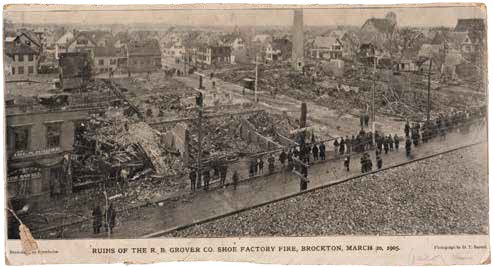
On March 20, 1905, a firetube boiler exploded at the Grover Shoe Factory in Brockton, killing 58 and injuring 117, highlighting the need for stronger boiler laws. On December 6, 1906, a boiler at the P.J. Harney Shoe Co. in Lynn exploded, reportedly killing two. This spurred Gov. Curtis Guild to call for significant changes, and the Massachusetts Steam Boiler Act, a stronger boiler inspection law, was passed in 1907.
Massachusetts’ new law became the template for boiler inspection programs for several other states. It also was the starting point for the American Society of Mechanical Engineers Boiler and Pressure Vessel Code, first published in 1915.
During Gov. Guild’s inaugural address on January 3, 1907, he advocated that all steam boilers be inspected annually under the “direct control and supervision of the commonwealth.” The subsequent rules, however, recognized and leveraged the good work boiler insurance company inspectors were already doing. The regulations required periodic inspection of steam boilers and for “boiler insurance companies to make a report to the state department of every boiler inspected by them.”
Details related to boiler ownership and location and information about the boiler’s current condition were needed to exercise jurisdictional control. The current NB-6/7 forms found in the National Board Inspection Code (NBIC) are not dissimilar to those used before 1926, which required those details.
The forms were developed for inspectors to communicate information related to boiler inspections, both initial and periodic, and equipment details such as boiler numbers (jurisdictional, National Board, and serial), Manufacturer, year built, use, type, and material. Information related to its location, owner/user names, and addresses was also captured. Today, this information is called location, equipment, contacts, and inspection data.
The long form required inspectors to capture extensive details about the boilers that could be compared to the Manufacturer’s Data Report (a boiler’s birth certificate) by the jurisdictional office in an effort to double-check the work of the shop inspector and was completed during the first internal inspection. Quite a bit of unhappiness likely arose if defects were found just before the owner was about to fire it up and start production. The need to repair a new boiler in the field is never popular. This situation, ensuring only code-compliant boilers left the shop, was never much improved when the method was to counsel or sanction the resident inspector. What did help were formal quality control programs, conformity assessment teams visiting boiler manufacturers, and holding the inspector’s supervisor accountable for the actions of their inspectors that were implemented in the 1970s. Conformity assessment teams helped ensure code requirements were being satisfied by the certificate holder through visits tied to accreditation renewal. That and additional training for Authorized Inspectors and their supervisors all worked to minimize manufacturing problems in the field.
Managing the Document Workflow
A system to identify post-construction and maintenance defects was also needed. At the National Board's (NBBI) fourth annual General Meeting in Chicago in 1926, Charles J. Manney, chief clerk of the Ohio Boiler Inspection Department, described the state’s system of tracking periodic inspections, invoices, communication with boiler owners, and maintaining boiler records. The system evolved over 15 years, beginning in 1911, when Ohio’s enabling boiler inspection statute and rules were enacted. The system focused on five metrics:
- Simplification
- Checking manufacturer’s data and field inspection reports
- Recoding and filing reports
- Bookkeeping to track any required fees
- Accuracy
The workflow started with the Manufacturer’s Data Report, progressed to installation and subsequent periodic operational inspections, and ended with the boiler decommissioning. Early on, shop inspectors had to hold certifications from states such as Massachusetts and Ohio where the boilers could be installed. Designs and plans had to be approved, and boilers were stamped as OH STD, for example, before entering the state where they would be installed.
The advent of National Board registration provided welcome relief to boiler manufacturers as it allowed them to manufacture boilers for stock. Most boiler users benefitted from the fact that those stock boilers were built to recognized and accepted uniform safety standards and could be delivered quickly and at a lower cost. Boilers built solely as Ohio standard compliant were still permitted but didn’t have the universal appeal.
For example, once a boiler was installed within Ohio’s jurisdictional boundaries, NBBI would send the NB-registered Manufacturer’s Data Report to Ohio’s central office. A local inspector then performed a first inspection on the long form, including issuing a unique Ohio jurisdiction number for post-construction tracking. The report is then mailed along with appropriate fees to the jurisdiction.
Jurisdiction numbers were assigned serially so that they would not be duplicated. Inspectors were assigned groups of numbers to be used. Before the numbers are released, a temporary card is created for each number, naming the insurance company it was assigned.
When the first inspection report was received in the central office, the temporary card was pulled, and a permanent card was created. Then, the boiler’s location, owner, physical characteristics, and inspection details were recorded. The cards were filed alphabetically by owner name, and the inspection reports were filed separately by jurisdiction number.
Color signals on the cards, such as red, were used for boilers requiring repairs before a certificate was issued. Violation letters were then issued at fixed intervals until a report was received that repairs had been made, at which point the red signal was removed and a certificate of inspection issued.
After the first inspection, a short report form can be used “with only enough information on it to properly identify the boiler. … This reduces clerical work for the inspector,” Manney said. Long forms and card records are retained, but the short forms can be discarded after a few years. The corresponding cards are placed in an out-of-service or out-of-list file for boilers that are no longer in service.
The central office also produced documents such as “Legal Notice for Boiler Inspection Past Due,” “Certificates,” and invoices for when the inspector did not attach the certificate fee to the inspection report. Each time the insurance on a boiler changes, the long form is used as a doublecheck of the prior inspector’s work. “Accident Inspection Reports” were also used in the event of a boiler explosion, including explosion details, the number of lives lost, injuries, and other pertinent details.
These cards were essentially a database record. Over time, mainframe computers used by insurance companies and jurisdictions could marry the card and inspection forms. Moving forward 50 years, at the May 1982 meeting of the NBBI Board of Trustees, R. E. Muise of the Advisory Committee referred to Form NB-7 on page 223 of the NBIC indicating that, in some instances, the form was not suitable for generation by computers. Muise agreed to review this matter and submit recommended changes.
The ability to produce preprinted inspection reports for use by inspectors helped streamline the process by completing form fields related to owner, location, and equipment data. When I began my career in the 1980s with The Hartford Steam Boiler Inspection and Insurance Company, I would receive in the mail at home a foot-high pile of preprints monthly for boilers coming due in my territory. The report had three color-coded layers – green, yellow, and pink. I would insert carbon paper between the layers, and if I pressed hard enough with the right style pen, I would have my inspection notes on three copies.
I would validate location and equipment information as needed, correct prepopulated information using a single-line strikeout, and neatly print the corrected information. Inspection details, note conditions, and violations would be entered as necessary. The yellow copy was for the customer, and the pink was for my records. The original was sent back weekly to the office so the staff could update the database.
From those inputs, a compilation of all the inspections performed by company inspectors for a specific period would then be provided to the appropriate jurisdiction. Loss prevention reports or letters used exclusively by the company could also be created and provided to the customer as required.
By the 1990s, landline computer workstations allowed inspectors to enter inspection information directly into a company database. If used at all, the form was used to help an inspector identify equipment and take inspection notes for later direct input into a database. A copy could also be provided to the owner to provide inspection results of a given inspection.
Boiler databases provide management information that can help identify equipment trends and staffing needs. The need for various customer contacts tied to locations and equipment has been recognized and has become a standard field in software developed to manage the boiler inspection workflow. The additional information has enabled efficient scheduling of inspections, payment of fees, and distribution of certificates, violation notices, and other communication.
Today, many jurisdictions require electronic transfer of inspection information directly to their electronic systems without ever seeing a paper inspection report. This saves time from having staff manually key information from inspection reports into the jurisdictional database. It allows jurisdictions to perform quality assurance checks on submitted information in real-time, greatly improving the time to process inspections while the boiler owner receives timely correspondence and, ultimately, their certificate of inspection in an expedited fashion.