Mark Jordan
Kentucky Chief Inspector
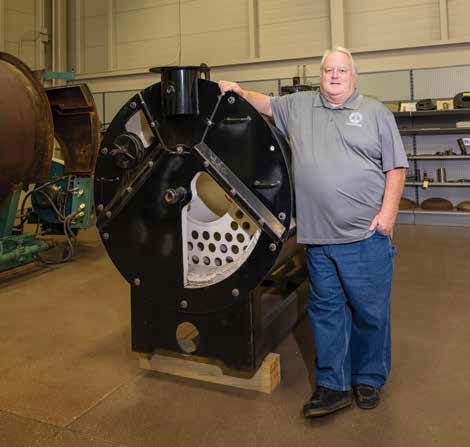
Mark Jordan stands in front of a Scotch
marine boiler at NBBI's Inspection Training
Center. The boiler was donated by Ware,
Inc., a transaction Jordan helped facilitate.
Mark Jordan’s love of steam engines started in his childhood and never wavered.
What began as a simple fascination with a model train set he received for Christmas as a toddler grew into a lifelong pursuit that carried him from his hometown of Ceredo, West Virginia, to becoming chief boiler inspector for the commonwealth of Kentucky.
Jordan, 60, has spent decades working with steam engines and has owned as many as seven Frick engines and currently has three. His journey is a testament to the enduring power of following your passion.
“I quickly learned I liked trains, and I started playing with model trains,” said Jordan, who lives in Louisville. “I still do, but on a more adult scale now.”
Summer vacations in the family’s Volkswagen camper deepened his early curiosity. Each trip included a ride on a steam train, often at the Cass Scenic Railroad in Pocahontas County, West Virginia, where relatives lived.
But it was an experience at a festival in Huntington, West Virginia, when he was in seventh grade, that solidified his passion. There, he encountered a Frick portable steam engine, and unlike others his age who might have merely observed, Jordan stayed behind to learn, and he even got the chance to fire and run the engine. It became clear this wasn’t just a passing childhood phase.
During his teenage years, Jordan immersed himself in the world of steam engine restoration. Using money earned from cutting grass, with a little help from his father, he “rescued” a Frick portable steam engine from a collapsed sawmill. Through this project, he gained a wide range of skills.
“I spent much of my high school years learning to be a boilermaker, pipe-fitter, engine painter, mechanic, and so forth,” he said. “And by the time I finished high school, I had an operable steam engine.”
He laughs about being “the weird kid,” but his fascination with steam power now had become a full-fledged commitment.
Even while he was in college, studying mechanical engineering at Georgetown College and the University of Kentucky, Jordan never strayed far from steam engines as he still attended shows, connecting with like-minded enthusiasts and mentors who helped deepen his understanding of the machines.
“When I finished college, I went into the tourist railroad world,” he said, starting his career as a volunteer at Bluegrass Railroad Museum in Versailles, Kentucky.
Jordan later worked at Queen Anne’s Railroad (serving Delaware and Maryland) from 1992 to 1997. His career path progressed as he became general manager for Big South Fork Scenic Railway from 1997 to 2004.
The transition to boiler inspection came unexpectedly but felt like a natural evolution.
“I had just purchased a Frick traction engine when I was working at the railroad in southern Kentucky, and I wanted to have the engine inspected as a condition of purchase,” he said.
The repair team that had completed the work and the Authorized Inspector who signed off on the project were also present at the meeting. Jordan took the lead, showcasing his expertise and leadership abilities. Impressed by his knowledge and confidence, those in attendance encouraged him to apply for a boiler inspector position with the commonwealth.
Jordan did so and was hired in 2005, a move that would define the next phase of his career. He learned how to inspect modern commercial boilers, but his knowledge of historical boilers gave him a unique start.
“My credentials to be an inspector came from my learning doing historic boilers,” he said. “I didn’t come from the US Navy; I didn’t come from a professional union hall, a pipe-fitters background, or a modern-day commercial background.”
Jordan, who has an IS Commission and an R Endorsement, became the chief boiler inspector in 2015 and oversees eight inspectors when the department is fully staffed. He describes his daily routine as far from typical, a feature of the job he finds especially appealing.
“Half of my time is spent in the field working as an Inservice Inspector for new installations and existing inspections, which means a lot of my chief work is done in my car while I’m in the field,” he said.
A major perk of the job, according to Jordan, is the unique settings he encounters. From inspecting autoclaves in surgical wards to walking through distilleries where he was “overwhelmed by the smell of fresh bourbon,” no two days are the same. One experience that stands out is performing inspections inside the Kentucky State Penitentiary in Eddyville.
“I’ve done inspections in the state penitentiary several times,” he said. “I remember walking out the main front door the first time after doing inspections there, thinking, ‘This is weird. I get to walk out the front door, which all these people behind me can’t do.’”
In addition to boilers and pressure vessels, inspectors in his jurisdiction are also responsible for piping systems.
“We inspect all types of piping beyond the boiler systems, including external piping,” Jordan said. “This encompasses steam systems, hot oil systems, anhydrous ammonia systems, compressed air systems, and hydraulic heating systems across all properties and buildings under our jurisdiction.”
Given his experience, Jordan also handles inspections of historical boilers, often bringing another inspector along for training purposes.
When asked about keeping up with evolving technology, Jordan emphasized the continuous learning aspect of his role, which he called enjoyable and challenging.
“A lot of it is on the job, and a lot of it is learning online,” he said, adding it’s important to stay current with the technology because his staff, contractors, and engineers reach out, relying on his expertise. “It’s always been a learning curve, and I guess it continually will be.”
He pointed to the increasing importance of non-destructive examination (NDE) techniques as an area where he has had to adapt.
“I’m not an NDE expert, but I’ve had to learn several of the applications and types of NDE being used,” he said.
Despite the challenges, Jordan finds fulfillment in his mostly anonymous yet critical role in public safety.
“When someone asks me what I do for a living, I tell them I’m the invisible person that helps keep you safe,” he said.
For Jordan, the reward comes from knowing that things are being maintained and operated safely and that he has contributed to that outcome.
Beyond his inspection duties, Jordan is a member of the National Board Inspection Code (NBIC) Task Group Locomotive Boilers. In 2017, National Board Executive Director Joel Amato invited him to join Task Group Historical Boilers. However, after one meeting, he was asked to move to Task Group Locomotive Boilers to provide that group with representation from an NBBI member. Jordan still serves on that task group.
This past summer, Jordan found another way to stay connected with steam engines outside the office. He accepted a part-time role as a relief engineer on the Belle of Louisville, the last original inland Western Rivers-style steamboat.
“Finding people to work on a steamboat with a background is kind of slim.”
Jordan’s experience with steam engines made him a perfect candidate for the job. Working on the Belle of Louisville, he finds himself in the engine room, firing boilers and running pumps.
As he reflects on nearly two decades as an inspector, Jordan remains as curious and passionate as ever.
“You really never know all of it,” he said. “There’s still equipment I’ll walk up to and say, ‘How does this work?’ You just have to scratch your head and figure it out.”
In many ways, this mirrors Jordan’s path from a young boy playing with model trains to becoming a chief boiler inspector – and it’s a journey that’s been powered by a passion for steam.