 When Jolene Durie and her father, Jim Faulkner, embarked on an eight-hour drive from Regina, Saskatchewan, Canada, to western Minnesota, they knew it would be a unique way to spend Father’s Day weekend.
Their destination was the University of Rollag College of Steam Traction Engineering in Rollag – a fitting father-daughter adventure.
“We have a collection of gas tractors, but we’ve always had a fascination with steam engines,” Durie said. “So we decided to come to this school. It came highly recommended by some neighbors. It was amazing.”
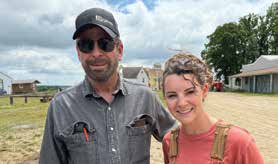
Jim Faulkner and his daughter, Jolene
Durie, embarked on a 16-hour round-trip
journey from Regina, Saskatchewan, Canada,
to Rollag, making the steam school their
Father’s Day weekend destination.
Since its inception in 1982, the steam school, through the dedication of its instructors, has helped keep the spirit of steam power alive, educating and inspiring future generations to preserve this cherished hobby and its technology.
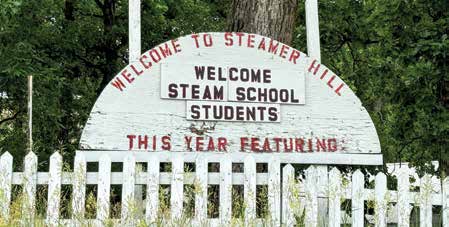
The school began as a one-day lecture with two instructors for about a dozen students. It now is a two-and-a-half-day course on Steamer Hill, the home of the Western Minnesota Steam Threshers Reunion (WMSTR), one of the country’s largest threshers reunion. The school offers a blend of lectures and hands-on experience.
Recognized as the country’s first steam school and widely regarded as the best among the roughly 25 others across the nation, Rollag’s curriculum has laid the foundation for several other programs. Many of Rollag’s instructors also teach at other schools, further spreading their knowledge and passion.
As has been the case for most of the school’s 42 years, the class June 14-16 was at capacity, with about 70 students attending and plenty more on a waiting list.
“After the first couple of years, we said that’s probably it,” said Dr. Gerald Parker, a retired dentist from Casselton, North Dakota, who instructed a class in his office basement in 1981 before being joined by Tom Hall, one of the students in that class, to form the steam school. “We thought we’d trained everyone who wanted to be involved. Now, we have a waiting list. So, yes, we’re a little surprised by all this.”
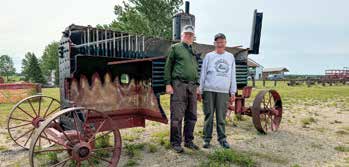
Dr. Gerald Parker (left) and Tom Hall
founded the University of Rollag College
of Steam Traction Engineering in 1982.
Since then, Hall estimates that approximately
2,500 students have completed the course.
Like many enthusiasts, Parker and Hall, a retired English/ industrial arts teacher who also worked in law enforcement, were drawn to steam engines at a young age and were influenced by family members.
Parker, 81, began learning his craft from his grandfather, Albert Gysler, at age 10 and became an engineer two years later. Hall’s father worked at a railroad depot in central North Dakota, and the family lived in the back two rooms of the building.
Parker noticed the obvious quite early.
“My grandfather loved teaching steam engineering,” Parker said. “And we had older engineers retiring. It occurred to me that we really needed to start training younger people so that we have more engineers.
“That’s what motivated me to keep the hobby going.”
Hall, 76, estimates that about 2,500 students have attended the school, representing 46 states, most Canadian provinces, and two European countries – England and Belgium.
There is no age limit for students, although younger children often struggle to reach the engine’s controls. They are encouraged to gain hands-on experience at WMSTR’s Miniatureland, where fully operational, quarter-sized versions of the equipment are available for youths ages 6-13 in what is an excellent preparation for steam school.
“By the time they get to be 10 or 11 years old, they go to steam school and know more about the engines than adults,”
The course costs $70 for adults and $35 for WMSTR members and students 16 and younger. Enrollment is available during the reunion weekend or by mail (University of Rollag c/o Tom Hall, P.O. Box 999, Moorhead, Minnesota, 56561).
The School
Shortly before school began at 6:30 p.m. Friday, students – male and female, young and older – filed into the building. Most were dressed in the customary engineer attire of bib overalls and boots and carrying course instruction materials, including “Steam Traction Engineer’s Checklist” by Jim Nowell, a longtime instructor, and “Case Steam Engine Manual” by the Case Company.
In his welcome introduction, Hall emphasized that the weekend was about learning – and fun. Students range from novices driven by curiosity to veteran operators seeking their Minnesota historical boiler operator’s license. Regardless of experience level, the focus of the 16 hours of instruction is on one word: safety – both in maintenance and operation.
There are no tests or quizzes, and students aren’t required to do anything they’re uncomfortable with. All graduates receive a certificate and 16 hours toward the 50 needed for their Minnesota license. The remaining hours are often gained by returning to Rollag to work on the site’s steam traction engines or steam locomotives. The Minnesota exams are administered after the school concludes on Sunday and again on the Thursday before the threshers reunion. Candidates must be at least 16 years old to obtain a license.
“Eventually, probably about half the students go on and get their license,” Parker said. “You have to complete the rest of the hours, which might take a few years. Some use the license, and others just hang it on the wall and never climb on an engine again. That’s fine too because they appreciate the engines and can tell other people about it."
Some students already volunteer at Rollag and view the school as an opportunity to enhance their skills. Dan Birnbaum, a supervisor for the Ortner train (a quarter-scale locomotive), is one such volunteer. He’s also following in his son’s footsteps.
“He’s 20 years old and is taking his licensing test,” said Birnbaum, a resident of West Fargo, North Dakota. “I’ve been volunteering here for four years, and I decided that getting my license is something I should do.”
Kelly Janke, a Glyndon, Minnesota, resident and a volunteer at the Thick and Thin Sawmill, was also encouraged by fellow volunteers to take the class.
“They said it would be beneficial to go through this class,” he said. “When you hear certain sounds from the steam engines, you either shut down the sawmill or risk serious problems. It’s all about understanding the sounds the steam engine makes.”
Classes typically last 30 to 45 minutes, with three sessions on Friday, seven on Saturday, and six on Sunday.
The school has expanded to its current format to maximize hands-on experience, making leather gloves as essential as notebooks and pens. Practical experience was introduced in the fourth year at a former student’s suggestion, and spreading it across two days enhances retention, according to Hall. The five-plus hours of hands-on instruction allows plenty of opportunity for students, which is why the class is capped at 70.
“For a number of years, we did only hands-on work on Sunday,” Hall said Saturday afternoon as students began assembling around one of the engines to apply what they learned in the classroom. “For beginners, it wasn’t making sense. Now, we discuss it in the morning and work on it in the afternoon. There’s more learning going on right now than last night and this morning.”
And, of course, the hands-on part is special for students, several of whom are hopping on a steam traction engine for the first time.
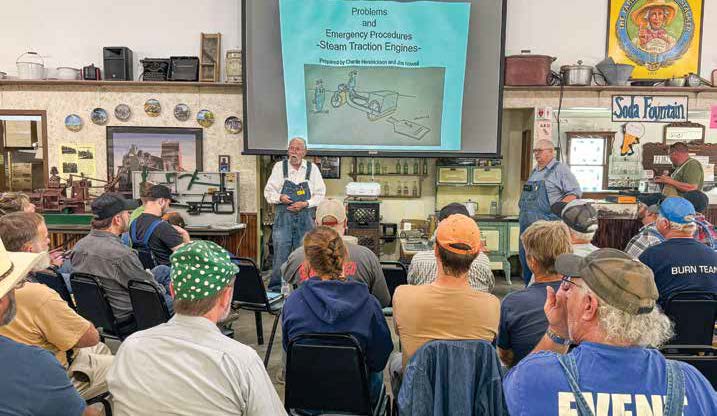
Classroom instruction began on Friday night and continued on Saturday and Sunday mornings, preparing students before they headed out to the engines. On Sunday, Jim Nowell and Pete Deets led a discussion on startup and shutdown procedures, providing the final insights before students put their knowledge into practice.
Saturday was spent learning the operation of the engine. That evening about 200 students and volunteers attended a dinner embracing tradition. The potluck-style meal featured hams cooked in the smokeboxes of the same engines used earlier for the course’s hands-on sessions. Despite the high winds canceling the planned spark show, the sense of community was evident as volunteers mingled, shared stories, and made the students feel right at home. And on the following day, students had the opportunity to drive, which took some students a little time to master.
“Everything was great,” Faulkner said. “But to get your hands on these tractors and operate them was the highlight for me.”
The Instructors
Instructors share a similar enthusiasm. Darren Gunderson, a Rollag graduate, has been an instructor for about 20 years and owns a 1924 20 HP Minneapolis he bought from another instructor, Dr. Jeff Knutson, a retired heart surgeon.
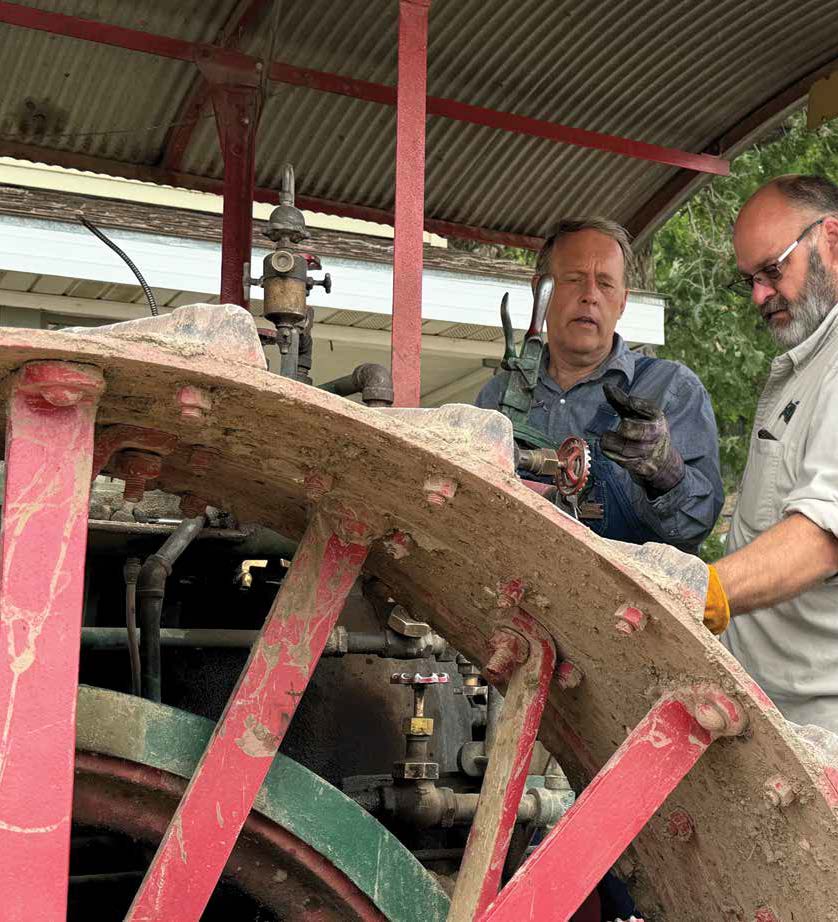
The University of Rollag College of Steam Traction Engineering provides over five hours of hands-on experience, a highlight for students eager to apply what they've learned in the classroom. Personalized instruction, like Darren Gunderson guiding Dan Birnbaum, ensures that students can directly translate classroom lessons into practical field skills.
“I love running the engines; it’s not something everybody does,” said Gunderson, who lives in Junction City, Kansas, where he is the school district’s technology manager after teaching science at the middle school level. “When I’m home, I can’t wait to get back up here.”
At first, returning to Rollag allowed Gunderson to gain the hours necessary to take the state’s licensing test. Hall and Parker always seek instructors, and with his background, Gunderson was a perfect fit. His wife, Shelly, also works for the school district. At Rollag, she can be found driving an engine at Miniatureland and at the building that houses the steam locomotives where she is a fireman for Engine 353, a Soo Line steam locomotive that is a prominent feature of the threshers reunion.
This weekend, Gunderson taught three classes and then spent several hours on his Minneapolis with students. The passion of the instructors is evident, not just in the classroom but also in the field. However, it’s the patience that is remarkable to watch during the hands-on sessions. Gunderson almost always had to repeat instructions, sometimes several times, but his encouraging approach and tone never wavered.
“Seeing people when they get it is quite a good feeling,” Gunderson said.
Countering Gunderson’s soft-spoken delivery is Erik Mars, a native of Kindred, North Dakota. Mars works for the state of North Dakota as a welder/fabricator in the experimental agriculture division. Known for his energetic style, Mars can be heard several feet from the crowd gathered around his 1913 75 HP Case. But it’s not just his voice that captivates; it’s his genuine enthusiasm for the craft that leaves an impression.
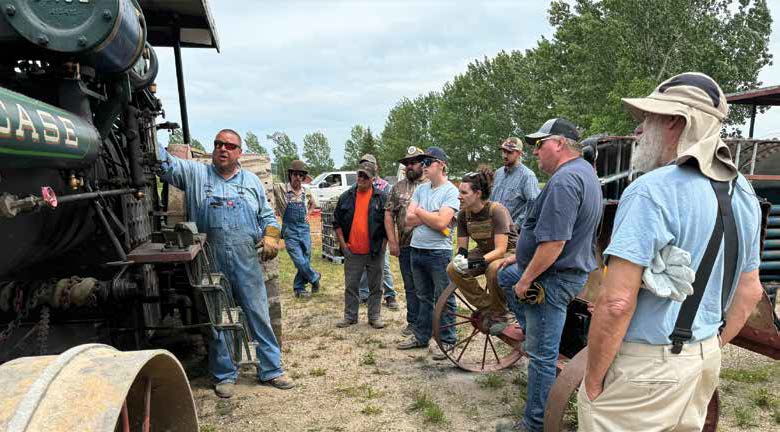
Erik Mars showcases classroom techniques on his 1913 75 HP Case, giving students a hands-on demonstration. Soon after, students took turns operating the engine’s controls, putting their newly acquired skills to the test from the platform.
“I enjoy getting to meet new people,” he said. “But once you get down to it, the camaraderie of everyone is truly special.”
For Jake Volk, who travels from St. Cloud to assist Mars during the school and reunion, the passion for steam engines runs deep as he was introduced to the hobby by his grandfather.
“I like meeting people and helping them learn,” he said, proudly noting that he named his 10-year-old son, Case, after the Case steam engine.
The school’s instructors are all volunteers, usually eight or nine for the classroom and another 15 for hands-on instruction. Many also volunteer their engines.
“You almost have to own an engine and operate it regularly to understand it well enough to teach,” Parker said.
Nicole Wallace Thurman, an instructor who grew up on a dairy farm in the Detroit Lakes area of the state, has taken her passion a step further by restoring a 1919 16 HP Minneapolis steam traction engine.
Wallace Thurman, an engineer with the US Department of Agriculture, has been an instructor for about 10 years. She taught three classes over the weekend. She said it was a natural progression from first coming to the reunion as a toddler to eventually getting hands-on experience at Miniatureland to graduating from the school.
“For some of the younger people in those chairs, it’s just part of the evolution,” she said.
Although Hall and Parker no longer teach regularly, they were pressed into duty this weekend when a couple of instructors had other commitments.
Watching them work together on Saturday morning at the cutaway boiler, it was clear that their passion for teaching remains strong. In a hobby focused on preserving history, watching them also gave a glimpse into the past, showing how this all started with just the two of them.
Knutson, a Fargo resident who has been an instructor for about 20 years, brings a unique perspective, especially with his interest in valves – likely stemming from his career as a heart surgeon.
“Over the years, I’ve given many talks,” Knutson said. “But I’ve taken a particular interest in how safety valves work.”
Pete Deets, a maintenance engineer from Evansville, Wisconsin, is another versatile instructor because of his knowledge, 20-year experience, and likely, his laid-back attitude.
“I teach wherever I’m needed,” said Deets, another Rollag graduate.
Other instructors for this session were Sanders Ellingson, Todd Hintz, and Ray Wangler.
“We actually have more instructors than time to do classes,” Hall said. “But that’s a good thing.”
During the weekend, it took very little time to understand that this hobby brings together people from all walks of life, united by a common goal: preserving history.
The Future
Hall and Parker have stepped away from most of his responsibilities with the school, and Hall said handling registration for the 2025 session was his final time for that task. However, both promise to remain fixtures at the school.
“Tom and I taught this year, so you never know,” Parker said with his customary and infectious laugh.
“Someday, I’m going to get old, and I’ll want someone to take my place,” Hall said. “I don’t want this to fade away.”
The next generation is already stepping up with instructors like Wallace Thurman, who is 35. “Many people aren’t able to get involved in this like I did,” she said. “The instructors here could be working on a project or doing anything they want this weekend, but everyone’s choosing to come here, volunteer here, and be here to keep the legacy of steam alive.”
2024 Course Schedule
Friday
6:30 p.m.: Introduction
7:15 p.m.: History of steam
7:45 p.m.: Properties of steam and water
8:15 p.m.: Safe working pressure and licensing requirements
Saturday
8 a.m.: Water level indicators
8:30 a.m.: Feed water pumps and indicators
9 a.m.: Presentation at cutaway boiler
9:45 a.m.: Boiler types and construction
10:20 a.m.: Reciprocating engine
11:15 a.m.: Field trip to Montana, Freeport locomotive buildings 12:45 p.m.: Handling the steam engine (part one)
2 p.m.: Hands-on experience
Sunday
8:10 a.m.: Start up, shut down
9:30 a.m.: Piping, valves and lubrication
10 a.m.: Firing; control of pressure
10:45 a.m.: Handling the engine (part two)
11:30 a.m.: Horsepower determination
12:45 p.m.: Emergency procedures
1:45 p.m.: Hands-on experience