Fifty years is a long time to do anything, but especially something as important as keeping people safe.
For a select group of National Board (NBBI) Commissioned Inspectors, five decades of service means more than just longevity. It reflects a lifetime of dedication to the safety of pressure equipment, benefiting the people who rely on it every day.
According to NBBI records, 13 inspectors have active commissions of at least 50 years. These inspectors have witnessed the industry evolve, technologies advance, and standards improve; however, one thing hasn’t changed: their commitment to doing the job right.
“Inspectors are the backbone of public safety in the pressure equipment industry,” NBBI Executive Director Joel Amato said. “Their expertise, vigilance, and integrity ensure that lives and property are protected every single day.
“To have maintained an active commission for more than 50 years is an extraordinary achievement. It’s a testament to both professional excellence and unwavering commitment to service. We deeply value and honor these individuals for their lifetime of contributions to our industry and our communities.”
Whether they began their careers in the U.S. Navy or after school, each of these professionals has built a career centered on protecting lives. Holding a National Board Commission for more than 50 years is no small feat, and it deserves to be recognized.
The BULLETIN interviewed nine of the 13 inspectors. Here are their stories:
Lane Griffin
Throughout his career, Lane Griffin has crawled inside steam drums, tracked down hidden hazards, and solved problems that operators never knew existed. But ask him what he’s proudest of, and his answer is simple.
“Fixing their problem because they didn’t know what the problem was – that’s what kept me doing this,” said Griffin, 84, a lifelong Georgia resident who now lives in Gainesville. “It makes you feel better. Nobody knows it but you. Maybe one or two people in the plant. But you know you could’ve prevented a fatality.”
Griffin works part-time at BPC XL, although his inspection days are fewer now. However, his experience remains a valuable resource.
“I think that’s my biggest asset now for the company,” he said. “I’ve seen almost everything you can do to a boiler, and most of the time I can figure out what caused it.”
Griffin has been solving those problems since earning his NBBI commission on August 26, 1969, and his No. 6620 is the lowest of any active commissioned inspector.
“That just means I’ve gotten old and still have to work,” he said.
Griffin didn’t set out to be an inspector. After a demanding stint at an industrial facility with punishing rotating shifts, his health began to suffer.
“My doctor told me, ‘Some people just can’t stand rotating hours, eating, and sleeping. You’re one of them. If you don’t get regular eating and sleeping habits, I’m going to take out half your stomach,’” Griffin said.
While mulling his career options, Griffin observed a Hartford Steam Boiler (HSB) inspector during an inspection at the plant. Griffin offered to help and was intrigued by the job.
“I’d been in there before, and I said, ‘I can do that,’” he said. “And then I got to thinking. This guy gets to go around to all these industries. I didn’t want to leave Georgia. I thought, ‘I probably just need to get that job.’”
He was hired by HSB, beginning a journey that would take him across the South, from Georgia and Alabama to Mississippi, Tennessee, and the Carolinas.
“When I started, the majority of our work was what we called A work,” he said. “Schools, small businesses, canneries. The everyday places where problems could be overlooked if someone didn’t know where to look.”
During that time, he also learned to be wary of repeated patterns.
“I remember the snakes that have bitten me before, and I look for them every time I’m in the same situation.”
Over the years, automation has transformed boiler rooms; however, Griffin stressed the need to rely on instincts.
He recalled a major failure at a Tennessee ethanol plant, when, during a cold spell, the operator watched his computer readouts go from mostly green to mostly red.
“But he still had good feed pump pressure and good steam pressure,” Griffin said. “His computer said he was fine. The direct read said he was out of water. He believed the screen and lost the entire boiler. Cost them about $6 million.”
The lesson was clear.
“You can’t beat a good set of eyes – and common sense. If your red lights are on, your water level is going down. I don’t care what your screen says.”
Griffin said he grew as an inspector by adapting.
“We used to hydrostatic test everything to 200%,” he said. “And on riveted boilers, we’d take a five-pound hammer and beat the seams under pressure.”
That practice ended after a tragic failure during a hydrostatic test in North Carolina, where a long seam gave way, killing several people.
Today, the National Board Inspection Code (NBIC) Part 3, Repairs and Alterations, requires repairs to be pressure tested to “verify the integrity of a repair,” which could be the operating pressure and not necessarily the original code of construction pressure.
Griffin said he takes pride in knowing that he helped make facilities safer.
“You get a good feeling knowing that boiler is a lot safer once I’ve explained what’s happening and what to do,” he said. “Even now, when someone calls, and we figure it out – that’s what this job’s really about.”
Harold Gragg
Harold Gragg never set out to be an inspector.
After working for an engineering company in Denver, he joined the U.S. Navy and trained as a boiler technician. But when his military service ended, inspecting boilers wasn’t part of his vision for the future.
“I really did not want to continue with this work, but I didn’t have a driving desire to do anything else,” he said.
What was supposed to be just a job eventually turned into a career.
“I like the work,” said Gragg, 81, who resides in Kansas City, Missouri. “I like talking with and helping people. And I feel like I am doing something good by keeping people safe.”
Unlike many in the field who start under the guidance of a mentor, Gragg was on his own almost from the beginning for his first job in Chicago.
“I’d already been through National Board courses, and with my Navy and engineering background, it didn’t take long for me to get comfortable,” he said.
His career took him across the country, from his hometown of Denver to Chicago, North Dakota, and eventually Kansas City, Missouri, where he now resides.
In North Dakota, he served as chief boiler inspector from April 1973 to July 1976 and from August 1977 to February 1982. Out of thousands of inspections and investigations during his career, one incident in North Dakota stands out vividly in his memory: the explosion of a semi-truck that resulted in the death of the driver.
Initially, the manufacturer was blamed for faulty materials or welding, saying the air compressor could never produce enough pressure to blow up the tank, but Gragg wasn’t convinced. He conducted an investigation, testing the compressor himself.
“I checked the materials and welds (of a test vessel), and they were sound,” he said. “We hooked (the air compressor) up to an electric motor, and the thing pumped up to 500 pounds. They said, ‘You know what? You’re right.’”
But perhaps the most defining moment of his career came during his tenure as chief, when he uncovered a serious breach of trust: three inspectors had been submitting falsified reports.
“They didn’t make the inspections they said they did,” he said. “One of the boilers was scrapped 10 years earlier, and they kept filing reports on it.”
Gragg didn’t hesitate, pulling all three inspectors from the field.
“My integrity means everything,” he said.
While his employer changed, Gragg’s safety- first mission remained.
“A lot of times, the owners of the vessels or the employees would fight you on something during an inspection,” he said. “But you convince them that it is something you need to do, and you feel good about it.”
Although the tools and technology have evolved, Gragg said the basics haven’t changed all that much. The most significant changes he’s noticed are in efficiency and design.
“Boilers are boilers, but nowadays, you hardly ever see any black smoke coming out of the boilers; it’s better for the environment,” he said.
And yet, one issue remains common: a lack of maintenance.
“The main thing is they just don’t clean them out,” he said. “When they’re full of mud, you can’t produce steam.”
Gragg still works full-time for HSB, and when asked what keeps him going, he answered with characteristic candor.
“Frankly, money. I hate to see a loss in money.”
He said he’ll likely continue for a couple more years before retiring. And despite all he’s seen and done, there’s no sentimental longing for the past. When asked if he misses anything about the old days of inspection, his answer is short and honest, “No.”
Gragg may not have planned a life in boiler inspection, but in a career defined by honesty, grit, and public service, he has built a legacy that speaks for itself.
 Mike Redmon
Mike Redmon At 77, Mike Redmon is in no rush.
Living in the quiet coastal town of Steinhatchee on Florida’s Gulf Coast, he’s winding down his career. His journey from marine engineer to an inspector is a testament to adaptability, commitment to safety, and a deep love for the work – and the occasional fishing trip.
After graduating from the Calhoun Marine Engineering Academy in Baltimore in 1968, he set sail as a marine engineer aboard merchant ships. But life had other plans.
“My wife decided I didn’t need to be doing that anymore,” he said.
It wasn’t long before he traded ocean waters for cast iron and fired heaters, responding to a newspaper ad in Houston that led him to Maryland Casualty Insurance Company and a job in El Paso, Texas, where he encountered a steep learning curve.
“I was used to big marine watertube boilers,” he said. “Then I show up at this apartment building, and I walked around the basement for a while thinking, ‘Where the hell’s the boiler?’ It was a little box about the size of two suitcases.”
Redmon’s decades in the field have given him a front-row seat to technological and regulatory changes.
“We started with riveted locomotive-type boilers,” he said. “Now we deal with everything from low-pressure systems to supercritical units.”
Inspection techniques have also evolved, with modern tools and more rigorous training standards becoming the norm. However, he said that’s one of the aspects of his job he appreciates the most.
“We do training every year, learning about new ways, new objects, and new methods and techniques. I really enjoy that.”
But with change has also come complexity, especially in plant operations. He said one of the industry’s modern challenges is operator training.
“Preventive maintenance gets overlooked too often.”
Like many inspectors, Redmon has had close calls. One particularly harrowing incident occurred during a holiday visit to a school in West Texas. A cast-iron boiler had overheated nearly to the point of glowing red – the result of a low-water condition.
“The janitor was ready to shoot water into it,” he said. “I screamed at him, ‘No, no, no!’ Thankfully, we got the gas shut off in time. It cooled down without incident, but it got your attention.”
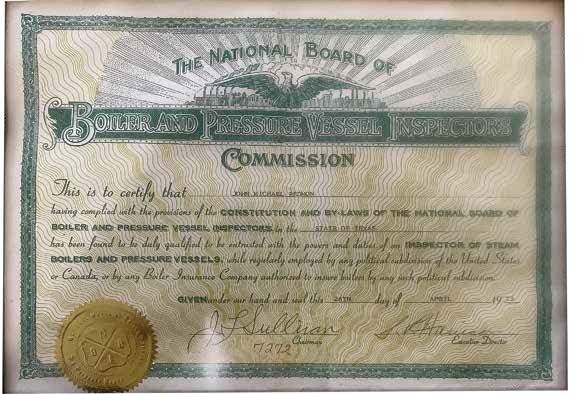
Mike Redmon earned his National Board Commission on April 26, 1973.
Handling those moments of potential danger gives Redmon a sense of purpose.
“Probably the most rewarding part of the job,” he said, “is knowing you helped prevent injuries or worse, especially in schools or public spaces.”
His understated nature is evident when asked whether he sees himself as a behind-the-scenes protector.
“Yeah, I kind of like being undetected.”
Redmon also fondly recalled how one of his early mentors, Andy Anderson of Texas, made a lasting impression.
“He always said, ‘Don’t get in a hurry. Look at everything. Do a thorough inspection.’ That advice has stuck with me for over 50 years.”
For the past 27 years, Redmon has been with ARISE. Although officially part-time for the last three years, he jokes that it might as well be full-time.
He’s done it all – jurisdictional inspections, machinery evaluations, and even supervisory roles.
“I’ve climbed the ladder,” he said, “and then climbed back down to where I want to be.”
The other thing he no longer climbs is inside an HRSG boiler.
“I retired from doing those this year,” he said. “My knees won’t take it.”
Some of his favorite assignments have taken him far from the Gulf Coast.
“Alaska was special,” he said. “When I started with ARISE, there were only eight of us – and we were worldwide. In Alaska, you could inspect a few small boilers in the morning and fish in the afternoon.”
He sees promise in emerging technologies, such as drones and robots, for performing inspections in hazardous environments.
“In a dangerous situation, you could use a drone to assess things instead of sending a person in,” he said.
While he admits that most new hires today may already have experience, he’s always willing to help them navigate the clerical and digital parts of the job. And his advice echoes that of his mentor.
“Don’t get in a hurry. Check everything. Be thorough.”
Redmon said he expects to retire by the end of the year and laughed when asked about his plans.
“Same thing I did yesterday. Go fishing.”
For Redmon, it’s another way to be satisfied and go undetected.
Bob Thompson
For Bob Thompson, life was supposed to be nuclear.
After high school, he joined the U.S. Navy and enrolled in the nuclear power program, envisioning a future in high-tech energy systems.
That led him to Idaho Falls, Idaho, where he qualified in nuclear power on the Enterprise prototype. It was the cutting edge of technology, and it seemed like just the beginning. But as fate would have it, Thompson’s future would take a very different turn.
After his military service, Thompson planned to join the civilian nuclear industry. Dow Chemical was expected to build a nuclear plant in Midland, Michigan, and he wanted to be part of it. But the project was never completed. His father, a Navy corpsman, as were Thompson’s two brothers, suggested he apply to Factory Mutual Engineering (now FM). Thompson landed the job, launching a long and interesting career as a boiler inspector.
“I didn’t know cast-iron boilers from hot-water heaters or firetube boilers,” Thompson said. “But I learned. I studied the code books, and I had a good trainer. It became my life’s work.”
Although he was new to boilers, Thompson understood their power – and their danger – firsthand. As a child in Navy housing in Omaha, Nebraska, he and his brother were injured when a hot-water heater exploded. After the heater was repaired, the gas was turned back on without the water being turned on, causing the explosion.
“It blew right through the two-story house and caught my brother’s bed,” he said. “He landed in the hallway, and I ended up under my bed.”
Thompson said safety standards were minimal early in his career.
"We didn’t have CO2 monitors or safety harnesses. You climbed inside a steam drum with a flashlight and a wrench and hoped for the best. We lost inspectors every so often back then.”
Technology would eventually transform boiler rooms, introducing sensors, control systems, and monitoring rooms. But not always without complications.
At one facility, a boiler with a nearby computerized control system would repeatedly shut down due to a malfunction.
“Turned out, the heat from the boiler was cooking the control box. They had to add more ventilation to keep the computer working,” Thompson said.
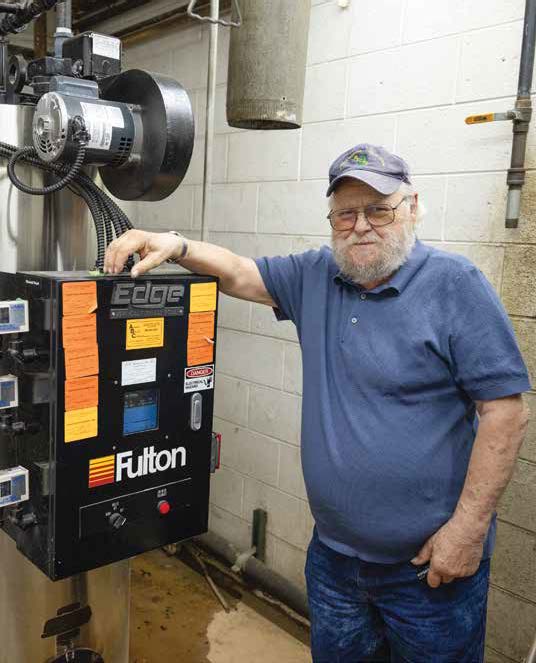
Bob Thompson stands beside a drycleaner's boiler he inspected several times.
His career as an inspector also provided many learning experiences. Thompson liked that many assignments offered insight into industries and operations he would have never otherwise known, such as visits to a CRT picture tube factory in Sylvania, Ohio, and a plywood mill in Washington. Some visits came with unusual perks.
At breweries, Thompson joked that the inspections were sometimes followed by “a sandwich, chips, and a cold one.”
And at an ice cream production facility, he and a trainee completed the inspection in the late morning and were handed a fresh half gallon of peach ice cream straight from the churn. “I told him, ‘We aren’t going to lunch today,’” he said.
Thompson said being an inspector also meant being an educator, an aspect he enjoyed. From casting facilities to apartment complexes, many people were unaware of what safe boiler operation entailed.
In one case, all the safety valves in a housing complex were installed horizontally – a direct code violation.
“They said, ‘They’ve always been like that.’ I said, ‘Doesn’t make it right.’”
He recalled another time when a utility company installed a shutoff valve between the boiler and the safety valve, allowing it to be isolated and repaired if it leaked.
“It made sense,” Thompson said. “Illegal as hell, but it made sense.”
Some inspections left lasting impressions because of what he encountered.
He said he once found a clinker – a mass of unburned residue – the size of a Volkswagen inside a coal-fired boiler.
“It had bent the supports and caved the tubes in,” he said, adding that he was told many clinkers at the facility were removed with a shotgun blast.
At another site, a water-level misreading warped the inside of a boiler so badly it resembled a playground slide. Then there was the time a poorly secured access ladder sent him tumbling – luckily, leaving him with nothing more than a sore wrist.
Thompson said each job reminded him of the responsibility he carried.
“I wanted to help people so they could operate their boilers safely.”
Thompson, 78, recently retired after 25 years with the state of Michigan and resides in Canton. As he reflects on his career, he finds meaning in the path he never intended to take.
“I can look back and say my life mattered,” he said. “Another job might have just been sitting in a chair, watching a monitor, but this way, I know that I might have saved a few lives and helped people understand boilers a little better.
“Yeah, I think I made a difference.”
 Tom Healy
Tom Healy’s career reflects a unique blend of technical expertise, human connection, and an enduring sense of responsibility.
In the U.S. Navy, he worked in the boiler room of a destroyer escort. The meticulous work and the presence of professional inspectors resonated with him.
“These guys came in with clean coveralls and a certain authority,” said Healy, 78, who resides in East Haddam, Connecticut. “I looked at them and thought, ‘I want to do that.’”
After leaving the Navy, Healy applied to HSB but was told he needed to be 25 years old to take the NBBI exam. Undeterred, he earned an associate degree in mechanical engineering technology and joined HSB, attending its internal school before taking the exam.
“I laugh now because slide rule accuracy was acceptable for the calculations,” he said. “Calculators were available, but they were very expensive, and I couldn’t afford one.”
Healy’s early days in the field were educational. One of his first visits, to a restaurant, is still etched in his memory.
“I pulled the test lever on the relief valve, and then it wouldn’t shut off. I had to tell them to get a plumber because it was dumping water everywhere. Now we don’t touch anything – the operator does. But it’s hard for me not to.”
Healy has seen vast changes in boiler technology and inspection practices.
“The efficiency of boilers has improved. Years ago, you went into a plant, and they had a big, old cast-iron H.B. Smith boiler, which was firing oil and smoking black. It was just totally inefficient,” he said.
Today, inspections utilize borescopes, infrared testing, and other advanced tools that enable faster and more precise assessments. Staying current is motivating and challenging.
“Boy, how things have changed. When I see something and I don't recognize it, I have to go online to find out who manufactured it and how it works.”
An event that left a lasting impact was an explosion at a fraternity house. A water heater not due for inspection exploded, traveling from the basement through two floors before settling in the attic. The power of steam was impressed upon him and became a topic of discussion for others.
While handling inspections, Healy said he tries to gain the respect and trust of plant operators by educating and supporting them, rather than lecturing, because most of the time, they know the system better than he does.
A perk of the job is he enjoys talking with people, and it’s through those discussions that he often can tell if something is amiss.
“I’m suspicious. If a fellow is proud of his plant and what he's operating, he'll go on and on and on and on about it,” Healy said. “I was early for an inspection at a commercial laundry facility, and when I started talking with the operator, his whole demeanor told me something was wrong. He was uncomfortable, giving one-word answers. After looking at the equipment, I asked for the logbooks. He finally showed me, and his problem was that he had updated the logbook through the time he thought I was going to arrive. Instead, I got there early, so there was blatant evidence that he wasn't doing his job.”
Healy said his career has allowed him to meet people and travel, which is one of the reasons he continues to work.
“I genuinely like people,” he said. “And it gets me out of the house. I work all of New England. I tell my wife that the only reason I’m working is to keep her in the lifestyle she’s accustomed to.”
He has conducted inspections in Australia, New Zealand, the Philippines, Saudi Arabia, and Europe, with Australia being his favorite experience. He said there was one drawback to all the travel.
“I couldn't get my wife to go. She hates to fly. I brought my kids with me on a couple of trips, but she wouldn't get on a plane.”
Mentoring new inspectors has become a natural extension of his work. It’s a role he takes seriously because he wants to pass along the wisdom and insight he’s gained.
“When the company hires someone new in New England, they’d often send them out with me,” he said. “I’m glad to help.”
Looking back on his career, Healy, who works part-time for Bureau Veritas, said he’s most proud of the honesty and integrity he’s applied to every inspection.
“Anything I do reflects upon me,” he said. “The boiler inspector’s job is very rewarding because, at times, you see something a customer didn’t, and you know right then that you potentially saved a life.”
 Paul Bourgeois
For Paul Bourgeois, the job of a boiler inspector has always been about more than just checking equipment. It’s about keeping people safe and businesses running – and always staying a step ahead of change.
Bourgeois, 76, recently received the C.O. Myers Safety Award at the 93rd General Meeting in Salt Lake City – an honor reserved for those who have made a lasting impact on boiler and pressure vessel safety (see page 13). The date of the presentation, May 14, 2025, marked the 51st anniversary of receiving his commission.
Bourgeois’ path to becoming an inspector began at sea. A licensed marine engineer in the U.S. Merchant Marine, Bourgeois worked aboard ships in the early 1970s.
“The pay was great. I got 15 days of vacation a month. But I couldn’t raise a family from the ocean,” he said.
Back on land and reading a newspaper, he spotted an ad from Hartford Steam Boiler. He was hired but was too young to work in an NBBI-code state like Louisiana. Instead, he was sent to Alabama, a non-code state at the time, until he turned 25 and could take the NBBI exam.
Over the years, Bourgeois’ approach to inspection has remained consistent: prioritize safety without shutting operations down unnecessarily.
“I never did an inspection to put somebody out of business. I did it to keep them running,” he said. “That’s our job – find the problems early and work with the customer to stay online safely. It’s rewarding when you do that.”
Bourgeois recalled one inspection involving a cracked air tank at a textile mill in Mississippi. The plant official refused to shut it down. Bourgeois suspended the insurance and called the state chief, who shut down the plant.
“That tank could’ve ripped apart at any time,” he said.
Bourgeois has held numerous titles and worked across the southern U.S., serving as a general adjuster overseeing commercial property claims in eight states. But two career highlights stand out: being named Mississippi’s chief boiler inspector (1977 to 1978) when he was 29 and being elected to the NBIC Main Committee, serving from 2007 to 2016.
Bourgeois credited mentor R.J. Sanford for helping guide his early career, and in turn, he does the same for younger inspectors.
“I tell them: Take your time, don’t overlook anything, and remember that your inspection isn’t complete until your report is submitted,” he said.
One of the most significant changes he’s seen is in the NBIC. In 1973, the NBIC was a booklet with fewer than 200 pages. Today, it’s a four-part document totaling nearly 1,000 pages.
“It’s a living document, and it has to be,” he said. “Technology is advancing fast, and the code has to keep up to keep people safe. In 10 to 15 years, the NBIC will grow even more. It has to because technology will keep changing, and we have to keep up.”
A senior risk control consultant for Travelers Insurance who lives in Tuscaloosa, Alabama, Bourgeois works about 20 hours a week and also serves as chairman of the Alabama Board of Boilers and Pressure Vessels.
He said he continues to collaborate with Eddie Wiggins, Alabama’s chief inspector, on regulatory issues.
“It keeps my mind sharp,” he said. “We’re not just protecting equipment – we’re protecting lives."
In a career filled with memorable moments, one of Bourgeois’ earliest inspections still stands out.
“I was just 23 and had to be lowered in a bosun chair into a 12-story boiler at a paper mill. I was terrified,” he said. “That’s when I realized how important safety standards really are. Today, you wouldn’t do anything like that without strict compliance with the NBIC and OSHA.”
Bourgeois said he has enjoyed the advancements in technology with inspection tools like drones and robotic crawlers.
“I witnessed a confined space drone inspection inside a 12-story boiler. The clarity and how close they can get to those welds were incredible,” he said. “That’s the future, and it’s less risk for inspectors.”
Still, Bourgeois said, no matter the advancements the industry sees, the inspector’s role will always be essential.
“We’ve come a long way from hand-fired boilers,” he said. “But the inspector still has to know what to look for.”
Bourgeois may have left a life at sea decades ago, but his journey as a boiler inspector has been smooth sailing in its own right. “I’ve enjoyed every minute,” he said. “And I’m proud to have played a part in helping the industry become what it is today – and what it’s going to be tomorrow.”
Tom Battles
The boiler and pressure vessel world found Tom Battles early and never let go.
Now 76 and still working part-time as a risk engineer for Travelers, Battles shows no signs of slowing down.
“I’m blessed with reasonable health, thus able to work,” he said.
His journey began in the late 1950s in the basement of a dry cleaner’s in Manhattan, where Battles helped his father repair and maintain equipment for garment and dry-cleaning clients.
“Dad was a boilermaker by all reasonable definitions,” Battles said. “He had Navy Yard experience and worked for many of New York’s boiler service companies. It was an introduction to the boiler world – and the cast of characters it offered.”
Although working with his father was a part-time affair, it left a full-time impression. Battles learned how to retube boilers, rotate them in and out of service, and – perhaps most memorably – the art of boiler insulation.
“Back then,” he said, “you’d cover the area with chicken wire, then mix dry asbestos with water to a troweling consistency and apply it.”
In 1969, Battles married and moved to New Jersey and began working as a lab technician for an instant tea manufacturing company. The job had an unexpected perk: The path to the pilot plant was through the boiler room where two Cleaver-Brooks firetube boilers stood. For someone with steam in his blood, it was an irresistible detour.
“I got friendly with the operators, most of whom had shoveled coal in their early careers.”
Soon, he was training in the boiler room and earned his New Jersey operating license, which led to part-time work at a hotel in Morristown, where he met Ray Snyder and Ralph Mindo, both NBBI Commissioned Inspectors working for Maryland Casualty Company. Snyder later served as New Jersey’s chief inspector.
“They endlessly encouraged me to join them,” Battles said.
While he didn’t join them, Battles took a job with Kemper, and his career was underway.
In December 1974, Battles took his NBBI exam at one of the towers of the World Trade Center.
“I still cry for lost friends,” he said.
One investigation in 2006 remains a pivotal teaching moment for him. A hospital boiler explosion led Battles to identify a failure in the electrically operated feedwater valve and 150 controls. However, the claim assessor insisted that the issue was a failed weld, citing a similar incident at a chicken processing plant.
“He said he’d send the report,” he said. “It’s been almost 20 years, and I’m still waiting.”
The takeaway? Always dig deeper.
“When you look at a boiler or pressure vessel, you need to look through it. Know the controls; know what's going on inside and outside. If you have questions, ask. The more you know, the better prepared you are – especially when your findings are challenged.”
Over the decades, Battles has seen significant technological advances, but he believes some of the most important improvements have come from training and code development.
“The creation and adoption of ASME CSD-1 has done much to increase safety,” he said. “Mandatory annual National Board training has helped with keeping inspectors sharp.”
Still, Battles remains cautious about overreliance on modern technology. He noted one example of a high school that replaced its 250 HP firetube boilers with high-efficiency units.
“The high-efficiency boilers should pay for themselves within years, so how can you say no?” he said. “However, can the custodian (handle the change)?”
Battles retired in early 2014 only to return a year later.
“Retirement was fun, but only for a short time,” he said. “I thought I had more to offer than walking into walls, all day, every day.
“And as long as I can be useful, I plan to keep going.”
 Jacob Scholl
Jacob Scholl still finds joy in the unknown.
“Because everything is new,” said Scholl, 77, a resident of Tallmadge, Ohio. “It may be the same old company, but you may have a challenge that day.”
That mindset has guided Scholl, an authorized nuclear inspector with HSB, through his career.
Scholl’s journey into inspection began indirectly. After graduating from college with a double major in English literature and history, Scholl said he wasn’t exactly flooded with job offers. It was his father, a licensed stationary steam engineer, who nudged him.
“Maybe you'd better find a real job,” his father told him.
Scholl listened. He earned his own Ohio stationary engineer’s license and soon transitioned into inspection, landing a position at HSB. At the time, Ohio didn’t have an NBBI member, so Scholl traveled to Indianapolis for his NBBI exam, which he passed in 1975. A year later, he earned his nuclear endorsement, which would define much of his career.
Scholl worked on the construction of major nuclear facilities, including the Davis-Besse Nuclear Power Station, the Perry Nuclear Power Plant, and Beaver Valley Unit 2. Later, he traveled across the country performing inservice inspections, often covering back shifts or stepping in until permanent staff were trained.
“I went to 14 different locations. It was always something new,” said Scholl, who added that he’s performed inspections in several countries as well.
In his early days, inspections were a paper heavy process. Scholl recalled heading to job sites with a tap hammer, pressure gauge, boiler bag, and a stack of forms. Communication was also primitive by today’s standards.
“It started out with a universal card,” he said. “You’d go to a pay phone, dial into the branch, and they’d tell you what to do next.”
Later came pagers, then cell phones. Scholl said he quickly embraced cell phone technology, helped, in part, by the fact that his wife worked for a phone company. After urging her to get a cell phone for herself, Scholl said he “immediately stole it and began calling clients.”
Although adapting to computers has been one of his biggest professional challenges, Scholl leans on a secret weapon: his son Todd, an IT professional, is always a call away.
While technology has transformed the how of inspection, the why remains unchanged: protecting lives and property. He said that’s why code compliance and the evolution of codes matter.
“The code used to be real simple,” he said. “Now it’s more complex, but in a good way. The codes include more to help customers and inspectors perform their jobs safely. It’s all about making sure things are done properly.”
When asked about memorable inspections, Scholl didn’t hesitate, saying he once oversaw a pneumatic test in Erie, Pennsylvania, on a vessel more than 300 feet long. Pressurized with a blend of oxygen and nitrogen to 105 psi, the test took two days to complete.
“We were all sitting there thinking, if this thing lets go, it’s going to land in Canada,” he said. Thankfully, it didn’t.
Despite the risks and challenges, Scholl said his job is gratifying.
“I like the clients. I like the people. Once I understand where they’re coming from, it’s easy to deal with them. Obviously, we have to work to the code, but I’m just there to make sure the paper’s right, the exams are done, and the hydro is witnessed when needed.”
Over the years, Scholl has also found satisfaction as a mentor, and his advice is to be patient.
“You’re going to learn a lot. You’ll be challenged, and there will be gray areas,” he said. “When that happens, always veer on the side of safety. The first person you’ve got to take care of is yourself. Go in safe and go home safe.”
Scholl still works full-time and doesn’t rush to clock out at the end of the day.
“I’ve never had that feeling. I’ll work late nights and weekends; whatever needs to be done,” he said. “If you enjoy what you’re doing, it’s not work.”
Looking back, Scholl is proud not only of what he’s done but of how long he’s done it.
“Most proud of in my career?” he repeated, pondering the question. “Oh gosh. Surviving at all.”
 Michael Schmidt
Michael Schmidt believes he has the best job in the world.
As a senior risk consultant with Travelers, Schmidt, 78, has enjoyed a career that has spanned continents, companies, and numerous inspections. From his home in Mahwah, New Jersey, he continues to work full-time.
“I still get excited about the work,” Schmidt said. “I’m my own boss, mostly; not only free to but mandated to dig into every relevant unknown – and occasionally doing undeniable good in the process.”
Schmidt's path into the inspection world began, as he puts it, by luck. After six years in the U.S. Navy, he responded to a cryptic ad in the “Navy Times.” Expecting to be pitched on selling encyclopedias, he was instead introduced to HSB. He accepted the position and stayed for 13 years.
That seemingly chance decision launched a lifelong career, and he has since worked across the U.S. and in the United Kingdom, Germany, Belgium, the Netherlands, Jamaica, and Brazil.
Schmidt has seen the full spectrum of situations – from boiler explosions to makeshift, ill-advised "repairs."
Among the most memorable was a catastrophic boiler failure in Chicago involving a faulty belly patch on a steam boiler. The resulting explosion tore through the basement, collapsing much of the first floor and cracking the concrete on the second floor. Another time, Schmidt witnessed the aftermath of a small cast-iron boiler explosion in upstate New York, which blew out skylights on the third floor and destroyed a partially finished basement.
"Had it happened a few hours earlier," he said, "there would have been much unpleasantness."
He's also dealt with more quietly dangerous situations, like flue-piping disasters that threatened lives with carbon monoxide exposure. In one recent case, he found a disconnected flue pipe in a daycare center. At a commercial facility, a flue pipe, suspended by a rope, had detached entirely. In both cases, he convinced on-site staff to shut down the systems and call contractors before he left the premises.
Over the years, Schmidt has watched the industry evolve dramatically.
“We’re no longer entering boilers for no good purpose,” he said. “NDE, thermography, and especially affordable borescopes are tools that non-invasively can confirm or deny what we could only suspect.”
Still, some things haven’t changed. Leaking safety and safety relief valves, as well as the replacement of steam safety valves with valves from domestic hot-water heaters, are the most common issues he encounters.
Schmidt is also troubled with what he sees as a growing sense of detachment from boiler operation and maintenance.
“I’ve called to arrange inspections and been told, ‘We have a boiler?’” he said.
His concern is genuine. As systems have become more complex and automated, there’s a perception that they require less attention – something Schmidt believes is a dangerous trend.
“I wonder whether the ultra-high efficiency boilers, which are also ultra complicated, will eventually produce hazardous workarounds when parts become unavailable.”
The attention to detail – and a healthy dose of skepticism – is what he tries to pass on to others.
“If there’s one thing I’m proud of,” he said, “it’s that I’ve occasionally been in a position to pass along what can only be gained through experience.
“Take nothing for granted. Read the manual. Run your checklist every time you see a boiler even though you saw it last year and the year before.”
Schmidt acknowledged that the job has changed.
“We’ve lost a little of our aura,” he said, recalling a moment about 40 years ago when he walked into a small factory and asked to inspect a boiler.
“It’s hard to characterize,” he said. “The plant manager, with tears in his eyes walked over to the red switch with obvious intent to shut it down. I managed to stop him to explain that it was only an external!”
Schmidt said he will remain on the job “as long as I’m physically able,” although he plans to retire in three years.
Until then, he’ll continue to do what he does best: following the clues, reading books, and ensuring that, behind every valve and vessel, safety always comes first."