Every year or so, “Popular Science” or “Popular Mechanics” serves up news of yet another breakthrough in invisibility.
However promising the headline, the attached article goes on to admit that limitations still exceed the promise. The best gadgets are workable in a lab under narrow conditions, but none would make a moving person invisible to others in the real world.
And yet invisibility in daily life is very real ... after a fashion. There are thousands of daylight, good-visibility traffic accidents around the world in which a fast-moving two-wheeler struck a car, or vice versa, after which the car’s driver pleads to the authorities, “That person just came out of nowhere and hit my car!”
This sounds like a pretty lame excuse, but there’s reason to believe that many of the drivers were telling the truth: They truly didn’t see that motorcycle or e-bike or scooter coming at them, so they pulled out in front of it. Of course, they’ll learn in court that this doesn’t let them off the hook.
Psychologists have given this odd but very common effect various names. One is “inattentional blindness,” and another is “looked but failed to see.”
What’s remarkable about inattentional blindness, human-factors consultant Marc Green wrote, is that an object can be right in front of our eyes – squarely in our high-quality central field of vision and yet be invisible to the decision-making part of the brain. So, it’s not a shortcoming of peripheral vision. Our retinas can clearly register an object for seconds at a time, but the information doesn’t reach conscious thought, hence its invisibility.
The problem lies in how our brains cope with an avalanche of information by filtering it down to what the prefrontal cortex regards as important and relevant at the moment. The brain is not a supercomputer, and filtering is how it keeps up with the processing load. For an everyday example, think of a crowded party setting, with many people, music, and clatter. That’s way too much stimuli to process, even if you wanted to track three nearby conversations at once. Instead, you “fuzz out” nearly all that noise to the background, allowing you to take in what your friend is saying. It happens automatically. That's the brain’s attention filter at work. It’s flexible: If you hear your name called from 10 feet away, the filter opens to pick it up.
While the workings are highly complex, researchers are confident that this amazing subconscious filter relies on several brain regions. What you might call the manager of all this – keeping a list of what's important and what isn’t – is the prefrontal cortex. This part of the brain sends directives – literally inhibitions – to parts of the thalamus that actually do the filtering. If we're stressed by having to do several demanding things at once, the prefrontal cortex sends extra inhibitory signals to narrow what reaches conscious attention.
A “selective-looking” experiment by Ulric Neisser and Robert Becklen, published in 1975, was the first to measure inattentional blindness. Subjects in one of the areas watched a videotape of a basketball practice and were instructed to count the passes. Told to distinguish bounce passes from thrown passes, most subjects failed to notice or remember a woman strolling through the scene while holding an open umbrella.
Many more experiments followed, all showing that people concentrating on an attention-taxing task are likely to blank out prominent but irrelevant things that were clearly in view: Such as a woman dragging her fingernails across a chalkboard; a person in a gorilla suit beating their chest; a unicycling clown; and currency clipped to a branch so low they had to move aside to get past. “Just because you’re looking at something doesn’t mean you’ll see it,” wrote Daniel Simons, one of the leading experimenters.
Psychologists at Cornell showed that even a simple conversation with a stranger on a sidewalk is so demanding of attention that it can trigger inattentional blindness. How blind? The experimenter, briefly concealed by confederates who rudely carried a large door between the two talkers, was able to switch his role with another man of strikingly different appearance, without most subjects noticing the change.
I’ve experienced this strange effect. Years ago, I was interviewing a professor at Texas A&M in his office. Like any reporter, I was totally focused on taking close notes and thinking about the next question. Suddenly the professor leaped from his desk and turned to his wastebasket, which was on fire. As he put it out, I remembered that I had seen a flash of flame behind the desk seconds earlier but had instantly dismissed it as so unlikely to be worthy of attention. That’s the prefrontal cortex and thalamus doing their filtration job.
The danger of inattentional blindness shows up across industry. Fatal crane accidents happen when an operator is so focused on boom angle, load swings, and ground obstructions that a clearly marked high-voltage line doesn’t register. Airline simulator sessions show that even experienced pilots can miss a large airplane parked on the runway during a landing exercise.
Dr. Kristen Pammer of the Melbourne School of Psychological Sciences studies motorcycle-car collisions but notes that even very large objects, like oncoming trains, can be invisible to drivers at crossings.
“When asked, ‘How could you miss seeing a train?’” Pammer said. “They say, ‘This is a road I’ve driven for years, and there never was a train there before.'"
Industry aside, inattentional blindness can hit any of us, and here’s an example. Over the last 10 years, millions of electric two-wheelers have joined the throng of gas-powered motorbikes. The statistics are worldwide. China now has more than 400 million powered two-wheelers in use – so many that this type now accounts for a quarter of all traffic accidents there. A survey of California crash records showed that e-bike injuries climbed from only two in 2018 to more than 1,500 in 2024, while the annual figures for conventional bicycle injuries stayed the same. The Consumer Products Safety Commission said that emergency room visits following electric two-wheeler accidents rose fourfold from 2017 to 2024, totaling 149,000. The World Health Organization reports that powered two-wheelers of all types now account for 30% of traffic deaths worldwide.
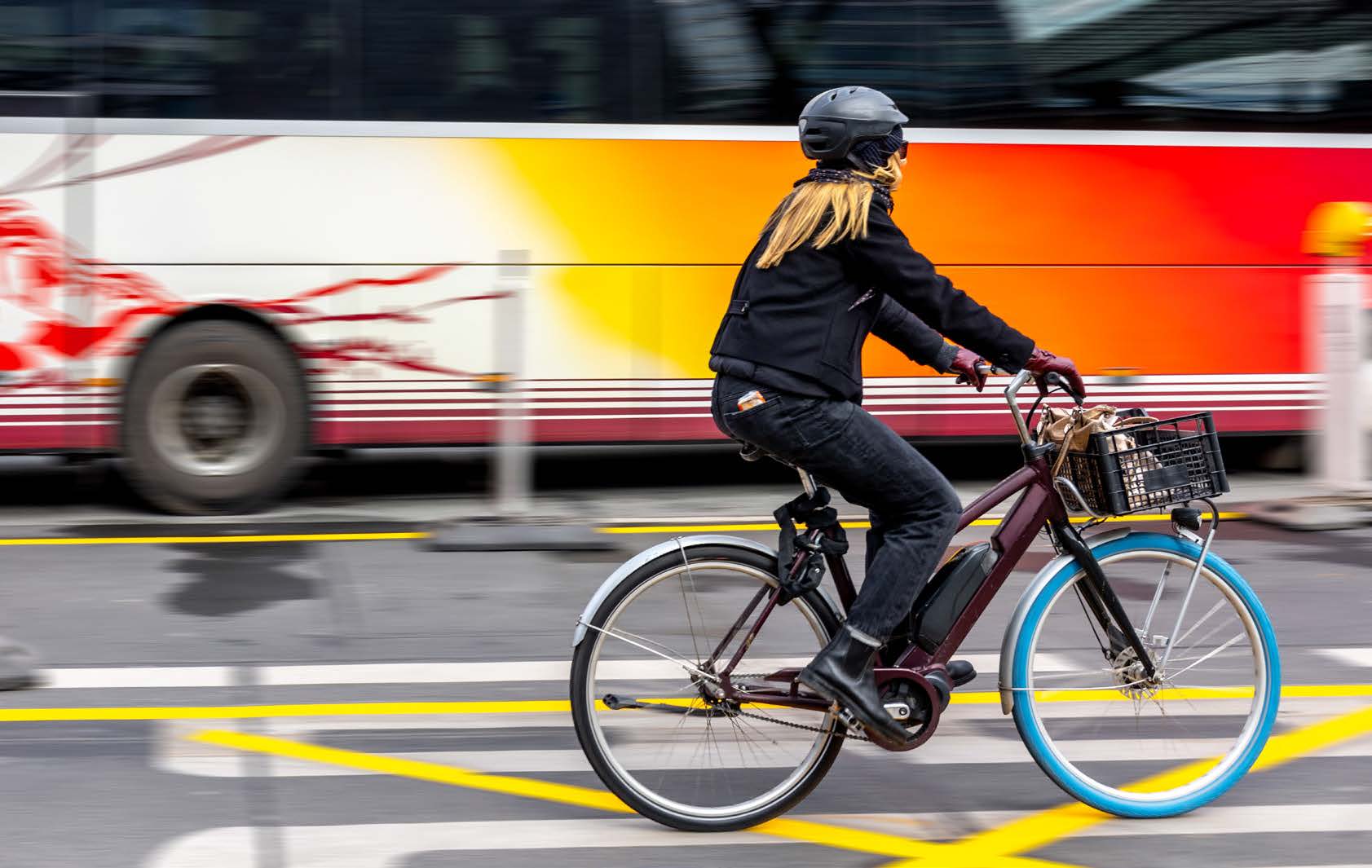
As electric two-wheelers become more common, motorists may need to adjust their awareness and scanning habits to account for these fast-moving vehicles.
Surgeons warn that injuries to e-riders are more severe than seen with collisions on conventional bicycles – more likely to send riders to intensive care, more likely to cause brain damage, more likely to kill.
“Overall, these patients tend to be younger,” according to Dr. John Austin of the University of California San Diego School of Medicine. “They tend to be unhelmeted and, in turn, be more severely injured.”
We can divide this tsunami of electrified machinery into three categories:
- Micro-mobility vehicles: The most numerous are electric scooters such as the rentable Lime models, but also include powered skateboards, hoverboards, and even unicycles.
- E-bikes: These have bicycle pedals but also an electric motor.
- E-motos: These carry much bigger motors and batteries than e-bikes. E-motos behave like conventional motorcycles and dirt bikes, but until recently fell into an unregulated bicycle category and so avoided motorcycle licensing and safety rules. That’s changing in some areas, like New Jersey and Illinois, but those state laws face heavy opposition from riders and retailers.
Speeds with the first two types usually top out at 25 to 30 mph, but e-motos are faster. An e-moto that ran a red light and crashed in 2025 in Yorba Linda, California, had been modified to hit 60 mph.
Reckless riders on any of these pose a distinct hazard to themselves and others. One evening, while researching this article, I watched an e-scooter zoom out of a residential street to match the speed of cars on a busy four-lane avenue. Last month, visiting Duluth, Minnesota, I saw a scooter rider making figure-eights between moving cars, defying them to hit the brakes, and grinning all the while. I've seen e-bikes narrowly miss pedestrians, and I've seen e-motos zoom down sidewalks to cross intersections without stopping or even slowing.
E-traffic isn’t a fad that comes and goes. And it’s not just for kicks; it’s cheap and fast transportation for commuters and delivery drivers.
Here’s a scenario that all drivers should think about: You’re waiting at a side street, looking for the next opening to join the stream of traffic. Your brain is very good at this, since it’s been trained to watch for a short list of hazards moving in familiar ways – trucks, cars, and (I hope) motorcycles. You wait a minute or two, impatience growing. When there’s an opening, you hit the gas.
That’s how e-bike collisions can happen. A rider approaching on the sidewalk saw your stationary car waiting there and was going to cross the intersection at full speed. Suddenly you’re in the way, and he’s headed to the hospital.
We haven’t formed the habit of making a 180-degree scan to check for fast-moving, unlit vehicles on sidewalks. We focus on familiar hazards, and the rest is literally invisible.
What to do? The problem, say cognitive psychologists, is that years of coping with a complex and busy world have hardwired the prefrontal cortex to allow only a small set of priorities to reach consciousness. These priorities are hazards and opportunities, making a mental template that optimizes our brain’s limited processing power. That priority list shrinks when we’re stressed, confused, or in a hurry. Non-priority things – however “visible” on the retina – are stopped by the brain’s filter. Like it or not, inattentional blindness is how we make it through the day.
Is it true, then, that this is all so ingrained and subconscious we can’t update our filter programming and add a new hazard, like fast-moving electric two-wheelers, to our tried-and-true priority lists?
I think it’s possible, with motivation and some new habits. I think of the 2006 movie “Sixteen Blocks,” in which a hardened criminal played by Yaslin Bey eventually convinces cynical cop Bruce Willis that, “People can change!”
One hopeful sign came when I polled two military pilots who, following retirement, went on to fly for major airlines. One recommended I look outside aviation to public swimming pools. I found a video of a lifeguard on her perch, moving her head in a timed, almost robotic manner. She stopped to scan the pool at one angle, then turned again, just a quarter-turn at a time. Pool-safety experts say this deliberate scan is important in a crowded pool since some people drown after slipping underwater very quietly, rather than after yelling and splashing. That deliberate and thoughtful sweep isn’t easy or natural, but it avoids inattentional blindness.
Another reason for hope is that our subconscious list of priority hazards can be tweaked. Ever wonder why police officers on a highway, when making a traffic stop, often park their squad cars at a sharp angle so it points to the ditch? There are several reasons, including visibility. It turns out that very bright flashing lights aren’t enough. In a 2002 study, researchers at the University of Sussex showed that the unusual angle attracted passing drivers’ attention. Because an angled patrol car is half-familiar and half-strange, the scene is more likely to get through the prefrontal filter. In the lingo of the field, the patrol car has a higher “conspicuity.”
A third reason it’s possible, and wise, to update your own hazard list to include electric two-wheelers is that powered two-wheelers are a distinct hazard to car drivers in a collision. I don’t mean so much physically – cars protect their passengers against such light impacts – but emotionally. The more responsible and caring person you happen to be, the greater the emotional hit. Imagine learning that the 12-year-old who crashed his e-bike into your car at an intersection is now paralyzed for life. You’ll never forget it.
Dr. Pammer provides expert testimony in Australian cases of car-motorcycle collisions. Referring to the drivers she sees in court, “I can tell you it’s absolutely devastating,” she told me. “They reflect that, ‘I caused such harm … how could I not have seen that?’” I asked her whether it brings the defendants any peace to hear that inattentional blindness is a common human failing. She does not believe so; they continue to blame themselves for carelessness.
So, accept that e-bike/car collisions are now a real and present danger, and take up a new habit of scanning for two-wheelers “coming out of nowhere.” And e-bike riders could learn to live with safety. People can change!