“A stitch in time may save nine.”
Thomas Fuller (Gnomologia, 1732)
On January 23, 2023, a reboiler exploded during the startup of a unit that produces hydrofluorocarbon refrigerant (the 245 Unit) at the Honeywell Performance Materials and Technologies facility in Geismar, Louisiana.
The explosion resulted in the uncontrolled release of over 800 pounds of highly toxic anhydrous hydrogen fluoride (HF)1 and 1,600 pounds of chlorine gas2.
Fortunately, no employees were present in the 245 Unit at the time of the explosion, and there were no injuries reported3. However, Honeywell reported $4 million in property damage, a complex-wide shelter-in-place was ordered, and local officials also temporarily closed nearby highways.
The U.S. Chemical Safety and Hazard Investigation Board (CSB) launched an investigation into the incident, along with a previous fatal incident that occurred at the facility in 2021 and a subsequent serious injury that occurred in 2024 (both of which involved releases of hydrofluoric acid). The 2023 reboiler explosion was caused by shell thinning due to corrosion, a mechanical integrity issue. This was the fourth time the 245 Unit’s reboiler had run to failure since the unit was commissioned in 2002.
A mechanical integrity inspection in 2021 identified the reboiler shell as near its minimum thickness. However, it remained in service despite this mechanical integrity issue. The CSB determined that the explosion was due to weaknesses in Honeywell Geismar’s approach to organizational and personnel change, capital project management, and organizational resilience.
Organizational and Personnel Change
The effect that physical changes at a facility can have on safety is widely recognized throughout industry. What is less understood is the effect that nonphysical changes, such as changes in job responsibilities or the loss of critical staff4, have on safety. Such changes can often lead to mismanagement and the creation or persistence of hazards.
After an inspection in October 2021 identified that the reboiler shell at the facility needed to be replaced, the 245 Unit maintenance engineer submitted a capital expenditure request. The request was approved in February 2022. In April 2022, however, the maintenance engineer left the company, and the project was never reassigned or completed. As a result, the reboiler remained in service until the incident in January 2023, nearly 15 months after the inspection.
The departure of the maintenance engineer constituted a significant personnel change that Honeywell Geismar should have managed through Management of Organizational Change (MOOC) principles. Although Honeywell Geismar had a procedure in place to manage such changes, it did not use it to replace the maintenance engineer.
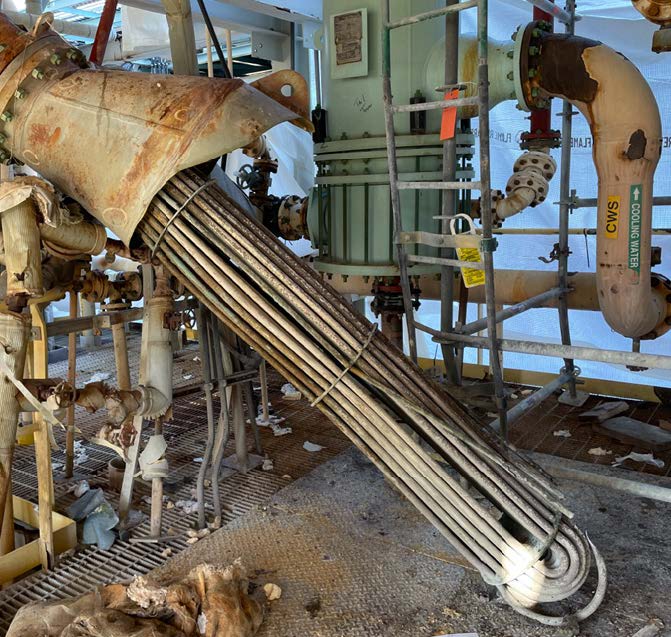
Post-incident image showing the remnants
of the reboiler.
Courtesy of the CSB and Honeywell
This was also the case for extended vacancies in the maintenance and reliability manager positions at the Geismar facility, the reassignment of those duties to other employees, and a 2020 reduction in force. By failing to follow its established processes, Honeywell Geismar missed the opportunity to preserve – and act on – critical information such as the urgent need to replace the reboiler shell.
At the outset of its investigation report on the Honeywell Geismar reboiler explosion, the CSB cited the agency’s investigation into the massive 2005 fatal explosion at the BP America Refinery in Texas City, Texas, (BP Texas City) for the importance of managing organizational changes. That incident resulted in 15 fatalities, 180 serious injuries, and significant economic losses. Moreover, since the BP Texas City incident and prior to the 2023 Honeywell Geismar explosion, the CSB conducted four other investigations in which the CSB found that deficiencies in managing organizational change were a contributing factor5. These other incidents resulted collectively in 16 fatalities and eight serious injuries.
In connection with the BP Texas City investigation, the CSB issued a recommendation to the federal Occupational Safety and Health Administration (OSHA) to explicitly require the management of organizational change under OSHA’s process safety management (PSM) standard. OSHA has not yet taken action to address this recommendation, however, and management of organizational change deficiencies continue to contribute to fatal incidents at chemical facilities.
Capital Project Management
The Honeywell Geismar facility used a matrix to assign a rating to its capital projects based on the “criticality” and “complexity” of the project. After the rating was assigned, the appropriate funding measure for the project was determined.
The replacement of the reboiler shell was determined to be highly critical with a low level of complexity, meaning it could be funded with available site-level resources without the level of corporate oversight necessary for more complex, less critical projects. The project received all necessary approvals after being submitted in January 2022, but as of August 2022, the project had not received funding. The project subsequently was moved to the site’s 2023 capital budget, indicating that Honeywell Geismar had abandoned efforts to complete the reboiler project in 2022.
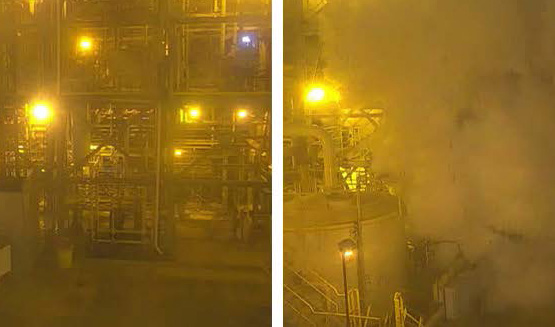
Surveillance images immediately before (left) and four seconds after (right) the reboiler rupture.
Courtesy of the CSB and Honeywell
This was unusual as projects were typically funded shortly after being approved. Between roughly May 2022 and October 2022, the facility requested more funding for a number of projects than could be made available. This caused site-level managers to re-prioritize their approved projects. During this process, the reboiler shell replacement’s criticality was not noted due to oversight by local management, causing the project to slip further down the priority list, delaying the funding of the project until the reboiler eventually failed catastrophically.
Honeywell Geismar did not effectively manage the capital project to replace the reboiler shell. From October 2021, when the reboiler shell was identified as needing replacement, to January 2023, 78 of 140 projects were funded ahead of the reboiler shell replacement despite being rated with a lower priority. The Geismar facility also used its emergency funding process twice during this time but not for the reboiler.
Organizational Resilience
Organizational resilience has been described as the capacity of an organization “to absorb unexpected shocks […,] understand warning signals, minimize damage by an unforeseen threat, and to restore quickly from damage sustained.”6 The Honeywell Geismar facility lacked organizational resilience sufficient to prevent this incident.
Before the 2023 reboiler explosion, Honeywell Geismar was experiencing significant disruption from the COVID-19 pandemic, which resulted in reduced staffing. The facility also had experienced the previously mentioned 2021 fatal incident. Following the 2021 fatal incident, the facility identified the need to replace all the gaskets in the 245 Unit.
The work to replace the gaskets began in 2021 and continued into 2024, further straining the time and focus of Honeywell Geismar’s remaining personnel. Although Honeywell Geismar’s focus on the 2021 incident did not cause the 2023 incident, their approach may have caused them to overlook the conditions and disruptions that did cause the reboiler explosion.
Lessons for Industry
The consequences of failing to address mechanical integrity issues with pressure vessels, further aggravated by other weaknesses, such as in organizational and personnel change, capital project management, and organizational resilience, can have catastrophic impacts, especially in the chemical industry.
To prevent future incidents:
- Once a deficiency is identified, robust mechanical integrity programs must ensure that corrective actions are identified and tracked to completion. It is not enough to simply identify a deficiency. Companies should manage and mitigate that deficiency.
- Capital projects that are intended to address mechanical integrity deficiencies are important safety tasks. Companies must ensure that all safety-related tasks, including safety-related projects, are included in their management of organizational change programs so they are properly managed, tracked, and reassigned when necessary.
- Companies should develop and implement systems to manage organizational and personnel change. It is crucial to ensure that safety-related responsibilities and tasks are not overlooked during such changes.
- To ensure that one incident does not cause or lead to another, companies should develop and implement resilience programs to recognize and prevent or minimize disruption to their routine safety management activities and other systems that contribute to safety, such as capital project management.
Companies that do not incorporate these lessons into the operation of their facilities run the risk of failing to correct mechanical integrity issues in time to prevent catastrophic incidents. Personnel come and go, and priorities shift. It is incumbent upon companies to effectively manage the safety of their pressure vessels with strong organizational policies and procedures.
For more information about the CSB’s investigation of the Honeywell Geismar incident, go to www.csb.gov/honeywell-geismar-chlorine-and-hydrogen-fluoride-releases/
1 HF is a highly corrosive and toxic chemical compound, which is immediately dangerous to life or health (IDLH) at a concentration of 30 parts per million (PPM).
2 Chlorine is a highly reactive, toxic chemical element with an IDLH of 10 PPM.
3 The incident occurred during the night shift when fewer workers are present at the site.
4 These are referred to as organizational changes.
5 These investigations are: Bayer CropScience Pesticide Waste Tank Explosion, August 28, 2008; Tesoro Anacortes Refinery Fatal Explosion and Fire, April 2, 2010; US Ink Fire, October 9, 2012; and Honeywell Geismar Chlorine and Hydrogen Fluoride Releases, January 23, 2023.
6 Hans Pasman, Risk Analysis and Control for Industrial Processes – Gas, Oil and Chemicals, 216