
94th General Meeting Presentation
“The Inspection and Refurbishing of Cryogenic Vessels”
Jacques Sénéchal
The following remarks were delivered at the General Session of the 94th General Meeting on May 11, 2026. It has been edited for content and phrasing.
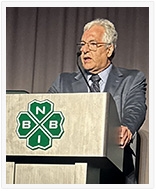 INTRODUCTION: Jacques Sénéchal, senior director of major investments at Air Liquide, has more than four decades of experience in engineering and project management across a wide range of industries.
Sénéchal has worked in the design, manufacturing, construction, and commissioning of hydroelectric equipment, aluminum smelters, steel mills, and industrial and medical gas systems throughout North America, Africa, and Asia. In his current role, he is responsible for developing and executing major projects for Air Liquide, including the commissioning of facilities in Canada. Most recently, he led the development and construction of a large PEM electrolysis hydrogen plant and an air gas plant in Bécancour.
His slide presentation can be found here.
MR. SÉNÉCHAL: First of all, I would like to thank the National Board and Eben (Creaser, NBBI Chair) for this special invitation. I was a bit surprised when I started meeting a lot of friends I've worked with over the last 40 years, especially on the pressure vessel side. It's a small world. You can see people all over the place with the same dedication to safety. It's what drives me.
I’ll start with the definition of cryogenics. A lot of people are talking about cryogenics, but I'm not sure we all share the same definition. I’ll also cover product temperature and density. That's mainly why we go to cryogenics. Storage tank – we use different quotas. I will cover that and how we protect our system.
It's very important to understand where we are coming from. Air Liquide is our owner. I'm representing an owner. We build things and operate, maintain, and, ultimately, dismantle the equipment we have built.
Air Liquide Canada is a relatively young company. The first CEO died on the Titanic. Making sure that we maintain our stuff is very, very important. We are in the industry, but we're also in healthcare. We supply hospitals. We supply many medical centers. If you look at our model, the orange shows we produce the gas on the pipeline and on liquid. Liquid is for transportation, and I will cover later why we do that on liquid.
We are in a different segment of the business. We're on electric. Like I said, we’re in healthcare and what we call the industry of merchant. Industry merchant is the thing that you see all over the place. We are involved in aerospace. For example, we deal with NASA, with SpaceX, and with the aerial program.
Air Liquide has 65,000 employees, and we're in 59 countries. Our U.S. head office is in Houston. We have more than 4.3 million customers and patients. Keep in mind that in healthcare, sometimes patients are really low-volume, and you are a big company, so they will take a lot of gases.
Our overall income is 27 billion euros ($31.7 billion) per year. And we invest close to five billion euros ($5.7 billion) per year. I would say around 25% of those investments are in North America. In the U.S., you probably have seen more Airgas than Air Liquide. This is the same company. In Canada, you will see more Air Liquide. We have started the integration of Air Liquide and Airgas for merchant gas.
With Airgas, it is important to understand that inspection and refurbishing is one number. We have more than 25,000 bulk installations in North America. It means we have to inspect those installations on a regular basis. We have to maintain them, and we have to refurbish them.
What does cryogenics mean? I will use a couple of examples of the company's involvement in cryogenics. If you look there, Liquefied Natural Gas is at minus 162 degrees Celsius (minus 260 degrees Fahrenheit). For nitrogen and oxygen, it's minus 274 degrees Fahrenheit. And for hydrogen, we are at minus 425 degrees Fahrenheit, which is very close to absolute zero (minus 459.67 F).
When we work with liquid hydrogen, one thing we have to be careful about is this: If you see liquid on equipment, on a pipe, on a valve, the liquid is not water condensation; it's air condensation. It's what we call liquid air. The concentration of oxygen in liquid air is about 40%. We have to be careful when you do that, because you risk a burn and high oxygen levels.
Those applications require specialized equipment. It's something that we tolerate very well in the industry. Just for information, especially in North America, we work with the Compressed Gas Association. It's self-regulation from the industry. Many people who supply equipment for industrial gases are members of the CGA.
I will cover mainly the storage. The process is a little detailed, and we apply different recipes to make it happen. If you look at the low-pressure tank, we use mainly API 620. For the piping, we'll use ASME B31.3. And for the pressure vessel, it's mainly ASME Section VIII, Division 1.
I will make a special note on what you call the small tank. The small tank for our facility can be up to 18,000 gallons. We'll often use a cold-stretch design. The cold-stretch design is what you do when you fabricate the tank: You pressurize it to stretch it, making it lighter. One reason we do that is that these designs are frequently subject to change.
Just to give you an idea, the average bulk tank fleet in North America is probably around 30 years old. With the life expectancy, we usually remove those tanks after five or six years for different reasons. Customers stop the operation and increase consumption; we need to install a larger tank or decrease consumption. For efficiency, we have to reduce the tank size.
Keep in mind that the plan is 270 degrees Fahrenheit. The liquid is boiling in the tank. If we put in too much liquid, the loss would be too high. And we have to change it to ensure we are efficient.
It's really schematic how we make hydrogen. First, we compress the air; we have a purification step. After that, we have the cooling. The gas will be hot, so you cool it down and expand it using a Joule-Thomson valve. That is a regulator that will decrease the pressure, and you will get cold. And with the cold, you will make liquid. And after that, you have the distillation column that you will use to separate the different gases. In the case of air, the gases are oxygen, nitrogen, and argon. And after that, we'll install those products in different tanks.
In the previous process, we added the distillation column. We call that a cold box. In the cold box, you have a pressure vessel with piping, and the box that you see around is carbon steel. It's just enough to keep the insulation inside. And what we do is we put nitrogen inside. It's why, if you look at – I refurbished a cold box like that 10 years ago, one that was 35 years old.
The main work that we do is to change all the information on the valve, the wire, things like that, and all the lead ladder and the platform. Everything else was in good shape because, inside, you have nitrogen, and with nitrogen, you don't have corrosion. With Airgas, we don't have corrosion anywhere. We are not concerned about the pressure vessel. It will keep its integrity. And what we saw, we did some experiments. We have approximately 35 years of care to check all our activities, and it worked very well. We know that after 45 years, we feel safe about the cold box that we have refurbished.
We have other kinds of tanks, like the spare one; we use that mainly for liquid hydrogen efficiency. We built those tanks on API. We use at least a 35 psig design, but we run those tanks at almost atmospheric pressure for efficiency.
In some situations, we have issues when we build tanks like that. If we always run at 5 psig and the tank is at 35 psig, it can create a challenge, and we need to deal with that and make sure they are very well aware of what we are doing. For those tanks, the major issue we have is not necessarily with the tank. It's on the pipe that supports the tank. One of the inspections has to be done, and we have to make sure that we'll fix it. The rest is relatively easy to see.
The product is so cold that if you were losing the vacuum, for example, you would have a cold spot; you automatically have a sign that you need to do something, and the external vessel is usually the problem. I saw once that we had a problem with – not with those kind, with one that they were present after – that we had a leak on the internal vessel, so one out of maybe 100,000 tanks.
This is an API tank that sits on the insulation. We keep a gap of air on the bottom to make sure that the cold won't go down into the ground. You have the tank inside that is stainless steel; you have the piping; you have the insulation, and, again, on those tanks, what do we do? We put some nitrogen to make sure they stay dry.
Every time that we have maintenance to do, it's more on the external, on the piping or on the one that is painted. It's very easy to do the inspection. We do online inspections. If we see a sign, we will react immediately to fix it.
The one on the left is the kind of tank that we had an interesting problem with. We built the tank, tested it, and everything was fine. We installed the tank and discovered that if it's half full, there's no leak. Between half and 75% full, we have a small leak.
More than 75%, we have a bigger leak. How we are detecting a leak on a tank like that is very simple. You look for a cold spot; if you have a leak, you're losing vacuum. Those things are right here. If we have a leak, we are losing vacuum. If you lose vacuum, you will have a terminal bridge. And the air condensation was thick on the surface. And if it's cold, it will freeze; you will have a cold spot.
The freight driver who would pick up from those tanks will notice condensation and an ice circle spot on that tank and will perform the inspection. The tank that will leak is one out of 100,000 that will leak in an internal vessel. What is interesting is that we have run tanks like that for 10 years with that section; we just keep it at full, and we're losing capacity.
And when the customer shuts down their operation, we move the tank to a shop and spend a month finding the leak. We find the leak, and we're looking to understand why. The reason was a little bit strange. With deflection, when the tank was more than half full, the load was enough to create a small microcrack. And as everybody knows, the best way to have a sealed-tight device is to have metal-on-metal, which is what we have, but it took a month to find the leak. Now that we have fixed the leak, the tank is in operation, and everything is fine. We were very curious to understand why it was a problem.
The other one, when I was talking about the fleet of more than 25,000 tanks that are moving all over the place and the cold-stretch design, one thing is sure: If one day we have a problem with the tank, we will probably scrap it because we don't know how to fix it yet. Maybe someone will find a way to fix it, because keep in mind that we built a pressure vessel; you can cold stretch it to give it more resistance. If you try to cut the tank and repair it, what's happening? Nobody can answer that, so we will need to study it. That's why those tanks in any spot – it's accepted by the Canadian jurisdiction that it is one condition that we don't repair, and we totally agree with that, because we don't know how to repair it.
The rest of the tank, the piping, and the external tank, yes, we will fix it, so that's easy. Usually the outside tank is in carbon steel, easy to fix. And the piping, we know how to fix piping.
Under pressure, as a safety valve, we have a period to retest it to recertify it. In many cases, we perform a pop test to see if the safety valve is still in good condition. They are always in good condition. We try to coordinate the major turnaround.
The other safety device we have is a thermal relief valve. The thermal relief valve is used to prevent liquid from becoming trapped between two mechanical components, such as two valves. You close the two valves to avoid having a pipe rupture; you have those small devices. What we do on a visual inspection is change it. We inspect our tanks on an annual basis. We have a computerized management system that our technician goes to see every insulation every year.
However, if the freight driver sees anything strange on the tank, they will report it, and we will send a technician. It's a very rare problem. The average age of our North American fleet involved bulk insulation is between 30 and 35 years old. It's an asset that is relatively easy to maintain. It's an asset that we see problems every week. I'm talking about a leak here, but it's certainly a leak here; everybody that's running bulk insulation they do the same. And through the CG, we make sure that we learn from each other all the safety aspects.
Now, do you have questions?
MEMBER: When you take a tank out of service, is there a routine frequency after 10 years of operation, or do you wait for an indicator?
MR. SÉNÉCHAL: You have two different cases. Like the big plan, it will run for 50 years without any problems. I have a tank that was as old as me. We did the inspection five years ago, and everything was perfect.
Where we have more difficulty is the tank that we call on the merchant. If you go to install, for example, an oxygen tank at a hospital, it's very clean; everything is perfect. You go to a chemical plant to see the tank one year later, and you have a hard time seeing who owns it because it's rusted; there are many chemicals that can affect it. It's sure those tanks won't survive for 35 years. The rotation would be much less.
MEMBER: So, as long as you have indications during your annual inspections, that's the only time when you would actually go further in the inspection process.
MR. SÉNÉCHAL: Usually the quality of our tanks is good enough to stay for five years. And if you look at the normal cycle for those tanks, it is roughly five years, sometimes up to 10, but we probably change the tank for different reasons. Sometimes the customer is taking too many products.
Each time we do an assessment on the tank, it will go for refurbishment. And sometimes, when the environment is too heavy, they go to scrap, and we evaluate to make sure it makes sense and stays safe. Keep in mind that we have more than 100 years, and we know we don't want to be in trouble tomorrow or in five years.
MEMBER: Just a quick question for drivers who are transporting those vehicles: What type of additional certifications and things like that do they require?
MR. SÉNÉCHAL: Our drivers need to have their driver's license to drive a truck. They have to have a permit to carry dangerous goods. On top of that, they have company training. Just delivering one product takes more than six months to train the driver before he can do a delivery on his own.
They learn they are more than a driver. They're almost like a cryogenics operator because they need to deliver the right thing, perform the inspection, and know how to report anything they find. They also need to understand that if it's dangerous, they won't deliver. They will call. That's very important. We have very knowledgeable drivers.
MEMBER: I figure that the training standard must be a lot higher than a typical classroom.
MR. SÉNÉCHAL: It takes time to make sure they have that level.
MEMBER: Let's say it's a perfect scenario, you never find a problem with the tank. Is there an average lifespan? I know it's probably going to depend on the contents, temperature, loading, and everything, but is there an average lifespan for the tanks?
MR. SÉNÉCHAL: When we do an inspection, we first do a visual inspection. And second, we'll look, for example, at the safety valve, if they are due to be recertified, those kinds of things. And we are then, also, the commissioner of the overall installation. As I said before, it depends where it is installed. Sometimes you go there every year, and it's always perfect, because the environment is perfect. When it wasn't, the outcome was that we have grass on our tank. We cleaned it six months ago, but when it's an urban area, it's so humid that we have grass on our tank. It's unbelievable. It's an impossible condition to keep it clean, but the grass is not the concern; it's the corrosion you may have under the grass that's an issue- those kinds of things. Each inspector we'll have in every area understands the challenges they face in that area and with the specific customer.
MEMBER: So just to follow-up, if there's no corrosion or cyclic stresses, thermal stresses, do you have a number that will create a lifespan that we might be aware of?
MR. SÉNÉCHAL: The only replacement – like, the tank is always at the same temperature and the same pressure. The problems we have are when we commission the tank and when we decommission the tank. It’s an old technology. As you know, old technology sometimes can be good. We have what we call a rivet exchanger for the first half of the application. Every 30 minutes, we switch the pressure to cold on one side, where you have all the moisture and CO2, and then switch again. You have zero pressure; you have 150 psig; it's cycling like that.
Those ones we know exactly the life expectancy. We replace those exchangers before the end of their life because we don't have enough money to save. Saving it during the whole plant shutdown is very expensive and has a significant impact on our customers. If you change it while you are in protective mode, you will save a lot of money. The rest, if you look, we don't have a process that they are through cycling. They will trade those kinds of problems if we don't have that.
MR. CREASER: Jacques, I'm curious because the National Board is obviously big on overpressure protection and safety valves. Do you have a periodic frequency, like the NBIC's recommended frequency for clean gases of every five years, for changes to overpressure protection? Is Air Liquide aligned with that, or what are you guys doing with that?
MR. SÉNÉCHAL: The one place where we try to do that is that we ask the regulation, which is mainly on the big plant, when our customer will shut down every six years, and the regulation asks for five years. OK, we are off sequence. What we'll do is demonstrate that we'll wait for six years. We'll do a pop test on the valves. We'll do a full inspection just to demonstrate that the valve can last six years without issue. But say we are the customer who is stuck every four years, the question is: Are we able to go to eight, or do the service at four? Before we leave it at four, try to demonstrate if we can go to eight. And if not, we'll add that on the customer turnaround schedule. It's very, very important.
MR. CREASER: And that's something that Part 4 would allow you to do if you could demonstrate compliance and the lifespan beyond the recommended thing, and that's permissible to be done as well, so you're following those rules.
MR. SÉNÉCHAL: One thing that I forgot to mention. We have what we call a group position. The first thing is: Are they in compliance? If you have a regulation, we comply with the regulation. We are part of the Air Liquide CG in Europe. We don't believe that you bypass a code and send it out. We believe that you can improve the code and send it out in regulation. We have our own system, but as I said, we don't have enough money to save money, because saving on maintenance and refurbishing is a way to spend more later, and we try to avoid that.
MEMBER: Hey, Jacques, good presentation. If the vessel experiences the cold stretch and the internal vessels are damaged, does the vessel need to be scratched? What's the criteria for you to make this decision to scratch the entire vessel?
MR. SÉNÉCHAL: The only time that we have a problem with the internal vessel is the example I showed. The problem wasn't the weld. It was a defect in the plate that we have to find. We were able to find it because, when we were doing the pressure test, we didn't have a leak. We were doing a pressure test with helium, and we didn't find the leak. The leak was very small. It took us 10 years to understand what was happening, but we dug, we dug, and we dug until we found the problem. Now we know where the problem is. But most of the time, when it happened, it was too expensive to refurbish all the vacuum jackets and the vessel around the piping inside, so we decided to scrap it. Yeah.
MEMBER: So that probably is deformation, a bulge or a rupture normally.
MR. SÉNÉCHAL: I don't remember that we had any rupture on the internal vessel.
MEMBER: Do you guys use NFPA 55 as a standard as well? Do you use NFPA 55 as a standard?
MR. SÉNÉCHAL: Yes.
MEMBER: For insulations and everything?
MR. SÉNÉCHAL: Yes. We all use the standard. Usually, we use the worst one. If it's not tough enough, we write one to make sure it's absolutely safe. And if we find something, we'll make sure to inform the industry to help keep us safer. Our main driver is safety. We have zero accidents. It's been very important to us for 40 years to focus on zero accidents, and we're very serious about that. Thank you very mu