PROFILE IN SAFETY
Dave Stenrose
Chief of Michigan
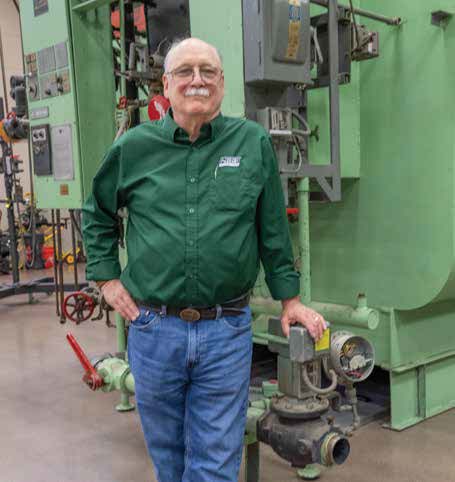
Photo by Brandon Sofsky
When Dave Stenrose talks about his path from the Detroit suburbs to the top of Michigan’s boiler inspection program, he does so with the unhurried ease of someone who’s seen – and learned – a lot.
His stories wind from Navy submarines to stock car pit crews, from Henry Ford’s powerhouse to a tomato garden in his backyard. They all trace a life shaped by discipline, curiosity, and an unshakable respect for machinery and the people who work with it.
“I’ve always liked working with my hands,” Stenrose says. “My father was an engineer, a stern, old-school kind of father. You learned by doing, and you didn’t make excuses.”
That mindset – part engineer’s precision, part sailor’s grit – has guided him through more than five decades in technical work, from the U.S. Navy to the Michigan Department of Licensing and Regulatory Affairs.
After graduating from high school, Stenrose joined the Navy in 1971, where he trained as a nuclear machinist’s mate under the exacting standards of Adm. Hyman G. Rickover, the father of the nuclear Navy. Although Stenrose never met the legendary admiral, he still counts him as one of his greatest influences.
“Rickover was a perfectionist. He didn’t tolerate nonsense,” Stenrose says. “He used to say, ‘If something goes wrong, do something. Don’t just stand there and think about it.’ That stuck with me. We drilled constantly, so when a real emergency happened, we just acted.”
Stenrose recalls one such incident vividly: a scram, an emergency shutdown of a nuclear reactor, while submerged at sea.
“We got it critical again in less than 20 minutes,” he says. “The engineer told us afterward, ‘You guys never did that fast in a drill.’ Well, this wasn’t a drill. This was for real.”
That training in discipline, procedure, and calm under pressure became the foundation for his later work in boiler safety.
During his Navy days, while stationed in Connecticut, Stenrose also found an unlikely weekend gig: working the pit crew for a local stock car team at a third-mile oval track. He and a friend watched races for a season before connecting with a driver through a mutual friend, who asked them to join the team for the second season.
“It wasn’t like NASCAR with fancy pit stops,” he says with a laugh. “We were back there between heats, servicing the car, setting the tires, and checking everything out. The cars were modifieds. This one had a ’57 Cadillac front end, a ’48 Ford rear, a Dodge motor, and a Corvair body. But it ran!”
That hands-on experience – understanding how systems work together, improvising repairs under pressure – would prove useful long after his days at the racetrack.
When Stenrose left the Navy in 1977, he joined McGraw Service Group, a company specializing in industrial and power equipment maintenance. “Then I thought, the government’s paying for school, I might as well go.”
A few years into the eight it would take him to get his mechanical engineering degree while attending evening classes, Stenrose met a fellow Navy veteran who worked for Hartford Steam Boiler. When Stenrose’s employer shut down, that connection led to an interview, and eventually, a job.
“I got hired, went to Hartford for a few weeks of training, and then took the National Board exam,” he recalls. “It was two days back then – one day of math and one day of practical work.”
Over the next 17 years, Stenrose built a career at HSB, moving from inspection to risk control, where he assessed industrial hazards around the world – from Mexico and Venezuela to paper mills in the Midwest.
“That was fascinating work, you’d go in, look at everything – boilers, stamping presses, electrical systems – and figure out where the risks were. It made you appreciate how everything connects.”
\After HSB, he spent eight years in heavy industry, including a stint supervising turbo blower operations at Rouge Steel, formerly part of the Ford River Rouge complex. There, he inspected some of the most remarkable boilers he’s ever seen, including massive 1930s-era Ford units still running strong.
“They were beautiful,” he says, describing the one-piece steam drums and rolled, not welded, tubes. “Henry Ford had those built. They powered 55-megawatt turbines, hydrogen- cooled. The only other setup like it was in Russia. You could still see the tool marks inside.”
In 2010, Stenrose joined the state of Michigan as an inspector and rose to assistant chief in 2013 and then chief in 2016. Today, he oversees 14 inspectors responsible for about 27,000 state-inspected boilers, which are part of the 67,000 total units in Michigan. The work, he says, is as much about people as it is about pressure vessels.
“I like dealing with people. My inspectors are a great group. It’s rewarding to see them grow and to help keep the public safe.”
But it isn’t always easy.
“A lot of folks don’t recognize the hazard sitting in their basement,” he says. “We’ve had cases where someone heard gurgling in the middle of the night, went down to look, didn’t know what they were looking at, and an hour later, the boiler exploded. It happens.”
His team spends much of its time educating owners about the importance of maintenance and compliance with ASME “Controls and Safety Devices for Automatically Fired Boilers.”
“A boiler’s like a car. If you don’t maintain your car, you’ll get stuck somewhere. If you don’t maintain your boiler, you’ll either be cold in the winter or it’ll blow up. Neither is good.”
Stenrose’s personal motto, “Lead, follow, or get the hell out of the way,” comes from his Navy days.
“Leadership and followership both matter,” he says. “You follow procedure, know your systems, and if things go south, you don’t freeze.”
He applies the same philosophy to management. His team meets every morning on Microsoft Teams for a check-in, usually lasting 15 minutes: where they’re headed, what challenges they’ve run into, and maybe a joke or two. They also meet in person quarterly.
“We keep it short, keep connected,” he says. “If everything’s going right, you don’t always get feedback. So, we make time for it.”
He also runs a “Pic of the Week” contest for his staff.
“I tell everyone to send me a photo that says ‘Michigan’ to you. Sunsets, funny stuff, whatever. Keep it clean. We’ve had roller coasters, chili dogs, snowdrifts. There are no prizes, just pride.”
Although he no longer performs field inspections himself – chiefs in Michigan are administrative – he still keeps up with developments through his inspectors and online research.
“I miss being out there,” he admits. “You can’t replace the feel of being in the field.”
Stenrose and his wife, Betty, live in Livonia, a western suburb of Detroit. They have two grown sons: Kenton, who lives in Florida with his wife and three children, and Devin, who lives nearby with his wife and two children.
Outside of work, his hands stay busy. He’s a skilled gunsmith, crafting rifle stocks and building firearms from the ground up. He honed this skill while working evenings in a gun shop.
“I built a Mauser once, bedded the stock and checkered it by hand. Shoots an inch at 100 yards,” he says with pride.
He’s also a gardener, with a fondness for tomatoes, although deer have forced him to add fencing this year.
Music is another passion. His playlists range from classic rock to the Mongolian folk-metal band The Hu and Norse-inspired Hailung, an experimental folk band.
“You don’t have to understand the words to appreciate good rhythm.”
After more than five decades in mechanical systems, Stenrose’s story is one of substance over show – a man driven by duty, craftsmanship, and a quiet sense of purpose.
“When I leave a place,” he says, “I just hope it’s a little safer or the people a little more aware about safety and the hazards. That’s the goal.”