Thomas P. Beirne, P.E.
NBBI Technical Manager, Pressure Relief Laboratory
Winter 2014
Category: Operations
Summary: The following article was published in the National Board BULLETIN. (2 printed pages)
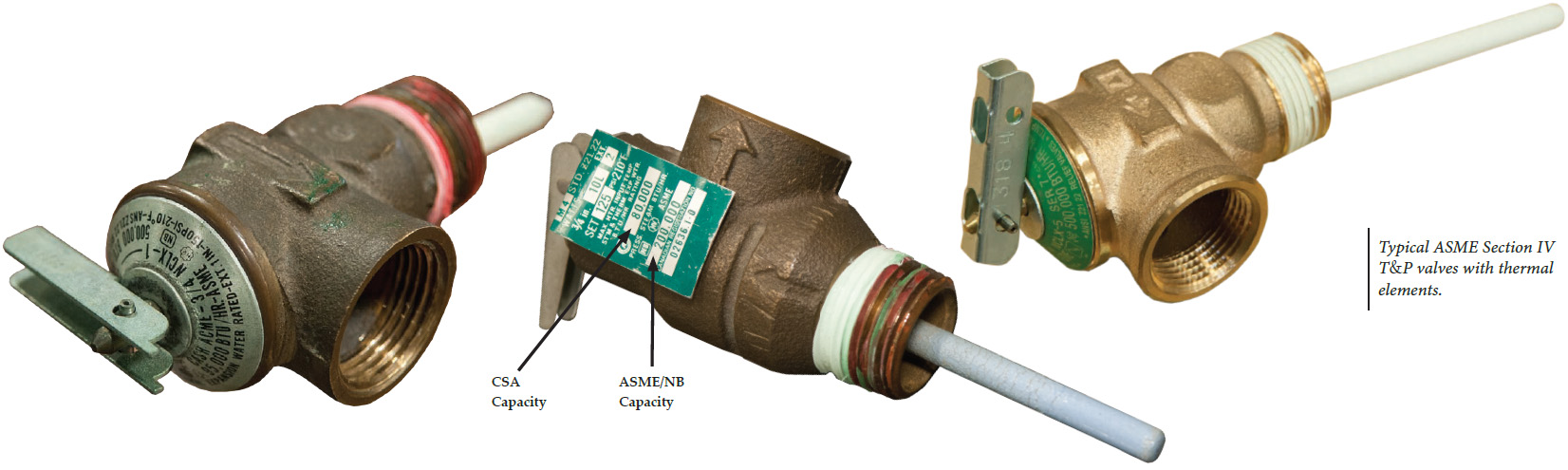
Temperature and pressure (T&P) relief valves are commonly found on potable hot water heaters and hot water supply boilers. Usually there are two capacity ratings listed on the valve nameplate: one by the Canadian Standards Association (CSA) and one by ASME/National Board. Both are expressed in BTU/hr. The reason for the two capacities is that the same valve may be used in different applications.
A common question asked of the Pressure Relief Department is: Which capacity should be used for T&P relief valves when they are stamped with both the ASME/National Board capacity and the CSA capacity?
To answer this question properly, we must look at how the valves are constructed and how the two capacity ratings are determined; and in doing so, we will see why the two ratings are so different.
Unlike a pressure relief valve, which only serves to relieve pressure, a T&P relief valve has a dual purpose: it will relieve as a result of excessive temperature and/or pressure. The valve is held shut by the force of the spring pressing the disk against the seat. At the specified set pressure, the force acting on the disk will overcome the force of the spring, thereby allowing the valve to open. The valve also has a thermal element, which is filled with a wax-like substance which expands when heated to a specified temperature. This expansion pushes up on a metal plunger which pushes on the disk to overcome the force of the spring and allow the valve to open.
The temperature relief setting on the valve is usually specified at 210°F. Since water boils at 212°F, the 210°F setting will prevent hot water from flashing to steam in case of rapid depressurization when the water contained in the hot water heater is above atmospheric pressure. Large amounts of expansive energy are released during flashing, which can cause an explosion. The pressure setting on the valve would typically be the MAWP of the hot water heater.
The ASME/National Board capacity is based on ASME Boiler and Pressure Vessel Code Section IV, which states that the capacity shall be determined with steam at a flowing pressure of 110% of set pressure. The ASME/National Board method relies solely on pressure to overcome the force of the spring and open the valve. The capacity rating is determined by one of three methods whereby three, four, or nine valves (depending on certification method) are submitted for baseline testing. Following the baseline testing, the capacity, slope, or coefficient (depending on certification method) are calculated and averaged. All of the calculated values of the valves tested must be within +/- 5% of the average. The average is then multiplied by 0.90 to obtain the rated capacity or the slope/coefficient used to calculate the rated capacity.
The CSA capacity is based on ANSI/CSA Z21.22, Part 3, which states that 15 psig steam at 250°F be applied to the valve at stable operating conditions for 15 minutes. The ANSI/CSA method relies on the temperature of the 15 psig steam to actuate the thermal element to overcome the force of the spring. The discharge of the valve is condensed and weighed. The test is then repeated for two additional sample valves. The average weight of the three tests is then used to calculate the average discharge capacity in BTU/hr. The capacity of each of the three valves tested must be within +/- 10% of the average discharge capacity.
Now that we have established the methods of determining the capacity, let’s run through a quick example to help explain why the two capacities are so different. Let’s assume we have a T&P valve set at 125 psig and 210°F. This would mean the ASME/National Board capacity would be based on the valve being fully open and flowing at 137.5 psig (110% of 125 psig). The CSA capacity would be based on the valve being fully open and flowing at 15 psig. The ASME/National Board capacity will always be greater than the CSA capacity because the ASME/National Board flowing pressure will always be greater than the CSA flowing pressure of 15 psig.
This brings us to our original question – Which capacity should be used? The answer: match the code of construction with the certified capacity rating. If the valve is protecting an ASME Section IV code-stamped hot water heater, then use the ASME/National Board capacity which is determined by ASME Section IV requirements. If it is not ASME Section IV code stamped, then use the CSA rating.
Editor's note: Some ASME Boiler and Pressure Vessel Code requirements may have changed because of advances in material technology and/or actual experience. The reader is cautioned to refer to the latest edition of the ASME Boiler and Pressure Vessel Code for current requirements.